
Quick Answer
CFO, controller or bookkeeper: what is the difference?
The real difference between a bookkeeper, a controller and a CFO, what each role costs, and which one a growing small business should add first.
The short answer
- Bookkeeper: records transactions, reconciles accounts, runs payroll entries. Backward looking.
- Controller: owns accuracy, the monthly close, controls and reporting. Present focused.
- CFO: pricing, cash strategy, forecasting, financing and major decisions. Forward looking.
- Most small businesses need the bookkeeping done first, then add CFO thinking before a full-time controller.
Three different questions
Each role answers a different question about the same numbers.
- Bookkeeper: what happened?
- Controller: is what happened recorded correctly and on time?
- CFO: given that, what should we do next?
What each one typically costs
A part-time bookkeeper commonly runs a few hundred to a couple thousand dollars a month. A full-time controller is a salaried hire. A full-time CFO is a senior salary plus benefits, which is why fractional and virtual CFO arrangements exist for companies under roughly $20 million in revenue.
Which to add first
Accurate books come first; advice built on unreliable numbers is worse than no advice. Once the books close monthly, most owners get far more value from CFO-level thinking on pricing and cash than from a full-time controller.
How the roles stack
They are layers, not alternatives. A CFO relies on a controller's close, which relies on a bookkeeper's records. One person can wear several hats in a small company, but the work still has to happen.
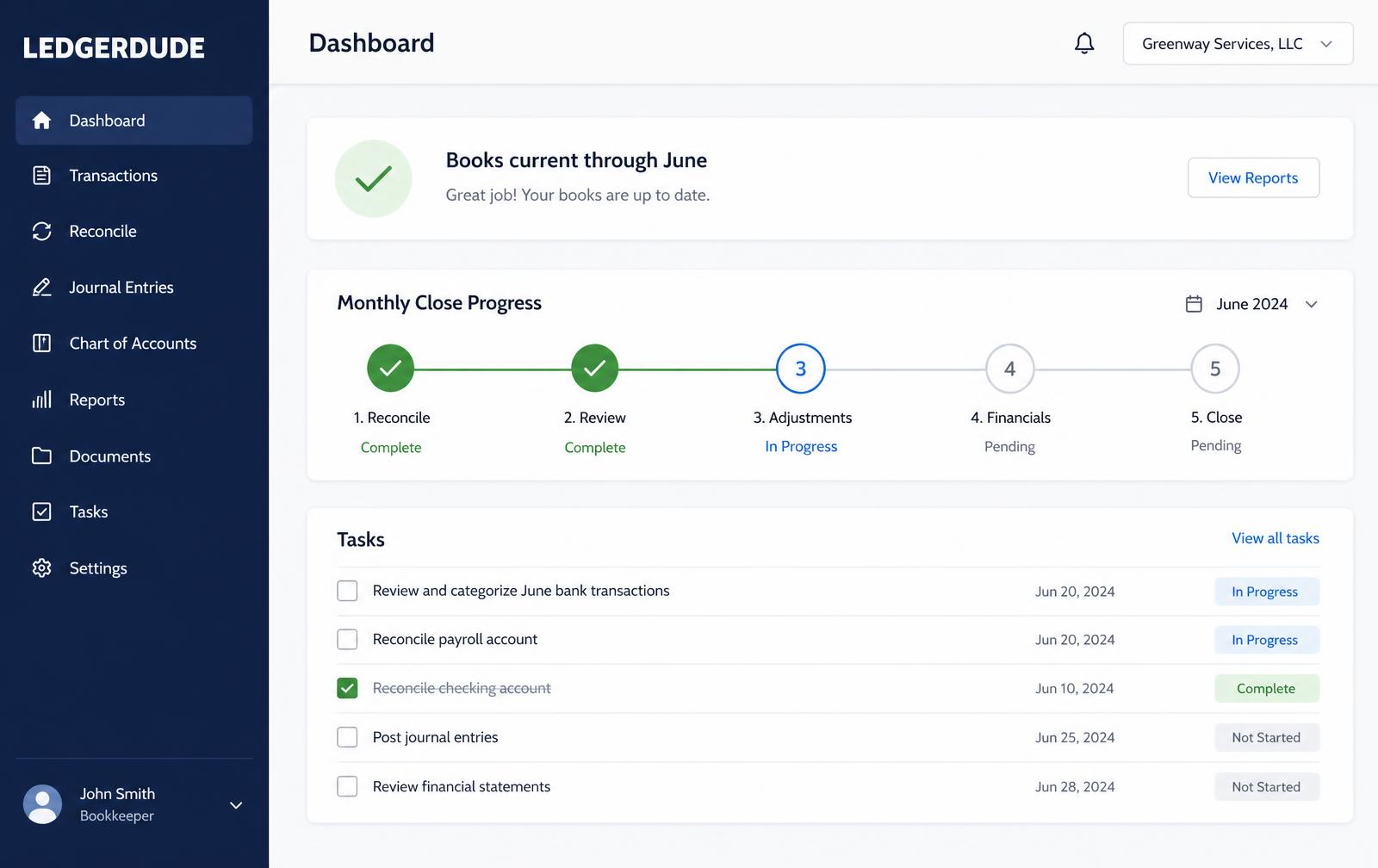
What you see inside LedgerDude
This is the page you get each month once your books are closed — the numbers behind every answer on this site.
In one sentence
A bookkeeper records what happened, a controller makes sure it is accurate and closed on time, and a CFO uses it to decide what to do next.
Questions people ask
Can one person do all three roles?
In a very small company, yes, but the skills are different. The risk is that the person strongest at recording is rarely strongest at forecasting.
Do I need a controller if I have a CFO?
Not necessarily. Many companies pair a bookkeeper with a fractional CFO and add a controller only when transaction volume or complexity demands it.
When does a full-time CFO make sense?
Usually somewhere above $20 million in revenue, or earlier with heavy financing, acquisitions or multiple entities.
What does this cost?
One flat monthly price. No hourly bills, no surprises. Founding plans start at $149 a month, and your rate stays locked.
Keep reading
What is the difference between a fractional CFO and a controller?
A controller makes sure the numbers are right. A CFO decides what to do with them. Controllers look back; CFOs look forward.
When should I hire a CFO?
Hire finance leadership when growth stops feeling like progress: revenue is up but cash is tight, profit is a mystery, or a big money decision is coming.
How much does a fractional CFO cost?
Most small businesses pay $1,000 to $5,000 a month for a fractional CFO, or $150 to $400 an hour with an independent consultant.
All answers
Every question we have written a straight answer to.
Pricing
Flat monthly plans based on your revenue.
Want your books handled for you?
We read your receipts, match your bank activity, and close your books every month. You get one short list of questions and a dashboard that always tells the truth.