
Quick Answer
Do I need a bookkeeper for my small business?
A seven-question test, the real cost of doing it yourself, when DIY genuinely works, and a business that got twelve hours a month back and found a pricing problem.
The short answer
- Score yourself on the seven questions below. Three or more yes answers means the cost of DIY has already passed the cost of hiring.
- The real cost of DIY is your hours at your own hourly value, plus decisions made late or wrong — not the software fee.
- You almost certainly need help with payroll, inventory, loans, multiple entities, or unreconciled months.
- You can reasonably self-manage a single-account service business under about 100 transactions a month.
- The common tipping point is the first month an owner cannot answer whether last month made money.
The seven-question test
Answer yes or no. Three or more yes answers and outsourcing is almost certainly cheaper once your time is counted honestly.
- Do you have more than one bank or credit card account for the business?
- Do you run payroll or pay contractors who need 1099s?
- Do you hold inventory or do job-based work?
- Do you have a loan, lease or line of credit?
- Are there months in the last year you have not reconciled?
- Do you spend more than two hours a month on the books?
- Could you tell me last month's profit right now, without looking?
What DIY actually costs
Owners compare a $525 fee against a $40 subscription and conclude DIY is cheaper. That leaves out the hours you spend and the value of decisions made on numbers you do not trust. Four hours at $75 an hour is $300 before a single error.
When doing it yourself genuinely works
One account, no payroll, no inventory, no loans, and a firm monthly habit of reconciling and locking. Many freelancers run this way for years, and that is a legitimate answer.
The middle option
Start with a monthly close only: you handle daily categorization, someone else reconciles, adjusts, closes and produces statements. It costs less than full service and removes most of the risk.
What LedgerDude does about it
We connect to your existing accounts, close the books each month, and send statements with a short plain-language summary of what changed and what to watch. You keep the software you already use.
The honest cost comparison
- Software subscription
- $85/month
- Your time, 4.5 hours
- $338 at $75/hour
- Year-end CPA cleanup, amortized
- $180/month
- True DIY cost
- $603/month
- Flat outsourced fee
- $525/month
- Difference
- $78/month saved, plus 4.5 hours back
What this tells you: Past the very simplest tier, DIY is not actually cheaper once time and year-end cleanup are counted.
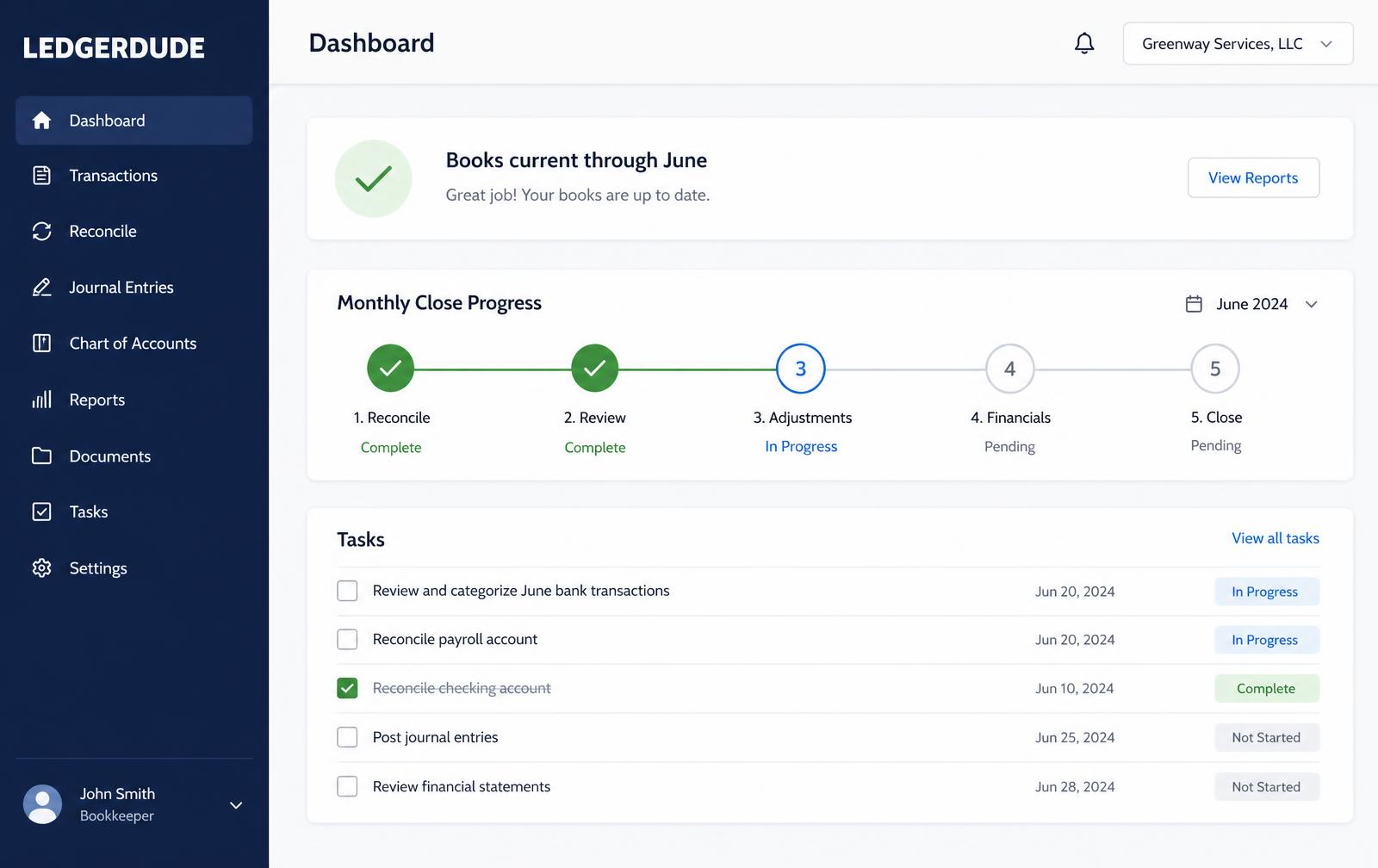
What you see inside LedgerDude
This is the page you get each month once your books are closed — the numbers behind every answer on this site.
Real example
Twelve hours a month back, and a pricing problem found
Where they started: A two-person marketing agency did their own books on nights and weekends, roughly twelve hours a month across two people, and had never produced a monthly profit and loss.
What we did: We took over the close, separated revenue by service line, moved contractor costs into cost of sales instead of overhead, and started sending a monthly summary.
How it ended up: The first clean month showed retainer work at 61 percent gross margin and project work at 22 percent. They repriced project work and shifted sales focus.
12/month
Owner hours recovered
61%
Retainer gross margin
22%
Project gross margin before
48%
Blended margin after repricing
“We thought we were buying time back. We ended up finding the actual problem with our pricing.”
In one sentence
If you have more than one account, any payroll, inventory, loans, or over about 100 transactions a month, yes. Below that, disciplined self-management can work.
Questions people ask
I am pre-revenue. Do I need one yet?
Not usually. Keep a separate business account, save receipts, and start when revenue or spending becomes regular.
Can I hire one for just a few months?
Yes. Many businesses start with a catch-up engagement and decide afterward whether to continue monthly.
What if a family member does the books?
That can work for simple businesses. The same test applies: reconciled monthly, period locked, and someone can answer what last month's profit was.
Will I lose visibility into my own numbers?
You should gain it. If an arrangement leaves you less informed, the arrangement is wrong, not bookkeeping.
What does this cost?
One flat monthly price. No hourly bills, no surprises. Founding plans start at $149 a month, and your rate stays locked.
Keep reading
How much does a bookkeeper cost per month?
Most small businesses pay $250 to $900 a month, driven by transaction volume, number of accounts and how far behind the books are.
Is QuickBooks enough without a bookkeeper?
QuickBooks records and suggests, but it does not reconcile, judge or close. Without review, 20 to 35 percent of auto-categorized transactions land in the wrong place.
Outsourced Bookkeeping vs Hiring In House
Longer guide with more detail.
What Is Included in Bookkeeping Services?
Longer guide with more detail.
All answers
Every question we have written a straight answer to.
Pricing
Flat monthly plans based on your revenue.
Want your books handled for you?
We read your receipts, match your bank activity, and close your books every month. You get one short list of questions and a dashboard that always tells the truth.