
Quick Answer
How much does a bookkeeper cost per month?
Real 2026 monthly bookkeeping prices by business size, what drives the number up or down, and a worked quote you can compare.
The short answer
- Most small businesses pay $250 to $900 a month for ongoing bookkeeping. Under $250 usually means categorization only, with no real monthly close.
- Price is driven by transaction count, number of bank and card accounts, payroll, inventory and entities — not by revenue alone.
- Hourly bookkeeping runs $40 to $85 an hour, but the bill swings every month, which is why most firms now quote a flat monthly fee.
- Catch-up work for prior months is quoted separately, usually $200 to $600 per month being cleaned up.
- An in-house bookkeeper costs $48,000 to $65,000 a year fully loaded, so outsourcing is cheaper until roughly 1,500 transactions a month.
What you should expect to pay in 2026
Pricing has settled into predictable bands. A one-person service business with one checking account lands at the bottom. A store with inventory, three sales channels and payroll lands at the top. The gap is work volume, not prestige.
- Solo or side business, under 100 transactions a month: $250 to $400
- Established small business, 100 to 400 transactions: $400 to $650
- Multi-channel or multi-location, 400 to 1,000 transactions: $650 to $900
- Inventory, job costing or several entities: $900 and up, usually per entity
What actually moves the price
When a quote comes back higher than expected, one of these is nearly always why. They are real hours of work, but most of them are fixable, and fixing them lowers your price permanently.
- Number of accounts to reconcile, including cards you rarely use
- Personal spending run through the business account
- Missing receipts, which turn a two-minute task into a five-email hunt
- Payroll, contractors and 1099 tracking
- Inventory or job costing, which need a real cost method
- Months already behind, billed as catch-up rather than ongoing work
What should be included at any price
A monthly fee without a real close is data entry, not bookkeeping. Before comparing two quotes, make sure both include the same deliverables: every account reconciled to the statement, monthly statements, a locked period, a named person who answers questions, and year-end books your tax preparer can use without a scramble.
How LedgerDude prices it
We quote a flat monthly fee based on your revenue band and complexity, and quote catch-up separately so a one-time cleanup never inflates your ongoing price. You see the fee before connecting anything.
Numbers worth watching
Each one is plain math you can check yourself.
| Number | How to figure it | Good range | Why it matters |
|---|---|---|---|
| Cost per transaction | Monthly fee ÷ monthly transactions | $0.80 to $2.50 | The cleanest way to compare quotes for different businesses. |
| Bookkeeping as a percent of revenue | Annual cost ÷ annual revenue | 0.5% to 1.5% | Above 2 percent usually means books are still being cleaned up. |
| Days to close | Days from month end to final statements | Under 10 business days | Old numbers are not decisions. |
Typical results we see
Median flat monthly fee
$525
US small businesses under $2M revenue.
Typical hourly rate
$40 to $85
Higher in major metros and for cleanup.
In-house, fully loaded
$48k to $65k
Salary plus taxes, benefits and software.
Catch-up per month cleaned
$200 to $600
Driven by volume and missing records.
A $900k landscaping company, quoted line by line
- Monthly transactions
- 310
- Accounts to reconcile
- 2 bank, 2 cards, 1 loan
- Payroll
- 9 employees, biweekly
- Job costing
- Yes, by property
- Flat monthly quote
- $690
- Percent of revenue
- 0.92%
What this tells you: Job costing and payroll pushed this above the median, but at 0.92 percent of revenue it is well inside a normal range.
What you see inside LedgerDude
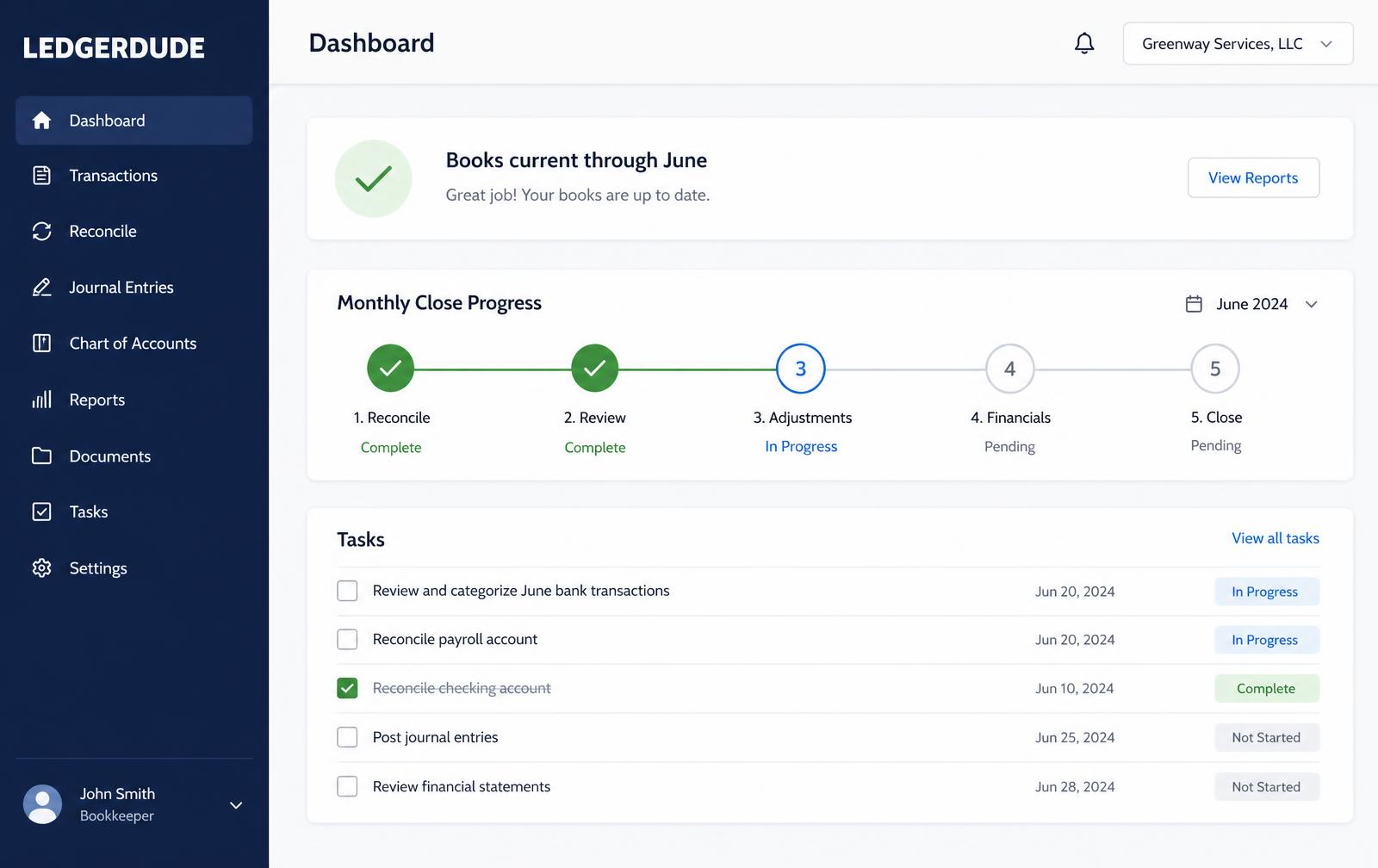
This is the page you get each month once your books are closed — the numbers behind every answer on this site.
How to get an accurate bookkeeping quote
- 1
Count your accounts
List every bank account, credit card and loan the business touches, including the ones you forget.
- 2
Pull a transaction count
Export three months from your bank and count the lines. This drives most of the price.
- 3
Say how far behind you are
Name the last month that was truly reconciled. Hidden catch-up is the top cause of a repriced quote.
- 4
List the extras
Payroll, inventory, multiple entities, sales tax and 1099s each add real hours.
- 5
Ask for flat monthly
Request a fixed fee with catch-up quoted separately.
Real example
From an unpredictable hourly bill to a flat $550 a month
Where they started: A six-truck mobile detailing company was billed hourly. Invoices ranged from $310 to $1,240 a month with no explanation, and the owner had stopped opening them.
What we did: A three-month assessment showed 40 percent of hours went to chasing receipts and untangling personal spending. We moved personal charges to a separate card and turned on phone receipt capture.
How it ended up: Volume stayed the same but the work dropped enough to quote a flat $550, and the close moved from six weeks after month end to day seven.
$780
Average bill before
$550
Flat fee after
$2,760
Annual savings
42 to 7
Days to close
“I finally know what bookkeeping costs me, and I get the numbers while they still matter.”
In one sentence
Most small businesses pay $250 to $900 a month, driven by transaction volume, number of accounts and how far behind the books are.
Questions people ask
Is a bookkeeper cheaper than an accountant?
Yes. Bookkeepers handle monthly work at $250 to $900 a month. CPAs charge $150 to $400 an hour and are best used for tax strategy on top of clean books.
Why do some services advertise $99 a month?
Those are usually software plus auto-categorization: no reconciliation, no closed period and no person reviewing the result, so errors compound until year end.
Does the price go up if I fall behind?
Ongoing pricing stays flat. Months that were never closed are quoted as catch-up, typically $200 to $600 per month, as a one-time cost.
Can I pay less by doing part of it myself?
Yes. Sending receipts as you spend and keeping personal charges off the business card are worth more than any discount.
When does hiring in house make sense?
Usually past roughly 1,500 transactions a month, or when someone must be on site handling billing daily.
What does this cost?
One flat monthly price. No hourly bills, no surprises. Founding plans start at $149 a month, and your rate stays locked.
Keep reading
What is the difference between a bookkeeper and an accountant?
A bookkeeper records and reconciles what happened each month; an accountant interprets it and files your taxes. Most businesses need both, and the bookkeeper first.
How do I catch up a year of bookkeeping?
Gather statements for every account, rebuild oldest month first, reconcile each month before moving on, then lock it. Most years take two to five weeks.
How Much Do Bookkeeping Services Cost in 2026?
Longer guide with more detail.
Outsourced Bookkeeping vs Hiring In House
Longer guide with more detail.
All answers
Every question we have written a straight answer to.
Pricing
Flat monthly plans based on your revenue.
Want your books handled for you?
We read your receipts, match your bank activity, and close your books every month. You get one short list of questions and a dashboard that always tells the truth.