
Quick Answer
How long should a monthly close take?
Realistic close-time benchmarks, the four bottlenecks behind slow closes, a full close checklist, and a business that went from 34 days to 6.
The short answer
- Target ten business days from month end to final statements. High performers close in five to seven.
- The usual bottlenecks are late statements, missing receipts, unanswered owner questions, and an account nobody reconciles until year end.
- A close is not finished until every account ties, adjustments are posted and the period is locked.
- Speed comes from doing work during the month, not working faster at month end.
- A close over fifteen days is historical reporting: correct, but too late to act on.
What a good close looks like
A close has a definition of done: every account reconciled to a statement, unusual items documented, adjustments posted, statements produced, period locked. If any of those are missing, the month is open no matter what the calendar says.
Why closes run late
Slow closes are almost never a speed problem. They are a waiting problem, and every day of waiting is a day you cannot act.
- Statements not available until day 5 to 8
- Receipts still in a truck console or an email inbox
- Questions to the owner sitting unanswered for a week
- Payroll or sales tax filings landing after everything else
- Inventory counts scheduled for whenever someone has time
How to cut a close in half
Move work out of the close and into the month: categorize weekly, capture receipts at purchase, and batch owner questions into one short weekly review. Most businesses cut a week off the close within two months.
How LedgerDude keeps the close on schedule
Our close checklist tracks each account and task with an owner and status, flags exceptions during the month, and sends statements plus a short executive summary as soon as the period locks.
Numbers worth watching
Each one is plain math you can check yourself.
| Number | How to figure it | Good range | Why it matters |
|---|---|---|---|
| Days to close | Business days from month end to locked period | Under 10, ideally 5 to 7 | The best measure of whether your numbers are decision-grade. |
| Open questions at close | Unanswered owner questions at lock | 0 | Every unanswered question becomes an estimate you correct later. |
| Reopen rate | Closed months reopened ÷ months closed | Under 5% | Frequent reopening means the close was declared done too early. |
Typical results we see
Small business median
12 business days
Service businesses under $2M revenue.
Top quartile
5 to 7 days
Weekly categorization and same-week receipts.
Bottom quartile
25+ days
Usually a receipt and response-time problem.
Acceptable reopen rate
Under 5%
Higher means the close definition is too loose.
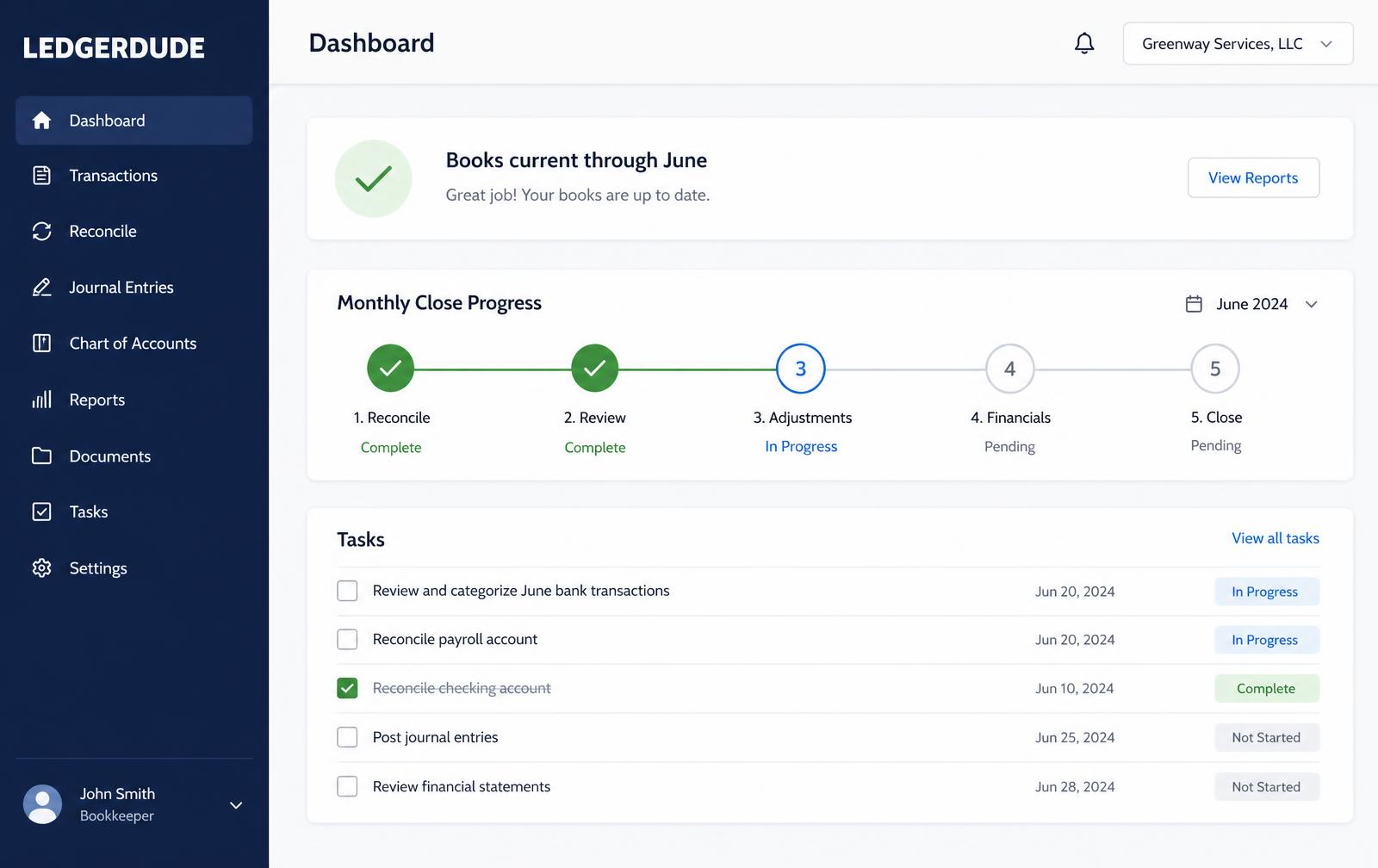
What you see inside LedgerDude
This is the page you get each month once your books are closed — the numbers behind every answer on this site.
A monthly close checklist that finishes in ten days
- 1
Import and categorize
Pull every account through the last day of the month and clear the categorization queue.
- 2
Reconcile every account
Match each ending balance to the statement exactly, including accounts you rarely use.
- 3
Clear the exceptions
Resolve duplicates, unmatched deposits, missing receipts and anything Uncategorized.
- 4
Post adjustments
Record depreciation, accruals, prepaid amortization, inventory movement and owner distributions.
- 5
Review the statements
Read the profit and loss against last month and flag lines that moved unexpectedly.
- 6
Lock the period
Close the month and send the statements with a short written summary.
Real example
From a 34-day close to 6 days
Where they started: A three-location fitness studio received prior-month numbers in the middle of the following month. Pricing and staffing decisions were made on gut feel.
What we did: We moved categorization to a weekly rhythm, turned on phone receipt capture for managers, replaced month-end email chains with one fifteen-minute weekly review, and put every account on a named checklist.
How it ended up: The close dropped to six business days within two months, and the studio caught payroll drift at one location in time to fix it inside the same quarter.
34
Days to close before
6
Days to close after
17 to 0
Open questions at close
$4,800/month
Payroll drift caught
In one sentence
A small business close should finish within ten business days of month end. Past fifteen, the numbers arrive too late to change anything you do.
Questions people ask
Is a fast close less accurate?
No, when the speed comes from doing work during the month. It is less accurate only when reconciliation is skipped, which is not a close at all.
What if a statement is not available yet?
Close everything else and hold that one account open with a documented reason.
Should prior months be locked?
Always. An unlocked prior month means filed numbers and system numbers can quietly disagree.
How often should I read the statements?
Monthly, within a day or two of receiving them, always against the prior month.
What does this cost?
One flat monthly price. No hourly bills, no surprises. Founding plans start at $149 a month, and your rate stays locked.
Keep reading
Is QuickBooks enough without a bookkeeper?
QuickBooks records and suggests, but it does not reconcile, judge or close. Without review, 20 to 35 percent of auto-categorized transactions land in the wrong place.
How do I catch up a year of bookkeeping?
Gather statements for every account, rebuild oldest month first, reconcile each month before moving on, then lock it. Most years take two to five weeks.
What Is Included in Bookkeeping Services?
Longer guide with more detail.
All answers
Every question we have written a straight answer to.
Pricing
Flat monthly plans based on your revenue.
Want your books handled for you?
We read your receipts, match your bank activity, and close your books every month. You get one short list of questions and a dashboard that always tells the truth.