
Quick Answer
How do I catch up a year of bookkeeping?
The exact order to rebuild twelve months of books, what documents you need, what it costs and how long it usually takes.
The short answer
- Work oldest month forward, never newest backward. Every month depends on the closing balances of the one before it.
- A month is done when the ending balance matches the bank statement to the penny and the period is locked — not when it looks categorized.
- You need twelve months of statements for every account, plus payroll reports, loan amortization schedules and inventory counts.
- Expect $200 to $600 per month cleaned, and two to five weeks of calendar time for a typical year.
- Most cleanups pay for part of themselves in found deductions, mis-booked owner draws and duplicate income.
Why order matters more than speed
Bookkeeping is cumulative. If March is wrong, every month after inherits the error, and fixing March later forces you to redo the nine months that followed. Oldest to newest means each month is verified once and stays verified.
What to collect before anyone starts
Collecting documents is the slowest part of a cleanup and the part only you can do. Having it all up front can cut weeks off the timeline.
- Twelve months of statements for every bank account and credit card
- Loan statements and amortization schedules
- Payroll reports by pay period, including taxes
- Merchant and platform settlement reports, which reveal fees the deposit hides
- Receipts for large purchases and all asset buys
- Beginning and ending inventory counts if you hold stock
The most common things a cleanup finds
None of these are exotic. They show up in most years left alone, and they usually move profit more than owners expect.
- Income counted twice, once from the invoice and again from the deposit
- Owner transfers recorded as expenses
- Merchant and platform fees never recorded
- Loan payments expensed in full instead of split
- Equipment expensed instead of capitalized
- Sales tax collected sitting in income instead of a liability
How LedgerDude runs a catch-up
We quote catch-up separately from your monthly fee, based on volume and record completeness. You get a fixed price before we start, month-by-month progress, and locked periods as each month finishes.
Typical results we see
Cost per month cleaned
$200 to $600
Driven by volume and missing records.
Calendar time for one year
2 to 5 weeks
Mostly set by how fast documents arrive.
Typical corrections found
40 to 200
Per twelve never-reconciled months.
Chance profit moves 5%+
About 7 in 10
Based on cleanups we have completed.
A twelve-month cleanup, priced and measured
- Transactions across the year
- 3,940
- Accounts reconciled
- 6
- Catch-up quote
- $3,600 ($300/month)
- Unrecorded deductible expenses found
- $14,200
- Duplicate income removed
- $21,800
- Reported profit change
- -$36,000
What this tells you: The books had overstated profit badly. Correcting it changed the tax position by far more than the cleanup cost.
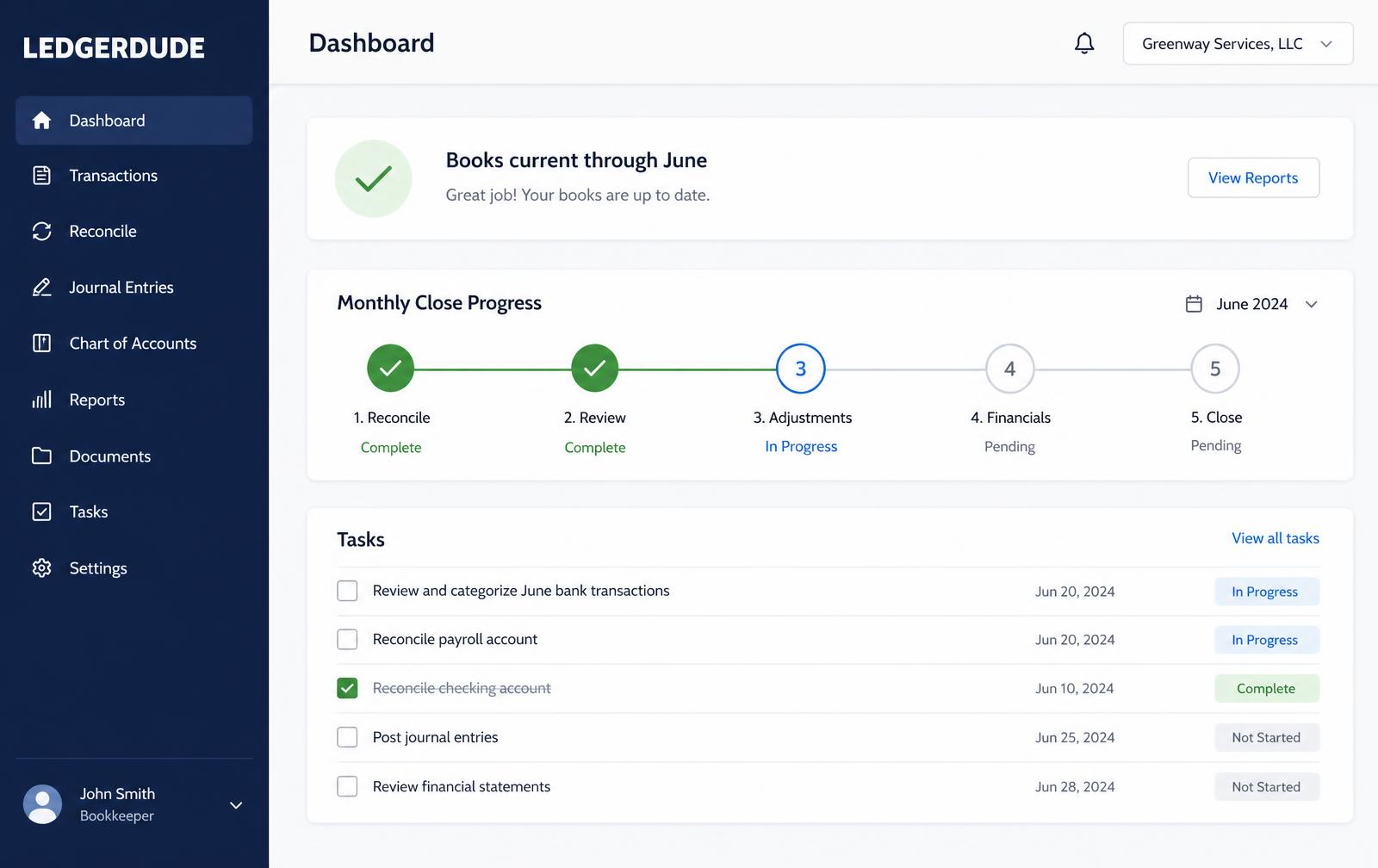
What you see inside LedgerDude
This is the page you get each month once your books are closed — the numbers behind every answer on this site.
How to catch up a year of bookkeeping
- 1
Inventory your accounts
List every bank, card and loan account used, including closed ones, and pull twelve months of statements.
- 2
Set the starting point
Use the last truly reconciled month's ending balances as your opening balances, or a bank statement opening balance.
- 3
Rebuild month one
Categorize the oldest month only, splitting loan payments and recording merchant fees from settlement reports.
- 4
Reconcile before moving on
Match every ending balance to the statement exactly. Do not start the next month until it ties.
- 5
Record the adjustments
Add depreciation, inventory changes, payroll accruals and owner distributions, with a note on each.
- 6
Lock and repeat
Close the period so it cannot silently change, then repeat until you reach the current month.
- 7
Hand off and stay current
Give your CPA the closed year, and put a monthly close on the calendar so it never happens again.
Real example
Fourteen months behind, filed on time
Where they started: A wholesale bakery had not reconciled since the prior January. An extension deadline was six weeks out and the CPA refused to file from the existing file.
What we did: We rebuilt fourteen months oldest to newest, pulled settlement reports for two platforms to recover hidden fees, split thirty-one loan payments, and locked each month as it finished.
How it ended up: The return was filed nine days early, and the corrected books showed wholesale accounts, not retail, were carrying the business.
14
Months rebuilt
212
Corrections posted
$14,200
Missed deductions recovered
9
Days before deadline filed
“I assumed catching up meant starting over. It was mostly handing over statements and answering questions.”
In one sentence
Gather statements for every account, rebuild oldest month first, reconcile each month before moving on, then lock it. Most years take two to five weeks.
Questions people ask
How far back do I have to go?
At minimum every year you still need to file or amend — usually back to the last year that was properly closed.
Can I just start fresh from today?
Only if prior years were filed and reconciled. Otherwise your opening balances are wrong, which breaks every future month.
What if I lost receipts?
Statements still substantiate amount and vendor. Reconstruct receipts first for large purchases, travel, meals and mixed-use items.
Will this trigger an audit?
Accurate books do not trigger audits. Wildly inconsistent numbers between years do.
How fast can it be done?
A clean year with complete statements takes about two weeks. Missing documents, multiple entities and inventory push it toward five.
What does this cost?
One flat monthly price. No hourly bills, no surprises. Founding plans start at $149 a month, and your rate stays locked.
Keep reading
How much does a bookkeeper cost per month?
Most small businesses pay $250 to $900 a month, driven by transaction volume, number of accounts and how far behind the books are.
How long should a monthly close take?
A small business close should finish within ten business days of month end. Past fifteen, the numbers arrive too late to change anything you do.
Catch Up Bookkeeping: How to Fix Months of Messy Books
Longer guide with more detail.
All answers
Every question we have written a straight answer to.
Pricing
Flat monthly plans based on your revenue.
Want your books handled for you?
We read your receipts, match your bank activity, and close your books every month. You get one short list of questions and a dashboard that always tells the truth.