
Quick Answer
What is the difference between a bookkeeper and an accountant?
A clear split of who does what each month, what each costs, how they hand off to each other, and a real example of a business that hired in the wrong order.
The short answer
- A bookkeeper handles recurring work: categorizing, reconciling, payroll entries and closing the month.
- An accountant works on top of those books: tax strategy, entity structure, filings and financing questions.
- Hire the bookkeeper first. A CPA cannot plan on books that were never reconciled, and will clean them up at CPA rates.
- Typical costs are $250 to $900 a month for bookkeeping versus $150 to $400 an hour for a CPA.
- Closed, locked monthly books are what let a CPA work in hours instead of weeks.
The simplest way to think about it
A bookkeeper writes the history. An accountant reads it and tells you what to do next. If nobody wrote the history accurately, the advice is guesswork with a letterhead on it.
What a bookkeeper does every month
This is repeatable, deadline-driven work that should finish within ten business days of month end and leave behind statements that never change afterward.
- Categorize every transaction to the right account
- Reconcile each bank, card and loan to the statement
- Record payroll, sales tax and loan interest correctly
- Chase and attach receipts and vendor bills
- Produce monthly statements and close the period
What an accountant or CPA does
This is judgment work, mostly a few times a year, and it is where money is saved — which is exactly why it should not be spent on cleanup.
- Tax planning and estimated payments
- Business and personal returns
- Entity structure and owner compensation
- Depreciation and fixed asset policy
- Statements for lenders or investors
Where the two overlap
Depreciation, owner draws, loan amortization and year-end adjustments sit in the middle. Problems start when each side assumes the other handles them. Agree in writing who owns each adjusting entry before year end.
How LedgerDude sits between the two
We do the monthly work and hand your CPA closed, locked, reconciled books with documentation attached to unusual items, so their hours go to your tax position rather than your bank feed.
Typical results we see
Bookkeeping, monthly
$250 to $900
Flat, recurring, volume driven.
CPA hourly rate
$150 to $400
Higher for advisory work.
CPA cleanup surcharge
2 to 4x
What messy books cost at tax time.
Time to file with clean books
1 to 2 weeks
Versus 6 to 10 weeks rebuilding a year.
The same year, filed two ways
- Bookkeeping paid during the year
- $0
- CPA hours to rebuild 12 months
- 34 hours
- CPA bill at $260/hour
- $8,840
- Alternative: bookkeeping at $525/mo
- $6,300
- CPA bill with clean books
- $1,560
- Total, clean-books path
- $7,860
What this tells you: Skipping bookkeeping saved nothing, cost more in total, and produced no monthly numbers all year.
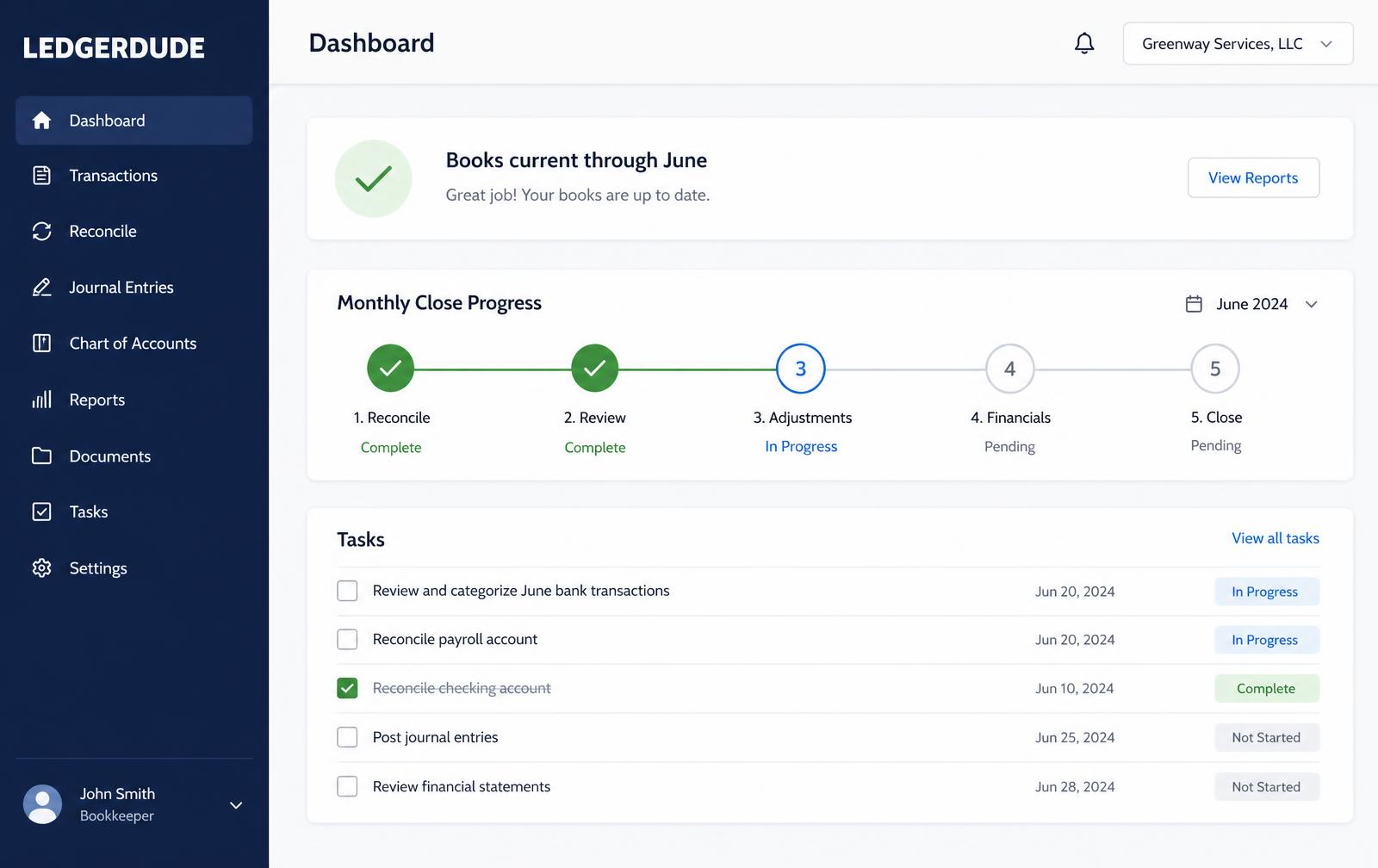
What you see inside LedgerDude
This is the page you get each month once your books are closed — the numbers behind every answer on this site.
Real example
A dental practice that hired in the wrong order
Where they started: A two-chair practice retained a CPA at $300 an hour and skipped a bookkeeper. Eleven months in, no month had been reconciled and the owner did not know if the practice was profitable.
What we did: We rebuilt eleven months, split personal from practice spending, corrected merchant fee handling that understated revenue by about 3 percent, and set a ten-day close.
How it ended up: The CPA's year-end engagement dropped from an estimated 30 hours to 7, and the owner found one insurance mix running at a negative margin and repriced it.
11
Months rebuilt
23
CPA hours saved
3.1%
Revenue previously understated
9
Days to close now
In one sentence
A bookkeeper records and reconciles what happened each month; an accountant interprets it and files your taxes. Most businesses need both, and the bookkeeper first.
Questions people ask
Can one person be both?
Yes, and many CPAs offer bookkeeping. Just make sure bookkeeping work is billed at bookkeeping rates.
Do I need a CPA if my books are clean?
For filing and tax strategy, almost always. Clean books make that engagement smaller and cheaper, not unnecessary.
Who should talk to my lender?
Your bookkeeper supplies the statements; your accountant explains the tax position. Lenders want both, and want them to agree.
Is a controller a third thing?
Yes. A controller owns the process and reporting accuracy, typically past a few million in revenue.
What does this cost?
One flat monthly price. No hourly bills, no surprises. Founding plans start at $149 a month, and your rate stays locked.
Keep reading
How much does a bookkeeper cost per month?
Most small businesses pay $250 to $900 a month, driven by transaction volume, number of accounts and how far behind the books are.
How long should a monthly close take?
A small business close should finish within ten business days of month end. Past fifteen, the numbers arrive too late to change anything you do.
What Is Included in Bookkeeping Services?
Longer guide with more detail.
All answers
Every question we have written a straight answer to.
Pricing
Flat monthly plans based on your revenue.
Want your books handled for you?
We read your receipts, match your bank activity, and close your books every month. You get one short list of questions and a dashboard that always tells the truth.