
Quick Answer
Should I use cash or accrual accounting?
The practical difference between cash and accrual, when accrual is required, and how the same month looks under both methods.
The short answer
- Cash basis records money when it moves. Accrual records revenue when earned and expenses when incurred.
- Cash is simpler and matches your bank account. Accrual is more accurate about whether a month made money.
- If you carry inventory or invoice on terms, cash basis will regularly tell you the opposite of the truth.
- Accrual is generally required above the IRS gross receipts threshold, and many lenders want it well below that.
- You can run accrual books for management and let your CPA convert to cash for the tax return.
The difference in one sentence each
Cash basis answers how much money moved this month. Accrual answers how much of this month's work made money. Owners get in trouble by asking the second question of a cash-basis report.
When cash basis is the right call
Cash basis is better when it is accurate enough, because simple books get maintained and complex ones get abandoned.
- Service business with no inventory
- Paid at time of service or within days
- Few outstanding invoices at month end
- No significant prepaid expenses or deposits held
When you need accrual
Once timing gaps exist between doing the work and getting paid, cash basis describes your bank's schedule rather than your business.
- You hold inventory
- You invoice on net 30 or longer
- You take deposits or retainers before doing work
- A lender, investor or buyer needs reliable statements
- You run job or project work spanning months
Switching methods
Changing your tax accounting method generally requires filing with the IRS, so decide it with your CPA. Changing management reporting is free — run accrual internally today while the return stays on cash.
How LedgerDude handles it
We keep the books so both views exist: accrual for management reporting and cash for your tax preparer, with the executive summary explaining when the two disagree.
The same March, under both methods
- Work completed and invoiced in March
- $78,000
- Cash collected in March
- $41,000
- Materials bought in February for March jobs
- $29,000
- Materials paid for in March
- $12,000
- Cash-basis profit
- $29,000
- Accrual-basis profit
- $49,000
What this tells you: Cash basis made a strong month look mediocre. In another month the distortion runs the other way, which is why job-based businesses need accrual.
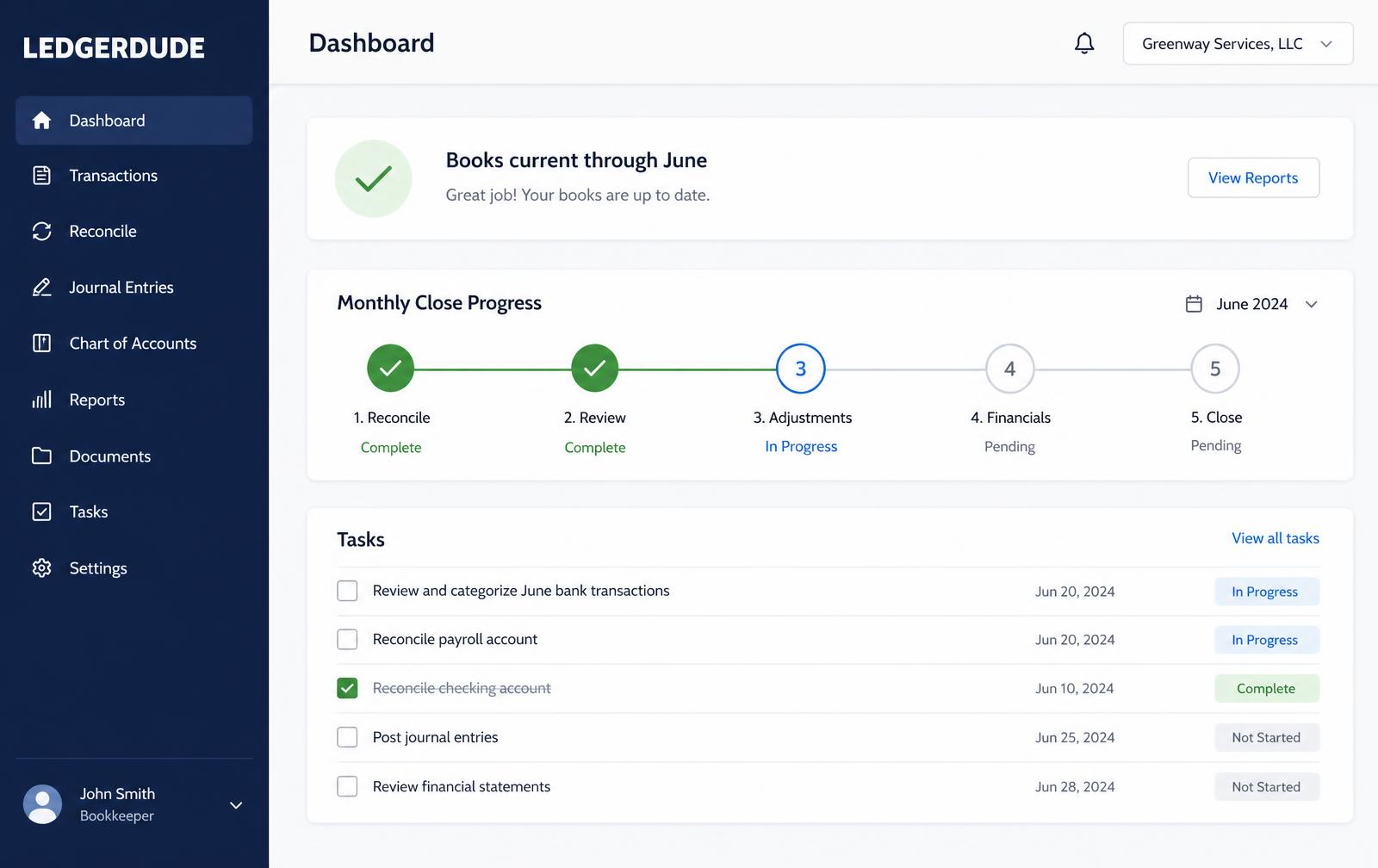
What you see inside LedgerDude
This is the page you get each month once your books are closed — the numbers behind every answer on this site.
Real example
A profitable month that was actually a loss
Where they started: A remodeling contractor reported a $62,000 cash-basis profit month, driven by two large customer deposits, and took a distribution against it.
What we did: We moved management reporting to accrual, recorded deposits as a liability until work was performed, matched materials to jobs, and added work-in-progress tracking.
How it ended up: The same month restated to a $9,000 loss. The owner changed the deposit policy and repriced two job types that had been losing money for a year.
$62,000
Cash-basis reported profit
-$9,000
Accrual-basis result
2
Job types repriced
18% to 27%
Gross margin 6 months later
“I was celebrating deposits. Accrual showed me I was celebrating money I still owed in labor.”
In one sentence
Use cash basis if you are small, service-based and paid quickly. Use accrual if you hold inventory, invoice on terms, or need a lender to trust the numbers.
Questions people ask
Which one does the IRS require?
Many small businesses may use cash basis, but accrual is generally required above the IRS gross receipts threshold and in certain inventory situations. Confirm with your CPA.
Can I use both?
Yes: accrual for internal management reporting and cash for the tax return. Properly maintained books support both.
Does accrual cost more to maintain?
Slightly, because receivables, payables and deferred revenue must be tracked. It is small next to the cost of misreading a month.
Which do lenders want?
Accrual, nearly always, because it shows earned revenue and real obligations.
What does this cost?
One flat monthly price. No hourly bills, no surprises. Founding plans start at $149 a month, and your rate stays locked.
Keep reading
What is the difference between a bookkeeper and an accountant?
A bookkeeper records and reconciles what happened each month; an accountant interprets it and files your taxes. Most businesses need both, and the bookkeeper first.
How long should a monthly close take?
A small business close should finish within ten business days of month end. Past fifteen, the numbers arrive too late to change anything you do.
What Is Included in Bookkeeping Services?
Longer guide with more detail.
All answers
Every question we have written a straight answer to.
Pricing
Flat monthly plans based on your revenue.
Want your books handled for you?
We read your receipts, match your bank activity, and close your books every month. You get one short list of questions and a dashboard that always tells the truth.