
KPI Library
Appointment business KPIs measured per service hour
Revenue per available service hour, service versus retail margin, rebooking rate and payroll load, built from real salon books.
The short answer
- An appointment business sells time in chairs or rooms, so the core number is revenue per available service hour, not total revenue.
- Service and retail are two different businesses with different margins and must be tracked separately or both become unreadable.
- Booth rent, commission and hourly pay produce completely different cost structures. Mixing them in one payroll account hides which stylists or providers are profitable.
- Tips are a liability held for staff, never revenue, and gift cards sold are deferred revenue until redeemed.
- Product used in service is a cost of service; product sold to a client is retail cost of goods. Buying them on one invoice does not make them the same line.
Time is the inventory
A chair open from nine to six is nine hours of inventory that expires at closing. Revenue per available service hour tells you what that inventory earned, and it moves for exactly three reasons: how full the book was, what the service was priced at, and how long it actually took. Tracking it weekly turns vague conversations about being busy into a specific answer about which day and which provider has room to improve.
- Available hours means scheduled open hours per station, not hours worked
- No-shows and late cancels consume inventory and belong in the denominator
- Blocked admin time should be excluded, not counted as unsold
- Compare weekday to weekend separately or the average hides both
Split service, retail, and product used in service
Retail typically carries a 45 to 55 percent margin, service carries 55 to 70 percent after provider pay, and backbar product used during a service is a cost of delivering that service. Most salon books we see have one Supplies account that mixes all three, which makes it impossible to know whether retail is worth the shelf space. Separating them takes one afternoon and permanently improves every pricing decision that follows.
Pay structure changes the entire cost picture
Booth renters generate rent income and almost no cost. Commission staff scale with revenue. Hourly staff are a fixed cost until the book fills. A location with all three needs its payroll split accordingly, because a 46 percent payroll load means something totally different in each model. We separate them and report an effective payroll load per revenue dollar for each.
Rebooking is a financial number
Rebooking rate belongs on the financial dashboard because it predicts next month's revenue better than anything in the ledger. A drop from 65 to 50 percent shows up in the profit and loss roughly six weeks later. Watching it alongside revenue per available service hour gives you time to react while the calendar can still be filled.
What LedgerDude produces for an appointment business each month
Revenue per available service hour by location and by provider, service versus retail margin, payroll load by pay structure, tip liability and gift card deferred revenue roll forwards, and a flag on any provider or day whose numbers moved enough to be worth a conversation.
Numbers worth watching
Each one is plain math you can check yourself.
| Number | How to figure it | Good range | Why it matters |
|---|---|---|---|
| Revenue per available service hour | Service revenue ÷ scheduled open station hours | $55–$95 salon, $150–$300 med spa | Measures what your real inventory — time — actually earned. |
| Service gross margin | (Service revenue − provider pay − backbar product) ÷ service revenue | 55–70% | Separates the profitability of the service from the retail counter. |
| Retail attachment rate | Retail revenue ÷ service revenue | 10–18% | Retail is the cheapest incremental margin an appointment business has. |
| Payroll load | (Wages + commission + employer taxes + benefits) ÷ total revenue | 38–48% for commission and hourly models | Read separately per pay structure, or booth rent hides the truth. |
| Rebooking rate | Clients who booked their next visit ÷ clients served | Above 60% | It forecasts revenue about six weeks before the books show it. |
| Average ticket | Total revenue ÷ number of visits | Rising, driven by mix rather than by price alone | The easiest lever most owners have and the one they measure least. |
| No-show and late cancel rate | Missed appointments ÷ booked appointments | Under 5% | Every point is unsold inventory you already paid staff to be present for. |
Typical results we see
Salons with retail cost mixed into supplies
Most
Makes retail margin impossible to read.
Typical unsold chair time
20–35%
Concentrated in specific days and providers.
Profit gain from mix and no-show work
6–12 pts
Without raising base prices.
One week, four chairs, ten-hour days, six days open
- Available service hours
- 240
- Service revenue
- $14,880
- Revenue per available service hour
- $62.00
- Provider pay and payroll taxes
- ($6,100)
- Backbar product used
- ($745)
- Service gross margin
- $8,035 (54%)
- Retail revenue
- $1,930
- Retail cost of goods
- ($965)
- Retail attachment rate
- 13%
- No-show and late cancel rate
- 7.5%
What this tells you: Service margin is one point below target and no-shows are running at 7.5 percent. Those eighteen missed hours were worth about $1,100 of unsold inventory in a single week — more than a deposit policy would ever cost to enforce.
What you see inside LedgerDude
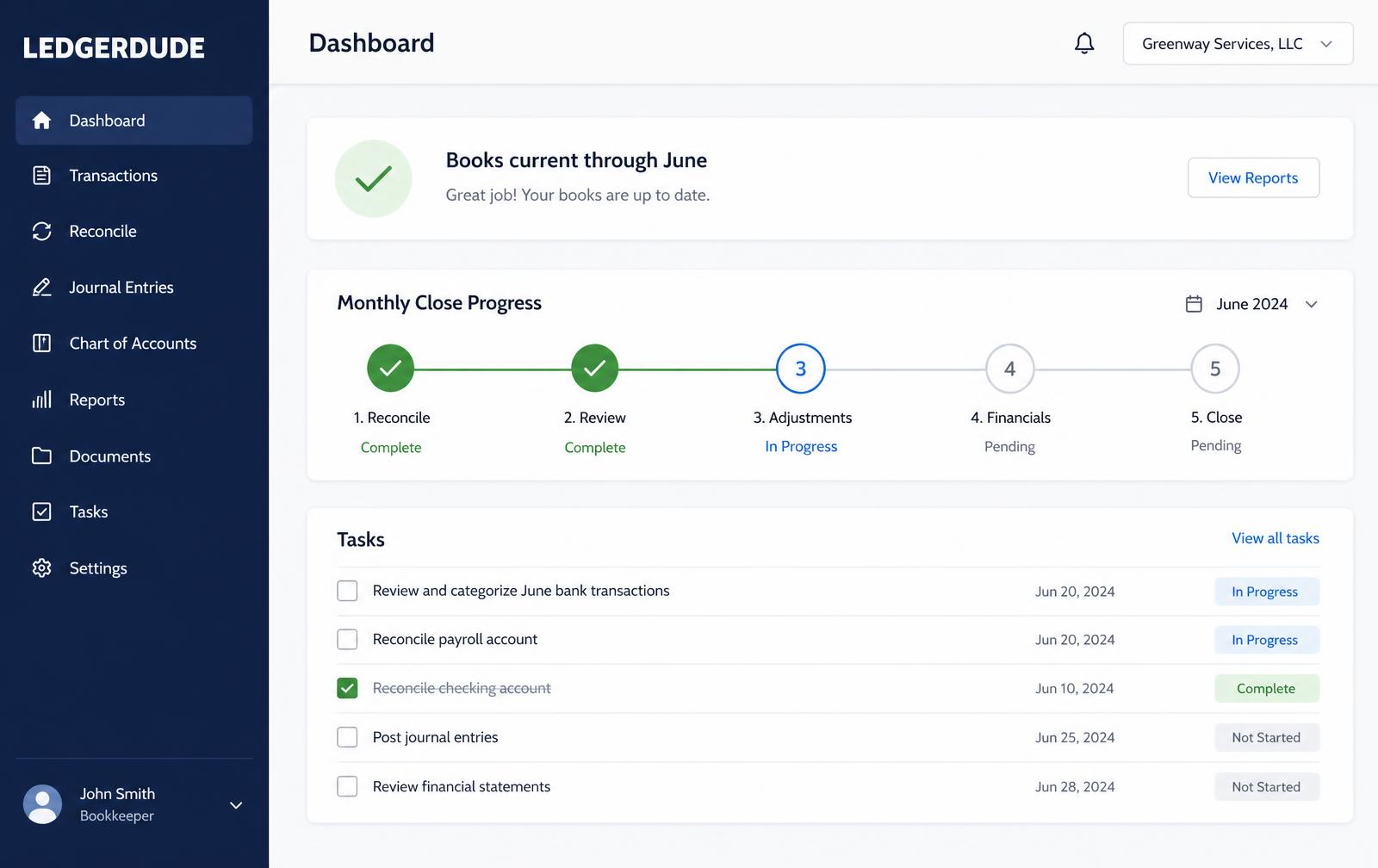
We put revenue per available service hour and the rest of these numbers on one page, refreshed as your books are closed each month.
How to set up appointment business KPIs
- 1
Move tips to a liability account
Tips are held for staff until paid out. They are never revenue.
- 2
Book gift cards as deferred revenue
Recognize revenue on redemption, not on sale.
- 3
Split service, retail and backbar
Three separate accounts, even when they come on one supplier invoice.
- 4
Separate payroll by pay structure
Booth rent, commission and hourly each reported on their own.
- 5
Record available station hours weekly
Scheduled open hours per station, excluding blocked admin time.
- 6
Track no-shows and late cancels
Count them as consumed inventory so the cost is visible.
- 7
Review revenue per available hour by provider and by day
Fix the specific empty day rather than running a discount across everything.
Real example
A three-location salon group that could not explain a flat year
Where they started: Fifteen thousand visits a year across three locations, a mix of commission staff and booth renters, one Supplies account, tips recorded as revenue and gift cards booked when sold. Revenue was flat year over year, profit was down four points, and nobody could say which location was responsible.
What we did: We split service from retail and pulled backbar out of retail cost of goods, separated payroll by pay structure, moved tips to a liability and gift cards to deferred revenue, and built revenue per available service hour by location and provider along with no-show tracking.
How it ended up: Revenue was not flat at all — two locations had grown while the third fell 14 percent, hidden by tips inflating prior-year revenue. The weak location had 31 percent unsold chair time on Tuesdays and Wednesdays and a 9 percent no-show rate. Hours were reshaped, a deposit policy was added, and retail was consolidated to the two locations that actually sold it.
+11 pts
Net profit
31% → 18%
Unsold chair time
9% → 3.5%
No-show rate
“Tips in revenue made a shrinking location look fine for two years. That correction alone was worth the engagement.”
Questions people ask
Why can't tips be counted as revenue?
Because the money belongs to your staff. Recording it as revenue inflates sales, distorts every percentage on your profit and loss, and can overstate figures used for lending or valuation.
How should booth rent be recorded?
As rental income, separate from service revenue, with any product or processing you provide the renter recorded against it. Blending it into service revenue makes your payroll load look artificially low.
Is retail worth carrying?
Usually yes, if attachment is above about 10 percent and inventory turns at least four times a year. Below that, shelf space and cash tied up in slow product outweigh the margin.
When can I recognize gift card revenue?
On redemption. Unredeemed balances stay as deferred revenue, and some states have escheatment rules for very old balances that we track for you.
What is the fastest way to lift profit here?
Usually cutting no-shows and reshaping the two weakest days. Both raise revenue per available service hour without touching prices or adding staff.
What does this cost?
One flat monthly price. No hourly bills, no surprises. Founding plans start at $149 a month, and your rate stays locked.
Keep reading
Ecommerce KPIs that come straight out of your books
Start with contribution margin per order — for shopify, amazon and etsy sellers doing $200k to $5m a year.
Construction and trades KPIs built from job-level books
Start with gross profit per job — for general contractors, remodelers, electrical, plumbing and hvac companies.
Agency and professional services KPIs from the books up
Start with gross margin per client — for marketing agencies, design studios, consultancies and law or engineering firms.
All KPI Library pages
Every industry we have written numbers for, in one list.
Outsourced bookkeeping services
Who does the work behind these numbers each month.
Pricing
Flat monthly plans based on your revenue, with catch-up quoted separately.
Want your books handled for you?
We read your receipts, match your bank activity, and close your books every month. You get one short list of questions and a dashboard that always tells the truth.