
Setup
Building a chart of accounts you will actually use
How to structure a chart of accounts so your reports answer real questions — without ending up with two hundred accounts nobody understands.
The short answer
- A good chart of accounts is small. Most small businesses need 40 to 80 accounts, not 200.
- Structure it around the decisions you make, not around every vendor you use.
- Use classes or projects for dimensions like location and job, never separate accounts for each.
- Merge duplicates and retire unused accounts at least once a year.
Design around decisions
Every account should answer a question you actually ask. If you never make a decision from a line, it should be merged. Restaurants need food versus beverage cost; a consultant does not.
Dimensions belong in classes, not accounts
Location, job, property and truck are dimensions. Creating 'Fuel – Truck 1', 'Fuel – Truck 2' multiplies your account list and destroys comparability. One fuel account plus a class per truck gives both views.
Keep cost of goods sold honest
Only costs that move with delivering the product or service belong in cost of goods sold. Rent and office software do not. Once that line is polluted, gross margin cannot be benchmarked against anything.
Annual pruning
During the year-end close we list accounts with no activity and duplicates with similar names, then merge or retire them so next year's reports stay readable.
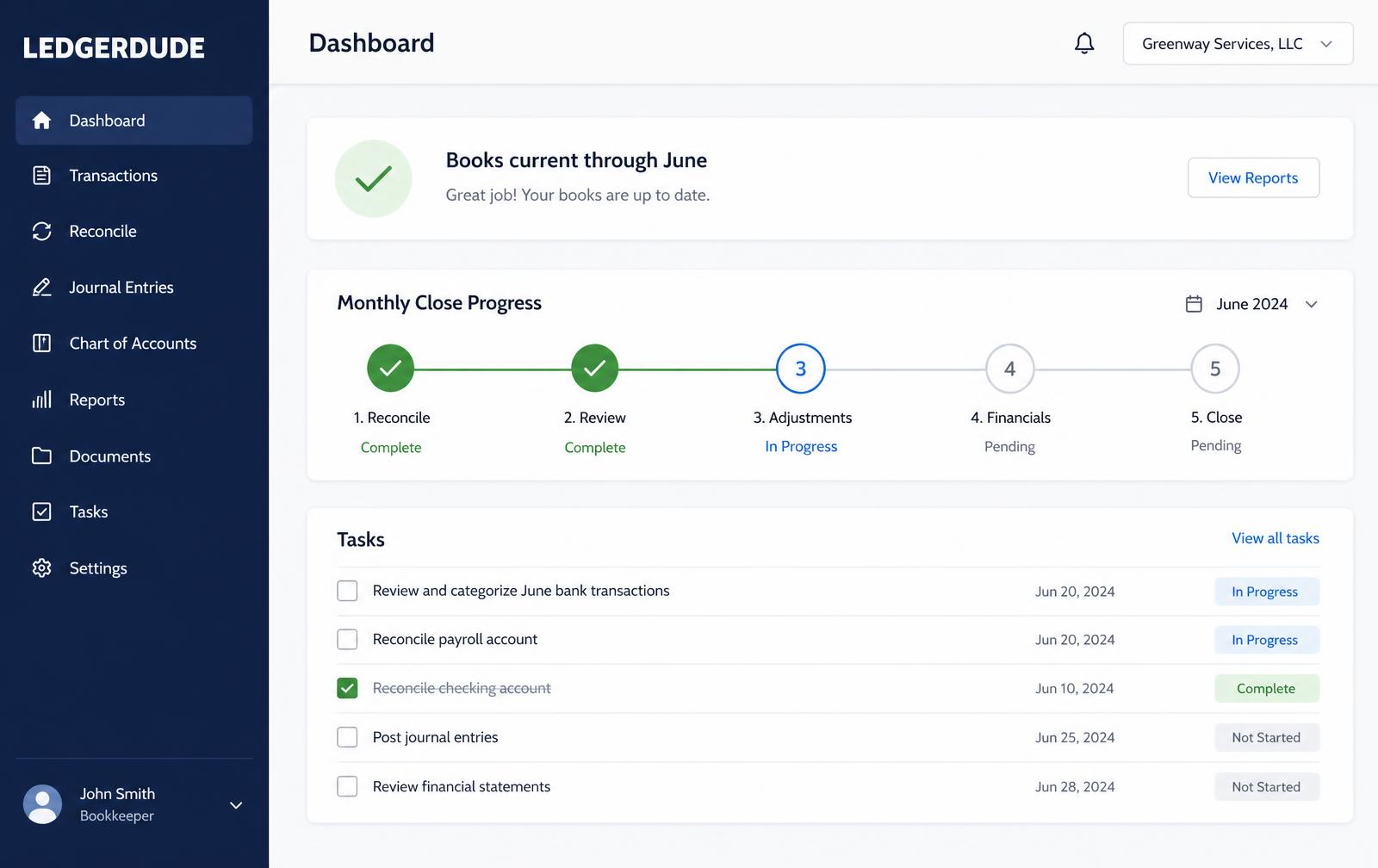
What you see inside LedgerDude
One page with your money in and money out, your cash on hand, and a short list of questions when we need your help.
How to rebuild a chart of accounts
- 1
List decisions
Write down the questions you want your monthly reports to answer.
- 2
Map accounts
Assign each existing account to a question, or mark it for merging.
- 3
Add dimensions
Move location, job or property splits into classes or projects.
- 4
Merge
Merge duplicates so history stays intact rather than deleting accounts.
- 5
Document
Write a one-line rule for each account so coding stays consistent.
Questions people ask
How many accounts should I have?
Most small businesses run well on 40 to 80. Beyond that, reports usually get harder to read, not more informative.
Can I delete an account?
Prefer merging or making inactive. Deleting can orphan history; merging preserves it and cleans the report.
Should each bank account be its own ledger account?
Yes. Every real bank, card and loan account should map one-to-one so reconciliation is provable.
What does this cost?
One flat monthly price. No hourly bills, no surprises. Founding plans start at $149 a month, and your rate stays locked.
Keep reading
Debits and credits, explained without the jargon
What debits and credits actually mean, why every entry has two sides, and how to tell in seconds whether an entry increases or decreases an account.
Cash vs accrual accounting: which one should you use?
The real difference between cash and accrual accounting, when each is required, and why many small businesses manage on one and file on the other.
Bank reconciliation, step by step
How to reconcile a bank account every month: match the statement, chase the differences, and prove the ending balance is real before you close the books.
All accounting guide library guides
Every guide in this library.
All guide libraries
Accounting, QuickBooks and catch-up.
Our services
Hand the whole thing to us instead.
Want your books handled for you?
We read your receipts, match your bank activity, and close your books every month. You get one short list of questions and a dashboard that always tells the truth.