
Bookkeeping workflows
Recording payroll so your labor cost is actually right
How gross wages, employer taxes and withholdings post to your books, and why the total that left your bank is never your true labor cost.
The short answer
- Gross wages, not net pay, are your expense. Net pay is just what reached the employee.
- Withholdings are liabilities you hold and remit; they are not an extra expense.
- Employer payroll taxes are an additional expense on top of gross wages.
- The payroll cash draft equals net pay plus taxes remitted, which is why it never matches wage expense.
The three pieces of every payroll
Payroll splits into wage expense, employer tax expense and liabilities held for someone else. Booking the bank draft as one lump expense hides the split and makes labor cost impossible to analyze.
- Gross wages: full amount earned, an expense
- Employee withholdings: income tax and the employee share of payroll tax, a liability
- Employer taxes: your matching share plus unemployment, an expense
- Benefits and retirement match: an expense, often with a matching liability until remitted
Fully loaded labor cost
Employer taxes and benefits typically add 10% to 20% on top of gross wages. If you price jobs off hourly wage alone, every quote is short by that margin. Our KPI library covers labor cost as a percentage of revenue in more depth.
Reconciling payroll to the bank
Payroll providers usually draft net pay and taxes separately, or as one combined draft. Match those drafts to the payroll register every period, or the liability accounts drift and year-end filings will not tie.
One biweekly payroll, fully split
- Gross wages expense
- $62,000
- Employee withholdings held
- $14,880
- Net pay to employees
- $47,120
- Employer payroll taxes expense
- $5,270
- Total labor cost
- $67,270
- Total cash out
- $67,270
What this tells you: The $47,120 that hit employee accounts is only 70% of the real cost. Pricing off net pay understates labor by roughly a third.
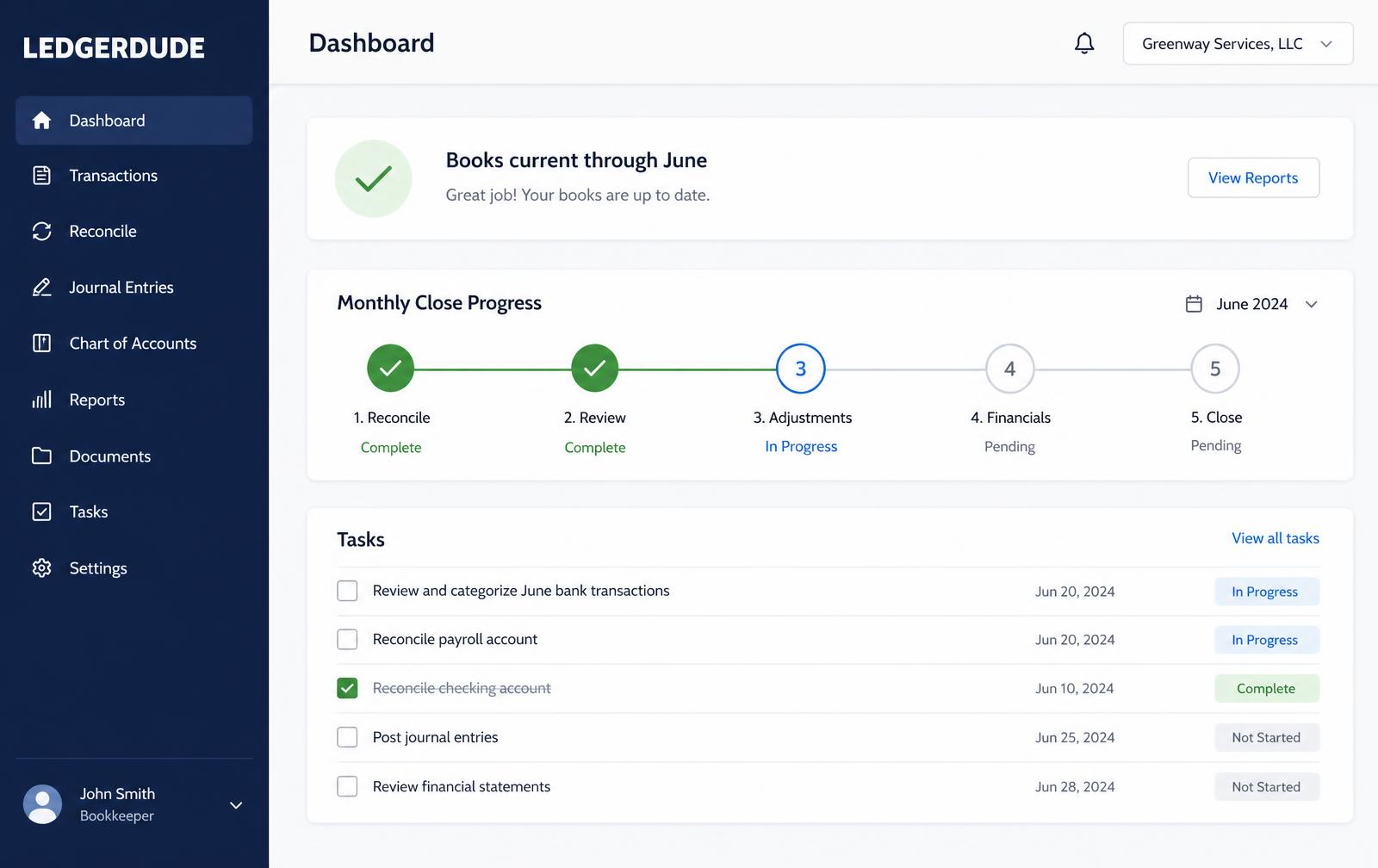
What you see inside LedgerDude
One page with your money in and money out, your cash on hand, and a short list of questions when we need your help.
Post a payroll run
- 1
Pull the register
Download the payroll register showing gross, withholdings, employer taxes and net pay.
- 2
Book gross wages
Debit wage expense for total gross pay, split by department if you track it.
- 3
Book employer taxes
Debit payroll tax expense for the employer share.
- 4
Book liabilities
Credit payroll liability accounts for withholdings and taxes not yet remitted.
- 5
Book the cash
Credit the bank for net pay and for tax payments as they draft.
- 6
Clear liabilities
Confirm liability accounts return to zero once remittances clear.
Questions people ask
Can my payroll provider post this for me?
Most sync a summarized entry. Check the mapping once, because default accounts frequently lump taxes into wages.
Why is my payroll liability account not zero?
Usually a remittance was coded to expense instead of clearing the liability, or a pay period straddles month end.
Are contractors part of payroll?
No. Contractor payments are an expense with no withholding, and they get a 1099 rather than a W-2.
What does this cost?
One flat monthly price. No hourly bills, no surprises. Founding plans start at $149 a month, and your rate stays locked.
Keep reading
Sales tax bookkeeping: collect it, hold it, remit it
Why sales tax you collect is never your revenue, how to record it as a liability, and how to reconcile what you collected against what you filed.
Fixed assets and depreciation without the headache
When a purchase is an asset instead of an expense, how depreciation spreads that cost over time, and how to keep a fixed asset schedule your CPA can use.
Inventory and cost of goods sold, step by step
How inventory sits on the balance sheet until it sells, what belongs in cost of goods sold, and how to count and adjust so your margin is believable.
All accounting guide library guides
Every guide in this library.
All guide libraries
Accounting, QuickBooks and catch-up.
Our services
Hand the whole thing to us instead.
Want your books handled for you?
We read your receipts, match your bank activity, and close your books every month. You get one short list of questions and a dashboard that always tells the truth.