
Industry
Virtual CFO for commercial cleaning and janitorial companies
Recurring contract revenue, labor as a percentage of revenue, supplies, and subcontractors versus employees, explained for janitorial company owners.
The short answer
- Commercial cleaning runs on recurring contracts. The single most important number is gross margin per contract, not company-wide revenue.
- Labor is usually 55 to 65 percent of revenue in janitorial work, so a small drift in scheduling or wage rates changes profit fast.
- Whether a cleaner is a W-2 employee or a 1099 subcontractor changes taxes, insurance and how the cost should be tracked. Misclassifying workers is one of the most expensive mistakes in this industry.
- Supplies and equipment need to be tracked against the contracts that use them, not lumped into one overhead bucket.
Contracts, not company totals, are the real unit of the business
A janitorial company might run twenty contracts of very different sizes and margins. Reading only the company-wide profit and loss hides the two or three contracts that are actually losing money and quietly getting subsidized by the rest.
- Track labor hours and cost against each contract's billed revenue
- Track supplies and equipment used per contract, not as one shared expense
- Flag contracts that require night differential pay or overtime separately
- Review contract profitability at renewal, not just at sign-up
Labor as a percentage of revenue
Labor typically runs 55 to 65 percent of revenue in commercial cleaning. Because margins are thin, a two or three point drift, from overtime, turnover or under-scheduling, can turn a profitable contract into a losing one. Tracking this monthly, by contract, catches drift before the renewal conversation.
Employees versus subcontractors
Cleaners paid as W-2 employees carry payroll taxes, workers' compensation and often benefits. Cleaners paid as 1099 subcontractors do not, but misclassifying an employee as a subcontractor to avoid those costs creates real legal and tax risk. We track both types separately and flag classification questions before they become a problem.
Supplies, equipment and consumables
Cleaning supplies, paper products and equipment should be tracked against the contracts that use them so a large-square-footage contract with heavy consumable use does not quietly drag down margin on paper while looking fine on labor.
What LedgerDude does each month
We track labor and supplies by contract, separate W-2 payroll cost from 1099 subcontractor payments, watch labor as a percentage of revenue trend by contract, and deliver a contract profitability report each month.
Numbers worth watching
Each one is plain math you can check yourself.
| Number | How to figure it | Good range | Why it matters |
|---|---|---|---|
| Labor cost as a percentage of revenue | (Wages + employer taxes + workers' comp) ÷ revenue | 55–65% | The single biggest driver of margin in a labor-intensive, thin-margin business. |
| Gross margin by contract | (Contract revenue − labor − supplies) ÷ contract revenue | 10–20% | Shows which contracts are worth renewing, renegotiating or walking away from. |
| Supplies cost as a percentage of revenue | Supplies and consumables ÷ revenue | 3–7% | Catches waste or theft before it becomes a pattern across contracts. |
| Contract retention rate | Contracts renewed ÷ contracts up for renewal | 85%+ | Recurring contracts are the backbone of the business; losing them is far more expensive than losing a single job. |
Typical results we see
Labor cost
60% of revenue
Typical range across the janitorial companies we support
Gross margin by contract
14%
Lower on new contracts still ramping up staffing efficiency
Supplies cost
4.8% of revenue
Higher for medical and food service accounts
Contract retention
88%
Drops sharply after service quality complaints go unaddressed
A company with 18 active janitorial contracts
- Total contract revenue
- $142,000
- Labor including employer taxes and workers' comp
- $85,900 (60.5%)
- Supplies and consumables
- $6,700 (4.7%)
- Subcontracted specialty cleaning (floor care)
- $4,200
- Gross profit
- $45,200 (31.8%)
- Overhead (admin, insurance, vehicles)
- $22,800
- Net income
- $22,400 (15.8%)
What this tells you: Three contracts were running labor cost above 68 percent of their billed revenue, well past the 65 percent ceiling. Two were due for renewal within 60 days, giving the owner a clean opening to renegotiate scope or price.
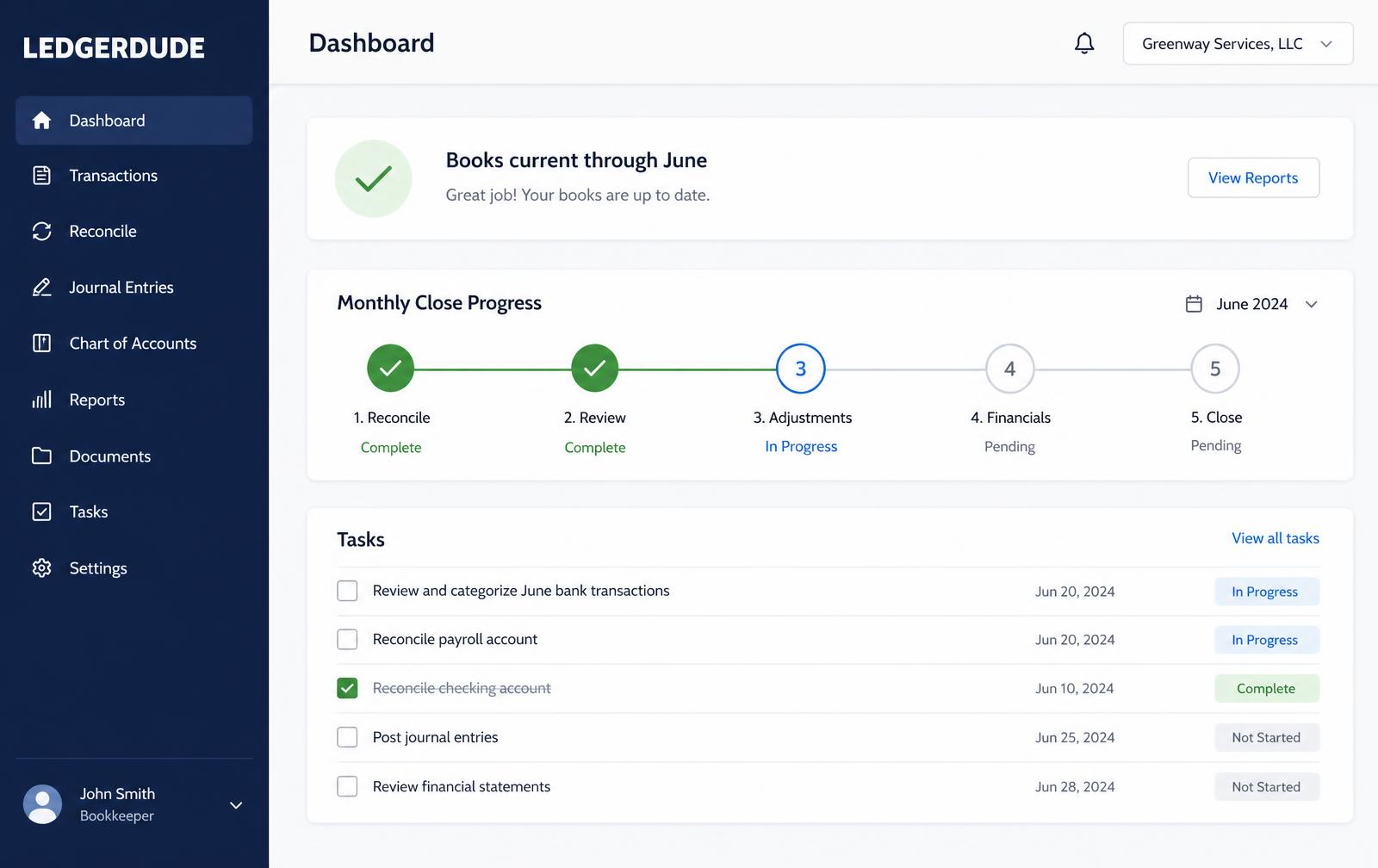
What you see inside LedgerDude
Your numbers on one page, refreshed as your books are closed each month.
Real example
Janitorial company paying cleaners as 1099 subcontractors without a clear policy
Where they started: The company paid most cleaners as 1099 subcontractors, but several worked set schedules under close supervision, a classic misclassification risk. There was no contract-level view of labor cost, so unprofitable accounts stayed on the books for years.
What we did: We reviewed worker classification against standard criteria and flagged the workers who should move to W-2, and built a contract-by-contract labor and supplies tracking system.
How it ended up: The owner reclassified four workers, avoiding a larger back-tax exposure, and dropped two chronically unprofitable contracts at renewal, improving overall margin.
4
Workers reclassified
2
Unprofitable contracts dropped
3.1 points
Company-wide margin improvement
“We had no idea some of our biggest contracts were actually losing money.”
How we set up your accounts
The accounts we build first for this kind of business, so reports read the way you think.
- Contract revenue tracked individually by client account
- W-2 labor cost separate from 1099 subcontractor payments
- Supplies and consumables tracked by contract where possible
- Workers' compensation and payroll taxes as their own labor cost line
- Equipment (floor machines, vacuums) tracked as assets with depreciation
Questions people ask
How much does a virtual CFO cost for a commercial cleaning company?
Most janitorial companies with 10 to 25 contracts pay $400 to $850 a month for a virtual CFO that includes contract-level labor tracking and a monthly close. Larger companies with mixed W-2 and 1099 staffing often run $900 to $1,600.
What is a healthy labor cost percentage for a janitorial business?
Most healthy commercial cleaning companies run labor cost, including employer taxes and workers' compensation, between 55 and 65 percent of revenue. Above 65 percent, individual contracts usually need a price or staffing review.
Should I pay cleaners as employees or subcontractors?
It depends on how much control you exercise over their schedule, methods and equipment. Workers who follow a set schedule and use your supplies under your supervision generally need to be W-2 employees. Misclassifying them as 1099 subcontractors carries real tax and legal risk.
How do I know if a cleaning contract is actually profitable?
Track labor hours and supplies cost against that specific contract's billed revenue, not against company-wide totals. A contract with labor cost above 65 percent of its revenue usually needs a renegotiation at renewal.
How should I track cleaning supplies and equipment costs?
Assign supplies and consumables to the contract that used them where possible. This keeps high-consumable accounts, like medical or food service facilities, from quietly dragging down overall margin while looking fine on labor alone.
What does this cost?
One flat monthly price. No hourly bills, no surprises. Founding plans start at $149 a month, and your rate stays locked.
Keep reading
Virtual CFO for restaurants and food trucks
How restaurant and food truck books really work: prime cost, daily sales journal entries, tip liability, third-party delivery fees and food cost swings.
Virtual CFO for construction and contractors
Job costing, retainage, progress billing and work in progress, explained for contractors who need books their bonding agent and banker will accept.
Virtual CFO for ecommerce and online sellers
Marketplace payouts, inventory, cost of goods sold, sales tax nexus and ad spend, handled the way ecommerce books actually need.
All industries
Every business type we have written up.
What we do each month
Our monthly virtual CFO service, step by step.
KPI Library
The numbers that decide whether a month made money.
Want your books handled for you?
We read your receipts, match your bank activity, and close your books every month. You get one short list of questions and a dashboard that always tells the truth.