
Industry
Virtual CFO for ecommerce and online sellers
Marketplace payouts, inventory, cost of goods sold, sales tax nexus and ad spend, handled the way ecommerce books actually need.
The short answer
- Marketplace payouts are net of fees, refunds, ads and reserves. Booking the payout as revenue understates real sales by 15 to 35 percent.
- Inventory belongs on the balance sheet until it ships. Expensing purchases makes profit swing with buying, not selling.
- Sales tax collected is a liability. Economic nexus can be triggered by volume in a state you have never visited.
- Contribution margin per SKU after ads and fulfillment is the number that tells you what to reorder.
Unwinding the marketplace payout
One Amazon or Shopify deposit can contain gross sales, refunds, referral fees, fulfillment fees, storage, advertising, chargebacks and a reserve. Each of those needs its own account. Once the settlement is unwound, gross sales tie to the marketplace report and every fee becomes visible and negotiable.
Inventory and cost of goods sold
Purchases go to inventory. When an order ships, cost moves to cost of goods sold. Landed cost should include freight in, duties and inbound prep, because those can add 10 to 25 percent to unit cost and change which SKUs are worth selling.
Sales tax and nexus
Marketplace facilitator rules mean the platform often remits for you, but your own website sales usually do not qualify. We track collected tax by state as a liability, watch thresholds and flag the month you cross one.
Ad spend belongs next to the revenue it created
Platform ads, off-site ads and influencer fees should sit together so you can read blended return on ad spend against gross margin. Ads buried in general marketing hide the moment acquisition stopped paying.
Numbers worth watching
Each one is plain math you can check yourself.
| Number | How to figure it | Good range | Why it matters |
|---|---|---|---|
| Contribution margin per order | Net sales − COGS − fulfillment − payment fees − ads | Positive at every scale | Revenue growth on a negative contribution margin only speeds up the loss. |
| Inventory turns | COGS ÷ average inventory | 4–8× a year | Cash trapped in slow SKUs is the top killer of ecommerce brands. |
| Refund rate | Refunds ÷ gross sales | Under 6% | A rising rate is a product or listing problem, not an accounting one. |
| Blended ROAS | Total revenue ÷ total ad spend | Above break-even ROAS | Break-even ROAS depends on gross margin, so it must come from the books. |
Typical results we see
Gross margin
42%
Median for the DTC brands we close
Marketplace fee load
23% of gross
Amazon FBA sellers, all fees combined
Refund rate
5.1%
Apparel runs far higher
Inventory turns
5.4×
Below 3 signals a cash problem building
One $61,400 Amazon settlement, unwound
- Gross product sales
- $61,400
- Refunds
- −$3,100
- Referral fees
- −$8,900
- Fulfillment and storage
- −$9,600
- Sponsored ads
- −$7,200
- Deposit received
- $32,600
- Cost of goods sold on shipped units
- $21,300
- Contribution margin
- $11,300 (18.4%)
What this tells you: If only the $32,600 deposit were recorded, sales would be understated by $28,800 and every fee would be invisible. The unwound version shows ads costing 11.7 percent of sales.
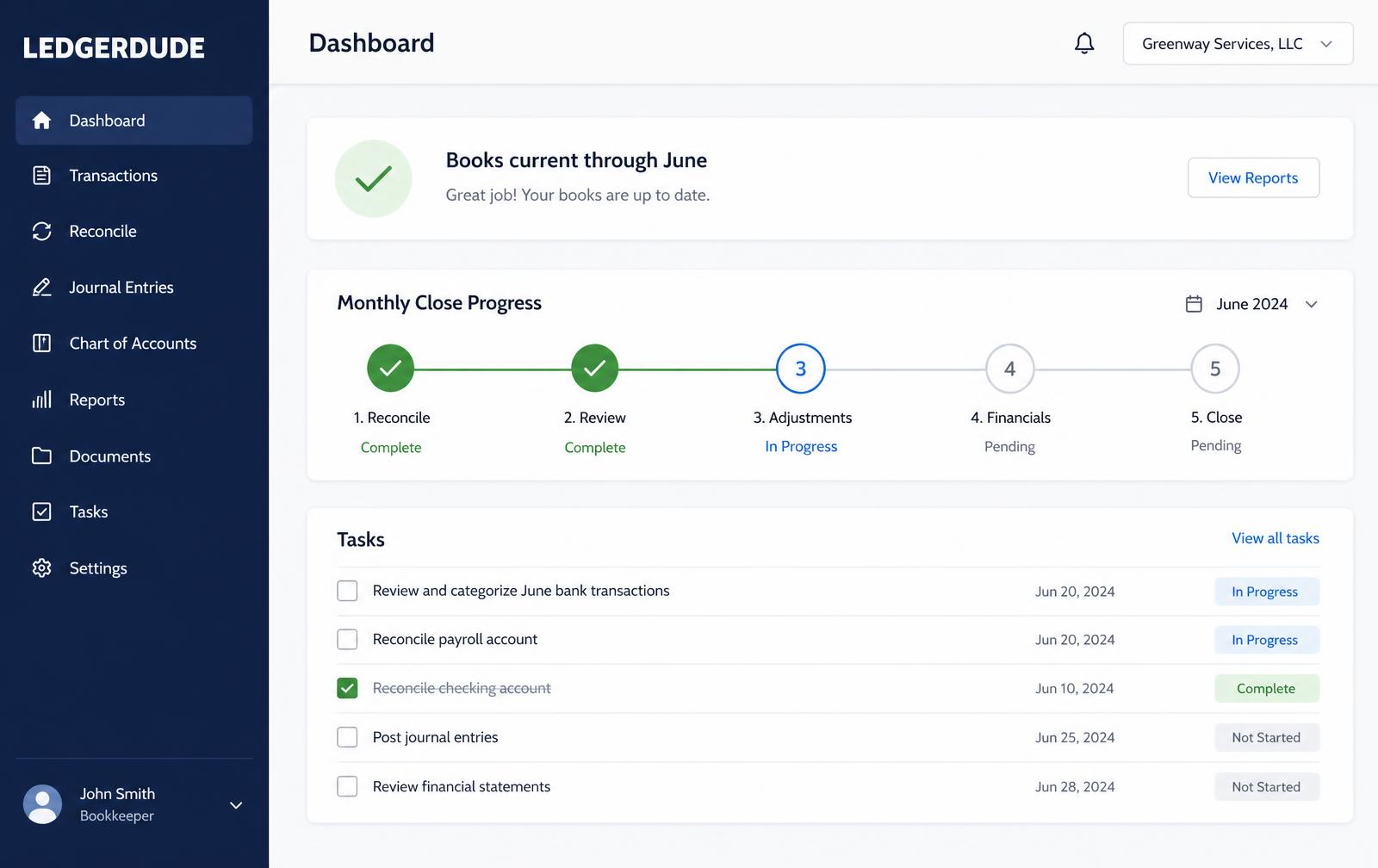
What you see inside LedgerDude
Your numbers on one page, refreshed as your books are closed each month.
Real example
DTC brand growing revenue and losing cash
Where they started: Sales up 40 percent year over year, bank balance falling. Purchases were expensed and payouts booked net.
What we did: We rebuilt inventory as an asset with landed cost, unwound twelve months of settlements and added contribution margin by SKU.
How it ended up: Two hero SKUs were losing money after ads. Killing them freed cash and profit turned positive the next quarter.
12 months
Settlements unwound
$74,000
Cash freed from dead stock
+9 points
Contribution margin
How we set up your accounts
The accounts we build first for this kind of business, so reports read the way you think.
- Gross sales by channel with refunds as contra-revenue
- Marketplace fees split: referral, fulfillment, storage, advertising
- Inventory asset at landed cost, with a separate inbound freight account
- Sales tax payable by state
- Merchant processing fees separate from platform fees
Questions people ask
Should I record the Shopify or Amazon deposit as revenue?
No. Record gross sales, then each fee, refund and reserve separately. The deposit is what is left over, not what you sold.
When does inventory become an expense?
When the item ships to the customer. Until then it is an asset on the balance sheet at landed cost.
Does the marketplace handle my sales tax?
Marketplace facilitator laws usually cover sales made on the marketplace. Sales through your own store are your responsibility once you pass a state's economic nexus threshold.
What does this cost?
One flat monthly price. No hourly bills, no surprises. Founding plans start at $149 a month, and your rate stays locked.
Keep reading
Virtual CFO for restaurants and food trucks
How restaurant and food truck books really work: prime cost, daily sales journal entries, tip liability, third-party delivery fees and food cost swings.
Virtual CFO for construction and contractors
Job costing, retainage, progress billing and work in progress, explained for contractors who need books their bonding agent and banker will accept.
Virtual CFO for real estate investors
Per-property books, mortgage payment splits, capital improvements versus repairs, security deposits and the reports a lender will accept.
All industries
Every business type we have written up.
What we do each month
Our monthly virtual CFO service, step by step.
KPI Library
The numbers that decide whether a month made money.
Want your books handled for you?
We read your receipts, match your bank activity, and close your books every month. You get one short list of questions and a dashboard that always tells the truth.