
Industry
Virtual CFO for construction and contractors
Job costing, retainage, progress billing and work in progress, explained for contractors who need books their bonding agent and banker will accept.
The short answer
- Contractor books are only useful when every dollar carries a job. Without job costing, a profitable quarter can hide two losing jobs.
- Retainage held by the customer is a receivable, not a discount, and it should sit in its own account.
- Progress billing creates over- and under-billings. The work in progress schedule is what turns that into real revenue.
- Equipment purchases are assets; the deposit that shows up in your bank is not income.
Job costing is the whole game
Every material receipt, subcontractor invoice, labor hour and equipment charge should attach to a job. Once that is true, gross margin by job becomes the report that runs the business: which crews, which customers and which bid types actually make money.
- Labor burden, not just wages, belongs in job cost
- Subcontractor invoices need the job before they get paid
- Materials bought for stock get allocated when they are used
- Change orders get their own line so scope creep is visible
Retainage on both sides
Customers hold retainage from your invoices and you hold retainage from your subs. Both need separate accounts. When retainage sits inside regular accounts receivable, your aging report looks alarming and your collections calls go to the wrong people.
Work in progress and the percentage of completion
For jobs that cross month ends, revenue should be recognized on cost incurred against cost to complete. The WIP schedule shows costs to date, billings to date and the over- or under-billing. Bankers and bonding agents ask for it first.
Equipment, loans and the payment split
A truck or excavator loan payment is part interest, part principal. Booking the whole payment to an expense account overstates costs and understates the loan balance. We split every payment from the amortization schedule so the balance sheet stays true.
What LedgerDude does each month
We tie every cost to a job, reconcile retainage both ways, produce a WIP schedule, split loan payments and deliver a gross margin by job report with the close package.
Numbers worth watching
Each one is plain math you can check yourself.
| Number | How to figure it | Good range | Why it matters |
|---|---|---|---|
| Gross margin by job | (Job revenue − job cost) ÷ job revenue | 18–35% depending on trade | The only reliable way to know which bids to repeat. |
| Labor burden rate | (Wages + taxes + insurance + benefits) ÷ wages | 1.25–1.45× | Bidding on bare wages is how contractors lose money on busy years. |
| Over/under billing | Billings to date − earned revenue | Slightly over-billed | Under-billing means you are financing your customer. |
| Backlog coverage | Signed backlog ÷ average monthly revenue | 3–6 months | Tells you when to sell harder, months before the slowdown lands. |
Typical results we see
Gross margin
24.8%
Median across the residential contractors we support
Labor burden
1.33×
Higher in states with heavy comp rates
Retainage held
5–10%
Typical on commercial work
Days sales outstanding
46 days
Excluding retainage
A $310,000 remodel job, closed out
- Contract value including change orders
- $310,000
- Materials
- $118,400
- Subcontractors
- $72,900
- Field labor with 1.33× burden
- $61,200
- Equipment and dump fees
- $8,700
- Total job cost
- $261,200
- Gross profit
- $48,800 (15.7%)
What this tells you: The bid assumed 24 percent. Two unpriced change orders ate 8 points. Pricing change orders at signing, not at closeout, recovers roughly $25,000 on a job this size.
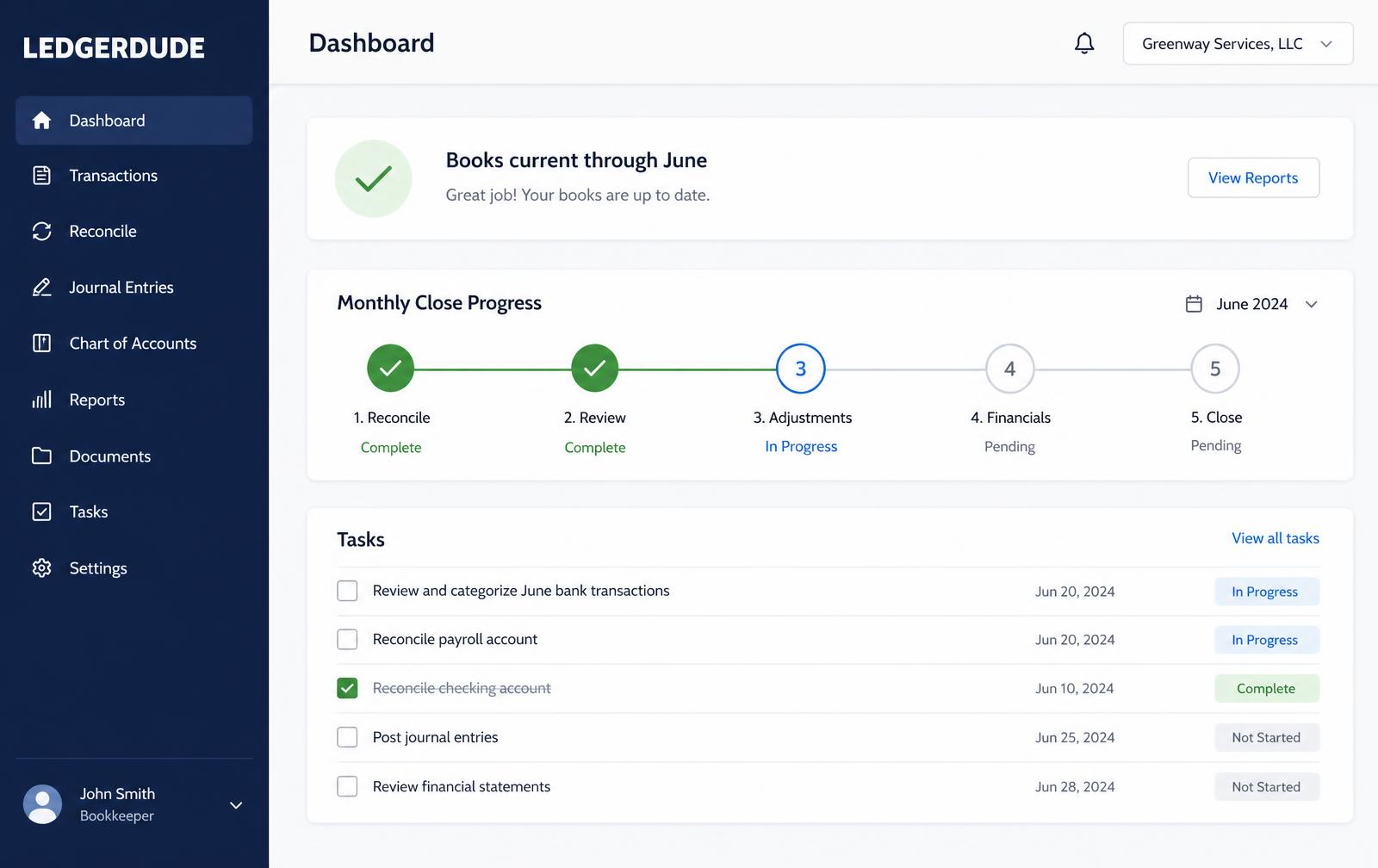
What you see inside LedgerDude
Your numbers on one page, refreshed as your books are closed each month.
Real example
Specialty trade contractor bidding blind
Where they started: Twelve open jobs, no job costing, and a bank asking for a WIP schedule before renewing the line of credit.
What we did: We rebuilt the chart of accounts around cost codes, back-coded nine months of transactions and produced a WIP schedule with over/under billing by job.
How it ended up: The line of credit renewed and two customer types were revealed as reliably unprofitable and dropped.
9
Months back-coded
+6.2 points
Margin improvement
Renewed
Credit line
How we set up your accounts
The accounts we build first for this kind of business, so reports read the way you think.
- Income split by contract type: new construction, remodel, service, change orders
- Cost of goods sold by cost code: materials, subs, labor, equipment, other
- Retainage receivable and retainage payable as separate accounts
- Equipment loans with interest split from principal
- Over-billings and under-billings on the balance sheet
Questions people ask
Do contractors need job costing in QuickBooks?
Yes. Without costs assigned to jobs you can only see company-wide profit, which averages winners and losers together. QuickBooks Online supports projects and cost codes; the discipline is attaching every bill and hour when it happens.
How is retainage recorded?
Retainage receivable is its own asset account, separate from regular accounts receivable. Retainage you hold from subcontractors is a separate liability. Both clear when the job closes out.
What is a WIP schedule and who asks for it?
A work in progress schedule compares cost incurred and estimated cost with the amount billed on each open job. Bankers, sureties and CPAs use it to see whether reported profit is real.
What does this cost?
One flat monthly price. No hourly bills, no surprises. Founding plans start at $149 a month, and your rate stays locked.
Keep reading
Virtual CFO for restaurants and food trucks
How restaurant and food truck books really work: prime cost, daily sales journal entries, tip liability, third-party delivery fees and food cost swings.
Virtual CFO for ecommerce and online sellers
Marketplace payouts, inventory, cost of goods sold, sales tax nexus and ad spend, handled the way ecommerce books actually need.
Virtual CFO for real estate investors
Per-property books, mortgage payment splits, capital improvements versus repairs, security deposits and the reports a lender will accept.
All industries
Every business type we have written up.
What we do each month
Our monthly virtual CFO service, step by step.
KPI Library
The numbers that decide whether a month made money.
Want your books handled for you?
We read your receipts, match your bank activity, and close your books every month. You get one short list of questions and a dashboard that always tells the truth.