
Industry
Virtual CFO for restaurants and food trucks
How restaurant and food truck books really work: prime cost, daily sales journal entries, tip liability, third-party delivery fees and food cost swings.
The short answer
- Restaurant numbers live or die on prime cost — food plus labor as a share of sales. Healthy full service sits near 60 percent; a food truck can run under 55 percent.
- Sales should post as one daily sales journal entry per location, not as a pile of deposits, so cash, cards and delivery apps all tie back to the POS.
- Delivery apps deposit net of commission. Booking the deposit as revenue understates both sales and expense by 15 to 30 percent.
- Tips are a liability until paid out, never revenue.
Why restaurant books break
A restaurant runs thousands of tiny transactions and four or five money paths: card settlements, cash drops, delivery apps, gift cards and catering invoices. When someone matches deposits instead of reading the POS, sales get understated, comps disappear and sales tax gets paid on the wrong base.
- Card batches arrive net of processor fees, one to three days late
- Delivery apps net out commission, marketing fees and driver tips
- Cash sales rarely equal cash deposits because of petty cash spending
- Gift cards sold are a liability until redeemed
The daily sales journal entry
The fix is one entry per day per location built from the POS Z-report. Gross sales, comps and discounts, sales tax collected, tips collected, then the money paths that settle it: cards, cash, delivery apps, gift card redemptions. Everything after that becomes a matching exercise rather than a guessing exercise.
Food cost that actually means something
Food cost is only useful with inventory counts on both ends of the period. Purchases alone move with delivery timing, so a heavy Sunday order can make a good week look terrible. We book beginning inventory, purchases and ending inventory so cost of goods sold reflects what you actually served.
Labor, tips and tip credit
Tips collected on cards are held for the staff, so they sit in a liability account until the payout run clears them. Wages, employer taxes and the tip credit all belong in labor cost. Leaving payroll taxes out of labor is the most common reason a prime cost number looks better than reality.
What LedgerDude does each month
We pull the POS daily totals, reconcile every card batch and delivery deposit, split the commission back out to an expense account, roll inventory into cost of goods sold, and send you a one-page prime cost read before the 10th.
Numbers worth watching
Each one is plain math you can check yourself.
| Number | How to figure it | Good range | Why it matters |
|---|---|---|---|
| Prime cost | (Cost of goods sold + total labor) ÷ net sales | 55–62% full service, 50–57% food truck | It is the single number that predicts whether the month made money. |
| Food cost percentage | (Beginning inventory + purchases − ending inventory) ÷ food sales | 28–33% | Catches portion drift, waste and price increases before they eat the quarter. |
| Labor cost percentage | (Wages + employer taxes + benefits) ÷ net sales | 25–32% | Schedules quietly grow. This is how you see it in week two, not month three. |
| Delivery commission rate | Delivery fees ÷ gross delivery sales | Under 25% | Tells you whether a delivery channel is profitable or just busy. |
Typical results we see
Prime cost
58%
Median of the full service restaurants we close each month
Food cost
30.4%
Higher for scratch kitchens, lower for limited menus
Delivery share of sales
18%
Down from the 2021 peak but still material
Net profit margin
5.9%
Before owner distributions
A $92,000 month at a 48-seat neighborhood restaurant
- Net sales
- $92,000
- Food and beverage cost
- $28,500 (31.0%)
- Labor including employer taxes
- $26,200 (28.5%)
- Prime cost
- $54,700 (59.5%)
- Occupancy and utilities
- $11,800
- Delivery commissions
- $3,900
- Other operating costs
- $14,100
- Net income
- $7,500 (8.2%)
What this tells you: Prime cost at 59.5 percent leaves room, but delivery commission is running 26 percent of delivery sales. Raising delivery menu prices by 12 percent adds roughly $470 a month with no extra labor.
What you see inside LedgerDude
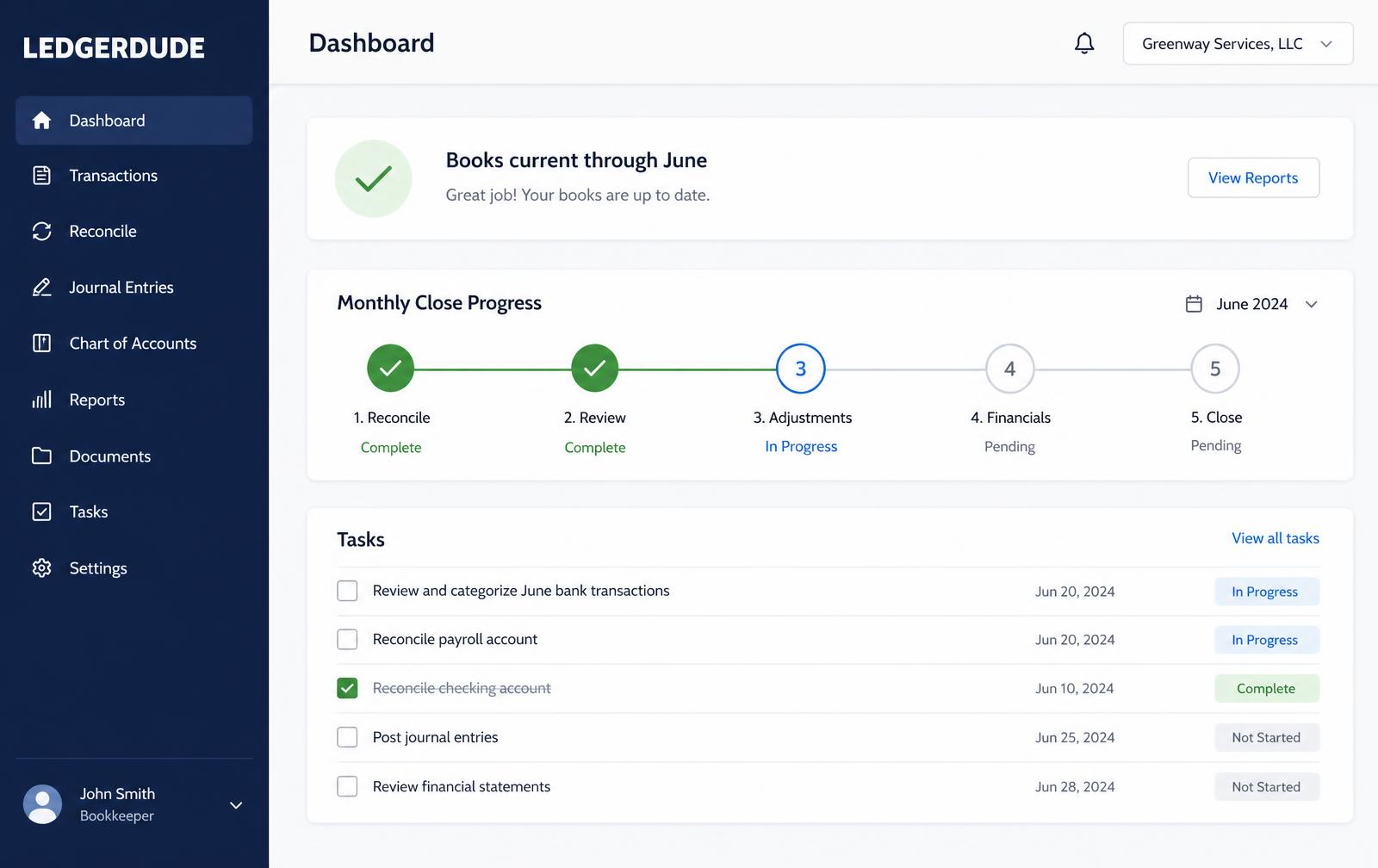
Your numbers on one page, refreshed as your books are closed each month.
Real example
Food truck group with three trucks and no inventory process
Where they started: Three trucks shared one bank account. Sales were booked from deposits, so card fees were hidden inside revenue and nobody knew which truck made money.
What we did: We set up class tracking per truck, built a daily sales entry from the POS, split processor fees back to an expense account and started monthly inventory counts.
How it ended up: Within two closes the owner could see that truck two ran an 8 point higher food cost. Retraining the prep list closed the gap.
$1,840 / mo
Hidden card fees surfaced
8 points
Food cost gap closed
6 business days
Close time
“For the first time I know which truck is actually paying for itself.”
How we set up your accounts
The accounts we build first for this kind of business, so reports read the way you think.
- Food sales, beverage sales, catering sales (separate income accounts)
- Comps and discounts as a contra-revenue account
- Cost of goods sold split food, beverage, paper
- Tips payable (liability), gift cards outstanding (liability)
- Delivery commissions and merchant fees as their own expense accounts
Questions people ask
How much does a virtual CFO cost for a restaurant?
Most single-location restaurants pay $450 to $900 a month for a virtual CFO with a daily sales entry, inventory roll and monthly close. Food trucks usually land between $250 and $450.
Should delivery app sales be recorded gross or net?
Gross. Record the full menu price as sales, then record commission, marketing and processing as expenses. Booking only the deposit understates both sales and expenses and hides how expensive the channel is.
Are tips income for the restaurant?
No. Tips collected on behalf of staff are a liability until they are paid out. They should never appear in revenue or in your sales tax base.
How often should a restaurant count inventory?
Monthly at minimum, weekly for high-value proteins and bar stock. Without both a beginning and ending count, food cost percentage is just a purchase timing number.
What does this cost?
One flat monthly price. No hourly bills, no surprises. Founding plans start at $149 a month, and your rate stays locked.
Keep reading
Virtual CFO for construction and contractors
Job costing, retainage, progress billing and work in progress, explained for contractors who need books their bonding agent and banker will accept.
Virtual CFO for ecommerce and online sellers
Marketplace payouts, inventory, cost of goods sold, sales tax nexus and ad spend, handled the way ecommerce books actually need.
Virtual CFO for real estate investors
Per-property books, mortgage payment splits, capital improvements versus repairs, security deposits and the reports a lender will accept.
All industries
Every business type we have written up.
What we do each month
Our monthly virtual CFO service, step by step.
KPI Library
The numbers that decide whether a month made money.
Want your books handled for you?
We read your receipts, match your bank activity, and close your books every month. You get one short list of questions and a dashboard that always tells the truth.