
Industry
Virtual CFO for real estate investors
Per-property books, mortgage payment splits, capital improvements versus repairs, security deposits and the reports a lender will accept.
The short answer
- Every property needs its own set of numbers. One combined profit and loss hides the property that is quietly bleeding.
- A mortgage payment is principal, interest, escrow and sometimes fees. Expensing the whole payment overstates costs and hides equity.
- Capital improvements are depreciated; repairs are expensed. Getting this wrong changes your tax bill in both directions.
- Security deposits are liabilities you are holding, not income.
Property-level books
We use classes or locations so each door carries its own income, expenses and net operating income. That makes refinancing, selling or firing a property manager a data decision instead of a feeling.
Splitting the mortgage payment
Each payment gets split from the amortization schedule: interest to expense, principal against the loan, escrow to a prepaid asset until taxes and insurance are actually paid. Done monthly it takes minutes; done yearly it takes a cleanup.
Repairs versus capital improvements
Patching a roof is a repair. Replacing the roof is an improvement that goes on the balance sheet and depreciates. We apply the safe harbor rules consistently and keep the documentation with the transaction so your CPA does not have to guess in March.
Deposits, prepaid rent and owner draws
Security deposits stay in a liability account, held separately when state law requires it. Prepaid rent is a liability until the month it covers. Owner draws are equity, not expenses — a distinction that decides whether a lender believes your cash flow.
Numbers worth watching
Each one is plain math you can check yourself.
| Number | How to figure it | Good range | Why it matters |
|---|---|---|---|
| Net operating income | Rental income − operating expenses (before debt service) | Grows year over year | It is what a buyer or lender values the property on. |
| Cap rate | Net operating income ÷ property value | Market dependent | Lets you compare a duplex with a strip center on the same scale. |
| Debt service coverage ratio | Net operating income ÷ annual debt service | 1.25× or better | Lenders require it before they refinance. |
| Operating expense ratio | Operating expenses ÷ gross rental income | 35–45% | A drifting ratio means deferred maintenance is catching up. |
Typical results we see
Operating expense ratio
41%
Small residential portfolios
Vacancy loss
6.3%
Long-term rentals, excluding short-term rental portfolios
Maintenance per door
$1,780 / yr
Higher for pre-1980 buildings
Debt service coverage
1.34×
Median across financed portfolios we close
A six-unit building, one month
- Gross scheduled rent
- $9,300
- Vacancy and concessions
- −$620
- Operating expenses
- −$3,540
- Net operating income
- $5,140
- Mortgage payment
- $3,820
- …of which interest
- $2,610
- …of which principal
- $1,210
- Cash flow after debt service
- $1,320
What this tells you: Expensing the full $3,820 payment would report $1,210 less profit each month and never show the equity being built — $14,520 over a year.
What you see inside LedgerDude
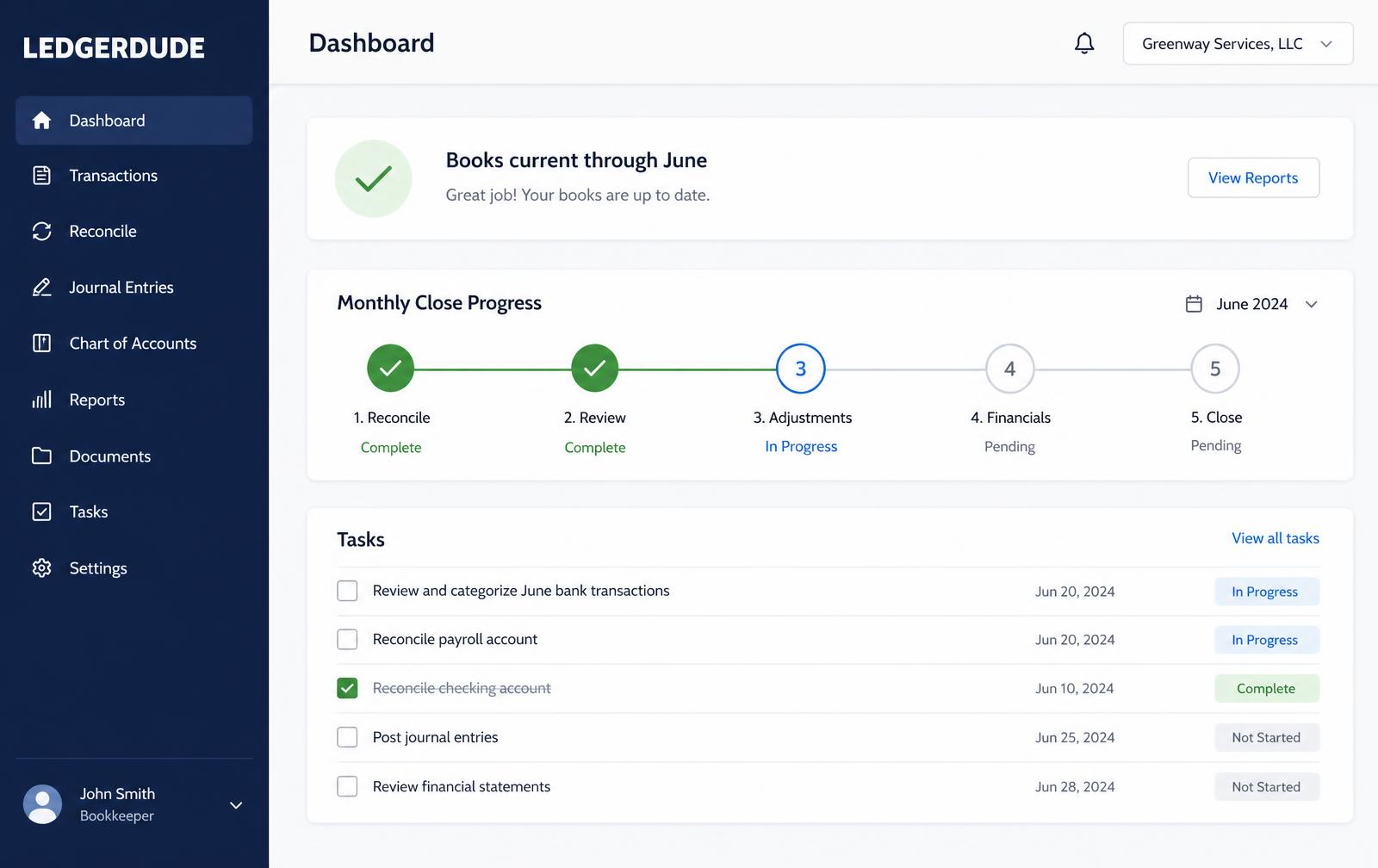
Your numbers on one page, refreshed as your books are closed each month.
Real example
Eleven doors on one profit and loss
Where they started: An investor could not tell which properties made money and a refinance stalled for lack of clean statements.
What we did: We split the books by property, rebuilt eighteen months of mortgage payments and reclassified $61,000 of improvements off the expense line.
How it ended up: Two properties were shown to be cash-flow negative and sold; the refinance closed at a better rate on real numbers.
11
Properties separated
$61,000
Improvements reclassified
Approved
Refinance
How we set up your accounts
The accounts we build first for this kind of business, so reports read the way you think.
- Rental income, late fees and other income by property class
- Repairs and maintenance separate from capital improvements
- Mortgage principal, interest and escrow as three destinations
- Security deposits held as a liability
- Owner contributions and draws in equity, never in expenses
Questions people ask
Should each rental property have its own bank account?
It helps, but it is not required if the numbers separate properties by class. What matters is that income and expenses are traceable to a single door.
Is a new roof an expense?
Usually no. A full replacement is a capital improvement that is added to the property basis and depreciated. Patching an existing roof is generally a deductible repair.
How are security deposits recorded?
As a liability. You are holding the tenant's money. It only becomes income if it is applied to unpaid rent or damages, and that should be documented.
What does this cost?
One flat monthly price. No hourly bills, no surprises. Founding plans start at $149 a month, and your rate stays locked.
Keep reading
Virtual CFO for restaurants and food trucks
How restaurant and food truck books really work: prime cost, daily sales journal entries, tip liability, third-party delivery fees and food cost swings.
Virtual CFO for construction and contractors
Job costing, retainage, progress billing and work in progress, explained for contractors who need books their bonding agent and banker will accept.
Virtual CFO for ecommerce and online sellers
Marketplace payouts, inventory, cost of goods sold, sales tax nexus and ad spend, handled the way ecommerce books actually need.
All industries
Every business type we have written up.
What we do each month
Our monthly virtual CFO service, step by step.
KPI Library
The numbers that decide whether a month made money.
Want your books handled for you?
We read your receipts, match your bank activity, and close your books every month. You get one short list of questions and a dashboard that always tells the truth.