
Industry
Virtual CFO for medical and dental practices
Insurance adjustments, patient receivables, provider productivity and payroll-heavy overhead — a virtual CFO built for practices, not retail.
The short answer
- Practice revenue is not what you billed. Contractual adjustments from insurers routinely remove 30 to 55 percent of gross charges.
- Collections, not production, pay the bills. The gap between them is the practice's single biggest cash risk.
- Overhead is payroll-dominated. Provider compensation should be separated from staff wages to read true overhead.
- Merchant, lab and supply costs belong in their own accounts to compare against per-visit revenue.
Gross charges, adjustments and net collections
The practice management system reports production; the bank reports deposits. Someone has to reconcile the two through contractual adjustments, write-offs, patient payments and insurance receipts. When that reconciliation is skipped, revenue is fiction.
Patient and insurance receivables
Aging should be split between insurance and patient balances because they behave differently. Insurance aging over 90 days is usually a claims problem; patient aging over 90 days is usually a collections policy problem.
Provider compensation and true overhead
Owner-provider pay is a distribution of profit, not overhead. Separating provider compensation from staff payroll is the only way to compare your overhead percentage with any benchmark.
Supplies, labs and equipment financing
Clinical supplies and lab fees move with visit volume, so they belong in cost of services. Equipment leases need the interest split out, and a capital lease sits on the balance sheet.
Numbers worth watching
Each one is plain math you can check yourself.
| Number | How to figure it | Good range | Why it matters |
|---|---|---|---|
| Net collection rate | Payments ÷ (charges − contractual adjustments) | 95%+ | Anything lower is money earned and never received. |
| Overhead percentage | (Total expenses − provider comp) ÷ net collections | 55–65% | The core profitability read for a practice. |
| Days in accounts receivable | (A/R ÷ average daily charges) | Under 40 days | Rising days almost always means claim denials. |
| Revenue per visit | Net collections ÷ completed visits | Trend upward | Detects payer mix drift before the year closes. |
Typical results we see
Overhead
61%
Median for the small practices we close
Net collection rate
96.2%
Below 93 usually means a denial backlog
Staff payroll
27% of collections
Excluding providers
Clinical supplies
6.8%
Dental labs run higher
A single-provider dental practice, one month
- Gross production
- $148,000
- Contractual adjustments
- −$52,000
- Net production
- $96,000
- Collections received
- $92,400 (96.3%)
- Staff payroll and taxes
- $26,900
- Lab and clinical supplies
- $12,300
- Facility, software, other
- $18,100
- Profit before provider compensation
- $35,100 (38%)
What this tells you: Overhead of 62 percent is in range. The number worth watching is the $3,600 gap between net production and collections — one quarter of that pattern is $10,800 of unclaimed revenue.
What you see inside LedgerDude
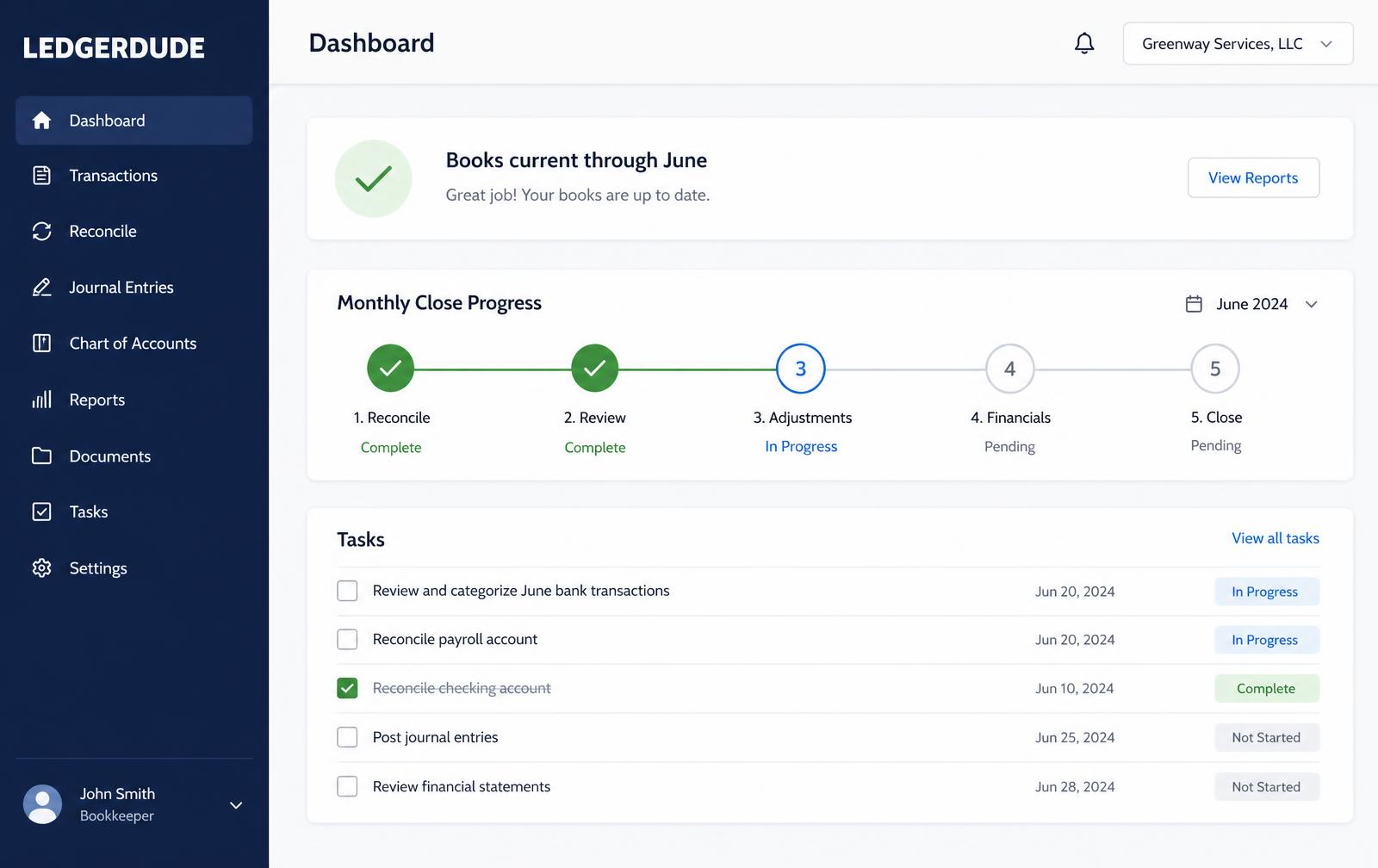
Your numbers on one page, refreshed as your books are closed each month.
Real example
Two-location practice with an unreconciled merchant account
Where they started: Deposits were categorized as revenue with no tie to the practice management system, so nobody noticed denials piling up.
What we did: We built a monthly production-to-collections reconciliation and split provider pay out of overhead.
How it ended up: A $41,000 denial backlog surfaced and was reworked, and true overhead was 9 points lower than the owner believed.
$41,000
Denials recovered
−9 points
Overhead restated
58 → 37
Days in A/R
How we set up your accounts
The accounts we build first for this kind of business, so reports read the way you think.
- Gross production with contractual adjustments as contra-revenue
- Insurance receivable separated from patient receivable
- Provider compensation separate from staff payroll
- Lab fees and clinical supplies in cost of services
- Equipment leases with interest split from principal
Questions people ask
Should a practice use cash or accrual accounting?
Many small practices report on cash basis for taxes but manage on accrual so receivables and unpaid claims are visible. Running both views is normal and worth the small extra effort.
Where do contractual adjustments go?
In a contra-revenue account beneath gross production. That keeps production visible while reporting revenue at the amount you can actually collect.
Is owner-provider pay overhead?
No. It is a distribution of practice profit and should be reported separately so overhead is comparable to industry benchmarks.
What does this cost?
One flat monthly price. No hourly bills, no surprises. Founding plans start at $149 a month, and your rate stays locked.
Keep reading
Virtual CFO for restaurants and food trucks
How restaurant and food truck books really work: prime cost, daily sales journal entries, tip liability, third-party delivery fees and food cost swings.
Virtual CFO for construction and contractors
Job costing, retainage, progress billing and work in progress, explained for contractors who need books their bonding agent and banker will accept.
Virtual CFO for ecommerce and online sellers
Marketplace payouts, inventory, cost of goods sold, sales tax nexus and ad spend, handled the way ecommerce books actually need.
All industries
Every business type we have written up.
What we do each month
Our monthly virtual CFO service, step by step.
KPI Library
The numbers that decide whether a month made money.
Want your books handled for you?
We read your receipts, match your bank activity, and close your books every month. You get one short list of questions and a dashboard that always tells the truth.