
Industry
Virtual CFO for professional service firms
Billable utilization, unbilled work in progress, retainers as a liability and per-client profit, explained for attorneys, consultants and agencies.
The short answer
- In a professional services firm, time is the product. Utilization, how much of a paid hour is billable, is usually the biggest driver of profit.
- Retainers paid in advance are a liability until the work is delivered, not income the day the check clears.
- Work in progress, hours worked but not yet invoiced, is real value the firm has earned but has not yet turned into a receivable. It needs to be tracked, not ignored.
- Realization rate, what actually gets billed and collected against standard rates, tells the truth about whether pricing and write-offs are under control.
Utilization is the number that runs the business
Billable utilization measures how much of a professional's paid time turns into billable hours. A firm can look busy on the calendar and still be unprofitable if too much time goes to non-billable administration, business development or rework.
- Track billable hours against total hours paid, by person and by role
- Separate client-facing time from internal administrative and business development time
- Track write-offs (time billed but not invoiced due to scope disputes) as their own category
- Compare utilization by service line to see which offerings are worth growing
Retainers as a liability
A retainer paid before work begins is unearned revenue. It sits as a liability on the balance sheet and moves to income as the work is actually performed. Booking it as income on receipt overstates the month it was collected and can create a sales tax or trust accounting problem, especially for attorneys with client trust obligations.
Work in progress and unbilled time
Hours worked but not yet invoiced are work in progress, real value the firm has earned. Tracking WIP monthly shows how much cash is sitting uncollected in the pipeline and flags client engagements that are falling behind on invoicing.
Realization rate and per-client profitability
Realization rate compares what actually gets billed and collected to the firm's standard billing rates. A firm can have great utilization and still lose money if discounts, write-offs and slow collections erode most of the value of the hours worked. Combined with cost per client, this shows which relationships are actually profitable.
What LedgerDude does each month
We track billable hours and utilization by person and service line, hold retainers as a liability until earned, maintain a work in progress schedule, and deliver realization rate and per-client profitability alongside the monthly close.
Numbers worth watching
Each one is plain math you can check yourself.
| Number | How to figure it | Good range | Why it matters |
|---|---|---|---|
| Billable utilization rate | Billable hours ÷ total hours paid | 65–80% depending on role and seniority | The single clearest predictor of firm profitability. |
| Realization rate | Fees actually billed and collected ÷ (hours worked × standard rate) | 85–95% | Shows whether discounting, write-offs and slow billing are quietly eating margin. |
| Work in progress (WIP) days | Unbilled work in progress ÷ average daily revenue | Under 30 days | Long WIP means cash is sitting on the shelf instead of turning into invoices. |
| Profit per client (or matter) | Client revenue − direct labor cost and expenses for that client | Positive and trending flat or up at renewal | Some clients are worth keeping at any price; others are quietly losing money. |
Typical results we see
Billable utilization
71%
Typical range across the professional service firms we support, varies by role
Realization rate
89%
Firms with clear engagement letters and fast invoicing run higher
Work in progress
24 days
Rises quickly when invoicing slips to end of month instead of as work completes
Operating profit margin
22%
Before owner or partner compensation
A 6-person consulting firm's month
- Billed and collected fees
- $118,000
- Retainer revenue recognized
- $14,500
- Total revenue
- $132,500
- Direct labor (consultants, including taxes)
- $58,200
- Gross profit
- $74,300 (56.1%)
- Overhead (rent, software, admin, marketing)
- $38,900
- Net income before partner draws
- $35,400 (26.7%)
What this tells you: Realization rate for the month was 87 percent against standard rates, mostly from write-offs on one fixed-fee engagement that ran over budget. Rebuilding the scope language in that contract template prevented the same overrun on the next renewal.
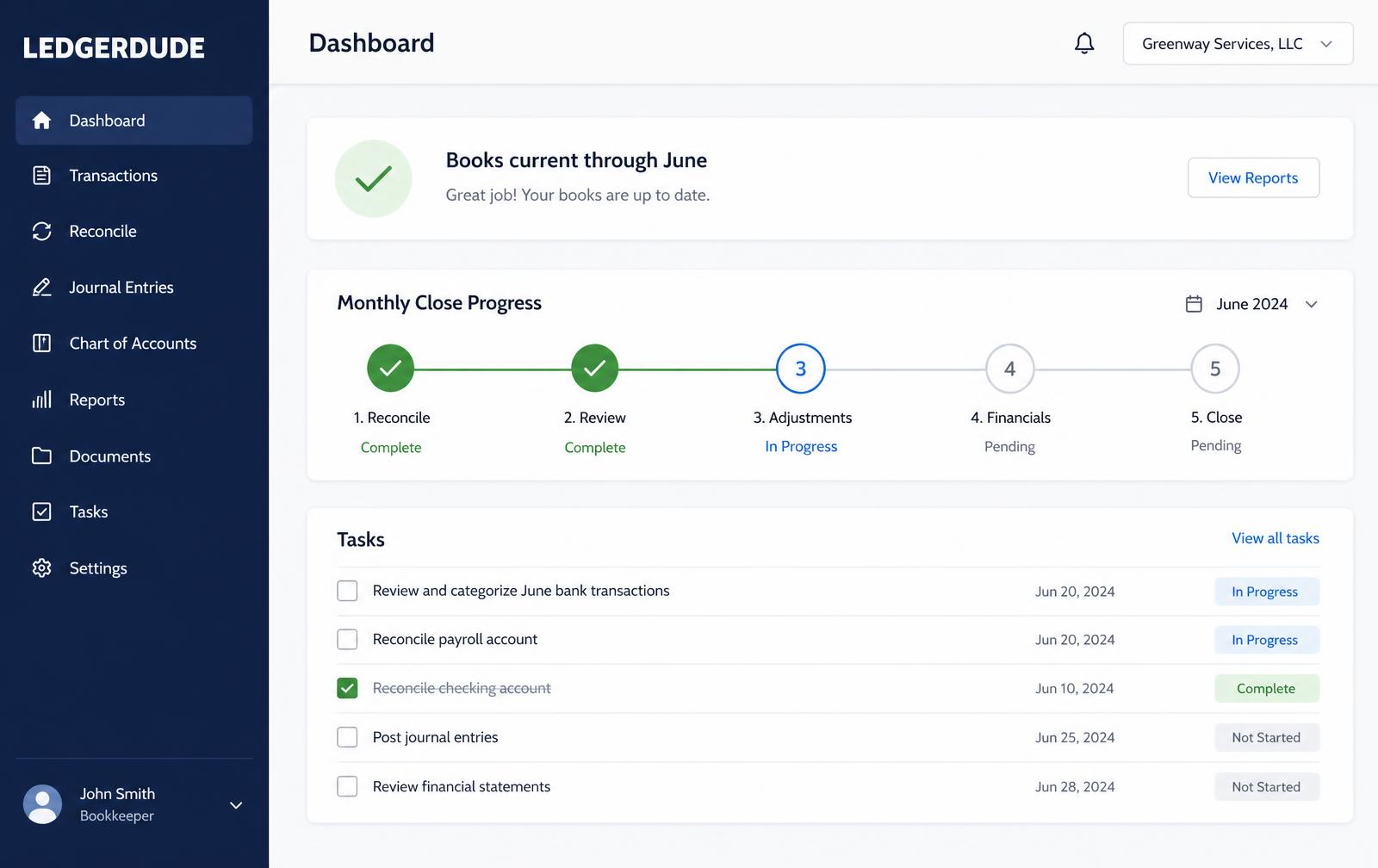
What you see inside LedgerDude
Your numbers on one page, refreshed as your books are closed each month.
Real example
Law firm treating retainers as income and losing track of unbilled time
Where they started: The firm recorded client retainers as revenue when received, which conflicted with trust accounting requirements and overstated monthly income. Hours worked often sat unbilled for six to eight weeks with no tracking.
What we did: We set up retainers as a liability released as work was performed, in line with trust accounting rules, and built a weekly work in progress report so unbilled time got invoiced within two weeks of the work.
How it ended up: Average time from work performed to invoice sent dropped from seven weeks to under two, improving cash flow without adding a single new client.
From 49 to 13 days
Work in progress days reduced
$62,000 reclassified
Retainer liability corrected
6 business days
Time to close
“We were doing the work for weeks before we ever billed for it. Fixing that alone changed our cash flow.”
How we set up your accounts
The accounts we build first for this kind of business, so reports read the way you think.
- Fee revenue by service line, separate from reimbursed client expenses
- Deferred revenue (liability) for unearned retainers
- Work in progress tracked off-balance-sheet or as a memo schedule by client
- Direct labor cost tracked by billable staff, separate from administrative payroll
- Client trust liabilities tracked separately from operating cash, where applicable
Questions people ask
How much does a virtual CFO cost for a law firm, consultancy or agency?
Most professional service firms with 3 to 10 billable staff pay $450 to $950 a month for a virtual CFO that includes utilization tracking, work in progress reporting and a monthly close. Larger firms with trust accounting needs often run $1,000 to $2,000.
Should a client retainer be recorded as revenue when it is paid?
No. A retainer paid before work is performed is a liability, unearned revenue, until the work is actually delivered. This is especially important for attorneys, where trust accounting rules generally require retainers to be held separately until earned.
What is a good billable utilization rate?
Most healthy firms run billable utilization between 65 and 80 percent, with more senior staff naturally lower due to management and business development time. Below 60 percent, non-billable time usually needs review.
What is realization rate and why does it matter?
Realization rate compares fees actually billed and collected to what the hours worked would be worth at standard rates. A firm can have excellent utilization and still struggle if discounts, scope disputes and write-offs quietly erode most of that value.
How do I know which clients are actually profitable?
Track direct labor cost and expenses against revenue for each client or engagement. Some high-revenue clients demand so much staff time that they generate less profit than smaller, more efficient engagements.
What is work in progress in a professional services firm?
Work in progress is time your team has worked but has not yet been invoiced to the client. It is real, earned value that has not converted to a receivable yet. Tracking it monthly keeps cash flow predictable and flags engagements falling behind on billing.
What does this cost?
One flat monthly price. No hourly bills, no surprises. Founding plans start at $149 a month, and your rate stays locked.
Keep reading
Virtual CFO for restaurants and food trucks
How restaurant and food truck books really work: prime cost, daily sales journal entries, tip liability, third-party delivery fees and food cost swings.
Virtual CFO for construction and contractors
Job costing, retainage, progress billing and work in progress, explained for contractors who need books their bonding agent and banker will accept.
Virtual CFO for ecommerce and online sellers
Marketplace payouts, inventory, cost of goods sold, sales tax nexus and ad spend, handled the way ecommerce books actually need.
All industries
Every business type we have written up.
What we do each month
Our monthly virtual CFO service, step by step.
KPI Library
The numbers that decide whether a month made money.
Want your books handled for you?
We read your receipts, match your bank activity, and close your books every month. You get one short list of questions and a dashboard that always tells the truth.