
Houston, Texas
Bookkeeping services for Houston small businesses
Houston bookkeeping: energy job costing, medical billing cycles, logistics fuel costs and Texas franchise tax for a diverse industrial economy.
The short answer
- Houston's small business base leans on energy services, medical practices, logistics and contractors, and each needs a distinct job or job-costing approach.
- Energy service companies bill against day rates and equipment usage, which needs job costing similar to construction, not a generic services setup.
- Medical practices carry insurance receivables that age very differently from a cash-pay business and need their own collections view.
- Texas has no personal income tax, but most Houston entities still file a franchise tax report, and Harris County property tax bills arrive in October.
- LedgerDude works remotely with Houston businesses through QuickBooks Online.
What is different about Houston books
Houston is an energy, medical and logistics town, with a heavy layer of contractors serving all three. The common thread across these industries is that revenue and cost rarely land in the same month, which makes cash-basis thinking dangerous.
- Energy service companies need job costing by well site or contract, including equipment and crew time
- Medical practices need insurance receivable aging separate from patient self-pay
- Logistics and trucking companies need fuel cost tracked against loads, not lumped into overhead
- Contractors serving industrial clients often work on 60- to 90-day payment terms that require cash flow planning
Energy services job costing
A service company billing day rates for equipment and crews needs the same discipline as a construction contractor: every cost attached to a job or well site. Without it, a busy quarter can hide jobs that lost money on fuel, downtime or equipment repair.
Medical billing cycles and receivables
Insurance reimbursement can take 30 to 90 days and often arrives at a different amount than billed. We track receivables by payer and by age so a practice can see real collections performance instead of guessing from bank deposits.
Franchise tax and Harris County property tax
Most Houston entities file a Texas franchise tax report based on total revenue from the books. Harris County property tax bills are mailed in October and commonly paid by the end of January, so accruing monthly keeps the numbers smooth.
Typical results we see
Houston energy service job margin
21%
After equipment maintenance reserve
Medical practice days in A/R
42 days
Median across payers we track
Contractor payment terms
60–90 days
Typical for industrial clients
A Houston energy service company's quarter
- Day rate revenue
- $412,000
- Crew labor and burden
- $118,000
- Fuel and equipment maintenance
- $96,500
- Equipment depreciation
- $54,000
- Job margin
- $143,500 (34.8%)
What this tells you: Fuel and maintenance were previously lumped into general overhead, which hid that one crew's equipment was running 40 percent above the fleet's average maintenance cost. Attaching costs to the job made the problem visible in a single quarter.
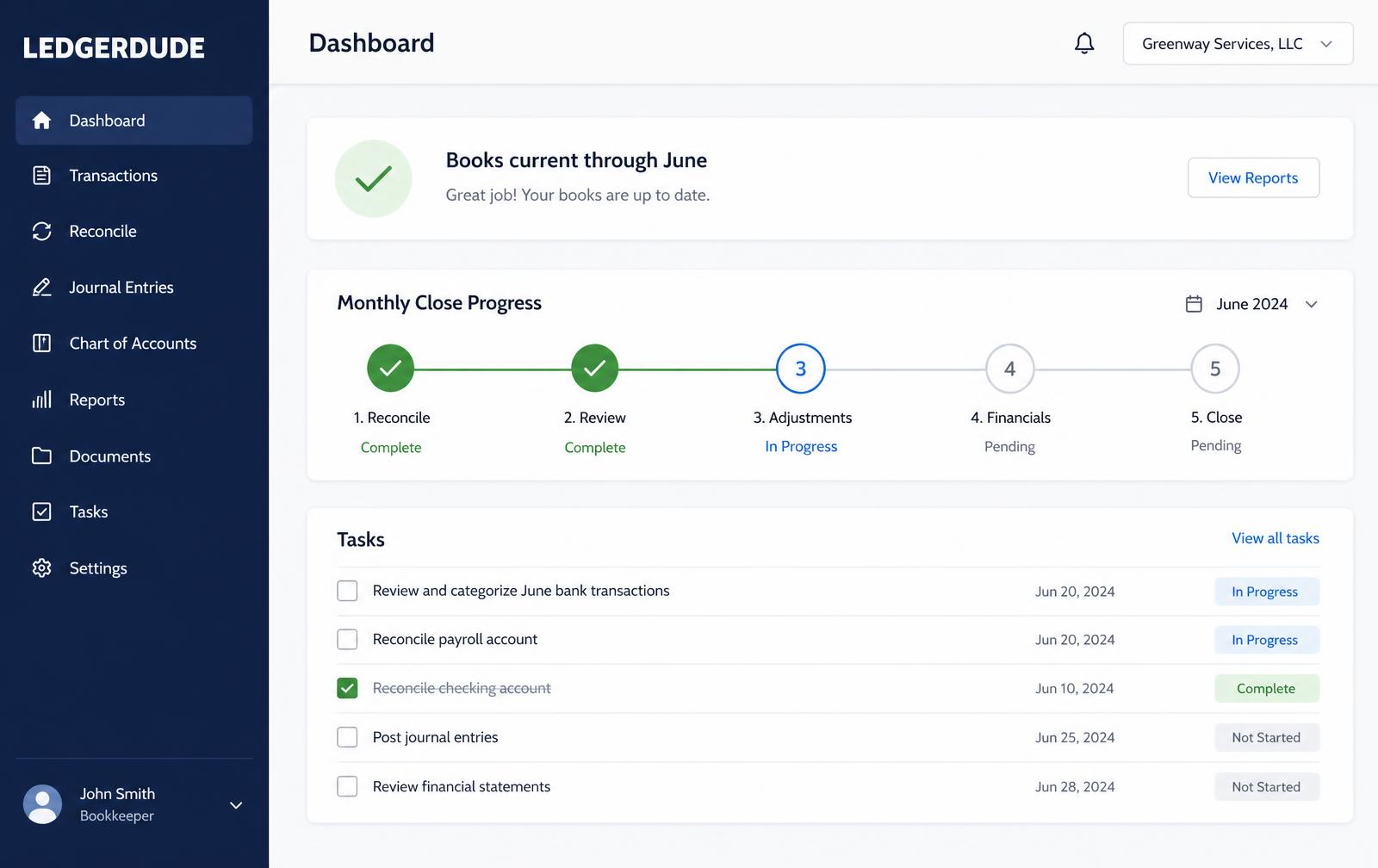
What you see inside LedgerDude
How your Houston numbers look once the books are closed each month.
Real example
Medical practice unsure why cash lagged reported revenue
Where they started: A multi-provider practice looked profitable on paper but was consistently short on cash, and nobody could explain the gap.
What we did: We built receivable aging by payer, reconciled insurance adjustments against what was billed, and separated real collections from billed charges in the monthly report.
How it ended up: One payer was found to be underpaying on a specific procedure code, and the practice corrected its fee schedule and appealed six months of claims.
6 months
Underpaid claims identified
-11 days
Days in A/R reduced
5
Payers tracked separately
What changes for Houston owners
Houston work is job-driven and capital-heavy: energy service tickets, medical billing lags and trucks that burn fuel faster than the invoices get paid.
Field tickets tied to invoices
Work performed is matched to what was billed and what was collected, so revenue is not sitting in a truck cab.
Insurance lag priced into cash
For practices, we track billed versus collected by payer so slow reimbursement shows up before payroll does.
Equipment costs where they belong
Fuel, maintenance and financed equipment are separated from overhead so you can see the true cost of a running unit.
Your next step in Texas
See the price
What bookkeeping costs in Houston
Houston operators with fleets and payroll usually need a plan with job costing and cash forecasting included.
Bookkeeping prices for Houston businessesSee the proof
Real businesses, real numbers
See how a Houston energy service company got its collections cycle back under 40 days.
Bookkeeping case studies with real numbersSee what you get
Bookkeeping done for you
See what done-for-you bookkeeping actually covers, and where you still have the final say.
Outsourced bookkeeping services in HoustonQuestions from Houston owners
Can you tie field tickets to invoices?
Yes. Work performed is matched to what was billed and collected, so you can see revenue sitting in unbilled tickets before it becomes a cash problem.
Do you track collections by payer for a Houston practice?
Yes. Billed versus collected is tracked by payer so slow reimbursement shows up in the reports before it shows up in payroll.
How is financed equipment handled?
Principal and interest are split each month and depreciation stays current, so both your Balance Sheet and your tax picture are right.
Businesses we see most in Houston
Questions people ask
Do I need a bookkeeper in Houston, TX?
Not physically local. What matters most is experience with your specific industry, whether that's energy services, medical billing cycles or logistics. Work happens remotely through QuickBooks Online.
How should an energy service company track equipment costs?
By job or well site, alongside crew labor and fuel, the same way a construction contractor tracks a job. Lumping equipment costs into general overhead hides which contracts are actually profitable.
Why does my medical practice look profitable but run short on cash?
Insurance receivables often take 30 to 90 days to collect and sometimes pay less than billed. Tracking receivables by payer and age, separate from patient self-pay, usually explains the gap.
When are Harris County property taxes due?
Bills are typically mailed in October and commonly paid by the end of January. Accruing the expense monthly keeps year-end financials from swinging on a single large payment.
What does this cost?
One flat monthly price. No hourly bills, no surprises. Founding plans start at $149 a month, and your rate stays locked.
Keep reading
Bookkeeping services for Austin small businesses
Austin-specific bookkeeping: no state income tax but a Texas franchise tax return, food trailer permits, mixed beverage tax and heavy contractor activity.
Bookkeeping services for Nashville small businesses
Nashville-specific bookkeeping: Tennessee franchise and excise tax, business license gross receipts, music industry 1099 volume and short-term rental taxes.
Bookkeeping services for Tampa small businesses
Tampa-specific bookkeeping: Florida sales tax and surtax, commercial rent tax, tangible personal property returns and hurricane-season insurance accounting.
Bookkeeping by city
Every city page we have written.
Our bookkeeping services
What we do for you every month.
Bookkeeping prices for Houston businesses
Flat monthly plans based on your revenue.
Bookkeeping case studies with real numbers
What changed for businesses like yours.
Outsourced bookkeeping services in Houston
Everything included each month, in plain language.
Want your books handled for you?
We read your receipts, match your bank activity, and close your books every month. You get one short list of questions and a dashboard that always tells the truth.