
Austin, Texas
Bookkeeping services for Austin small businesses
Austin-specific bookkeeping: no state income tax but a Texas franchise tax return, food trailer permits, mixed beverage tax and heavy contractor activity.
The short answer
- Texas has no personal income tax, but most Austin entities still file a Texas franchise tax report, and books must support the revenue figure on it.
- Austin's food trailer scene needs prime cost and permit tracking; bars owe mixed beverage gross receipts tax that must be separated from sales.
- Travis County property tax bills land in October, which makes escrow and accrual timing matter for property owners.
- LedgerDude works remotely with Austin businesses and connects directly to QuickBooks Online.
What is different about Austin books
Austin's mix is heavy on food trailers, breweries, construction and small technology consultancies. Each carries a different chart of accounts, and the most common local mistake is running a trailer or bar on a generic retail setup.
- Mixed beverage gross receipts and sales tax must be tracked separately from food sales
- Food trailer commissary rent, permits and propane belong in operating costs, not cost of goods sold
- Contractors need job costing because Austin remodel work is bid-driven
- Consultants often collect prepayments that belong in deferred revenue
Texas franchise tax and no income tax
No state income tax does not mean no filing. Most entities file a franchise tax report where total revenue comes straight from your books. If revenue accounts are inconsistent, that report is guesswork. We keep revenue clean by type so the report is supportable.
Travis County property tax timing
Bills arrive in the fall and are commonly paid in January. Businesses that own property or hold escrow should accrue property tax monthly so December does not look artificially profitable and January artificially awful.
Working with a remote bookkeeping team
We work through QuickBooks Online and your phone camera, so nothing depends on driving a shoebox across town. Onboarding is one call, and the connection is read-only until you approve anything that writes back.
Typical results we see
Austin food trailer prime cost
54%
Lower than full service because labor is thinner
Local contractor gross margin
26%
Residential remodel work
Consultant effective rate
$142 / hr
Fixed-fee projects, after real hours
An Austin food trailer month
- Net sales
- $41,800
- Food cost
- $12,700 (30.4%)
- Labor with taxes
- $9,900 (23.7%)
- Commissary rent and permits
- $1,450
- Propane, ice, packaging
- $1,980
- Net income
- $9,640 (23.1%)
What this tells you: Trailers can run much better margins than restaurants because occupancy is small — but only if commissary and permit costs stay out of food cost, where they would distort your food percentage by four points.
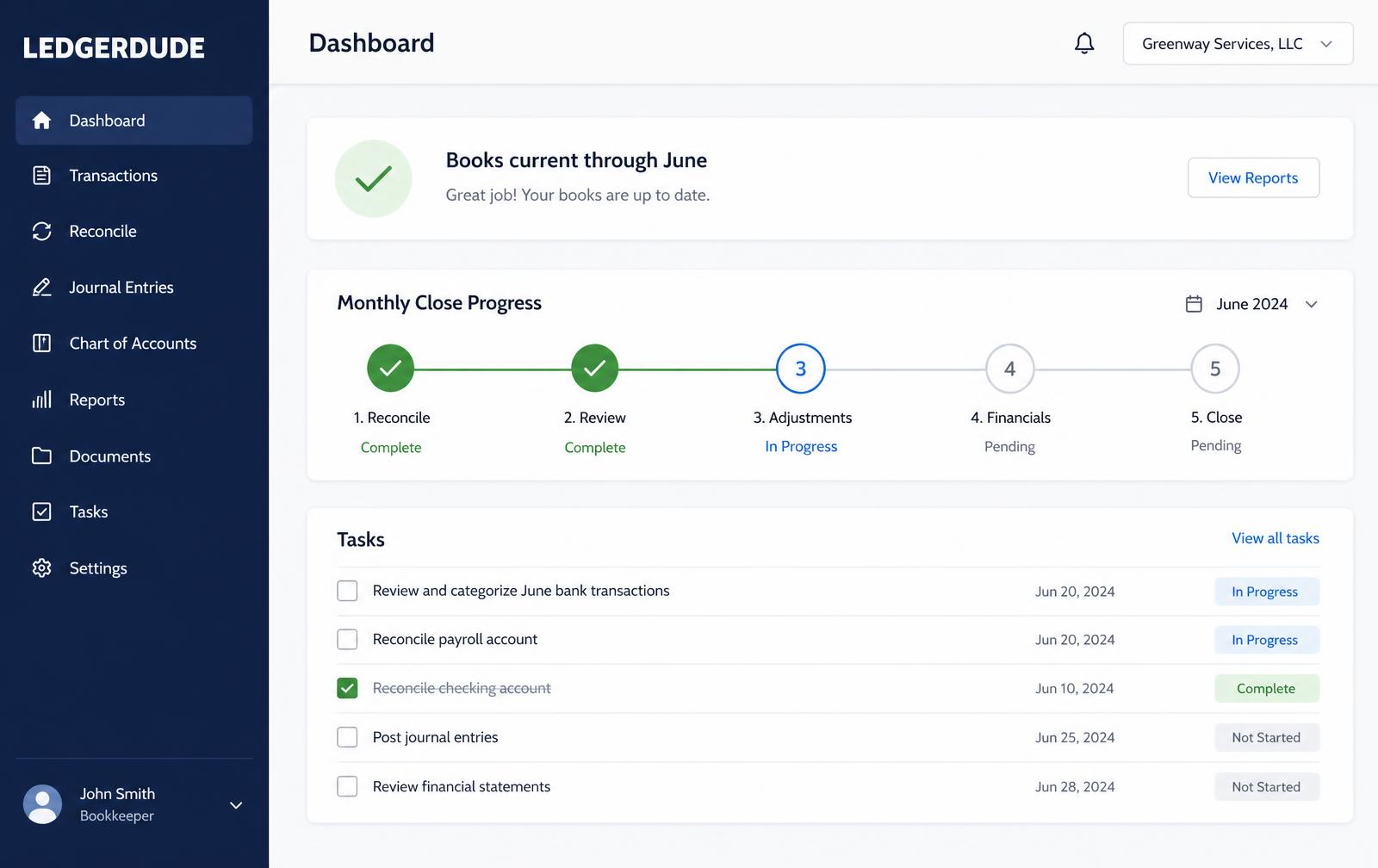
What you see inside LedgerDude
How your Austin numbers look once the books are closed each month.
Real example
Two Austin trailers and a brick-and-mortar opening
Where they started: An owner opening a permanent location could not tell whether the trailers would fund the buildout.
What we did: We split the books by location, built daily sales entries and modeled the new location's fixed costs against trailer cash flow.
How it ended up: The opening was pushed one quarter, funded from operations instead of a high-rate loan.
3
Locations separated
$14,000
Interest avoided
5 days
Close time
What changes for Austin owners
Most Austin owners we meet are running a trailer, a remodel crew or a two-person studio out of one checking account, and the books only get looked at when the franchise tax report is due.
Trailer and bar taxes stay separate
Mixed beverage gross receipts and sales tax sit in their own liability accounts, so your sales number is the real one when you price a menu.
Franchise tax revenue you can defend
Revenue is split by type all year, so the total revenue line on the Texas report comes straight out of the books instead of a spreadsheet guess.
Travis County tax spread across the year
Property tax is accrued monthly instead of landing in one January hit, so a strong December still looks like a strong December.
Your next step in Texas
See the price
What bookkeeping costs in Austin
Austin trailers and remodel crews usually land in our lower two plans, because volume is low and cleanup is small.
Bookkeeping prices for Austin businessesSee the proof
Real businesses, real numbers
Read how an Austin trailer owner funded a brick-and-mortar opening out of operations instead of a high-rate loan.
Bookkeeping case studies with real numbersSee what you get
Bookkeeping done for you
See the full monthly rhythm: bank feed sorted, receipts read from your phone, one short question list, closed books.
Outsourced bookkeeping services in AustinQuestions from Austin owners
Can you handle a food trailer and a brick-and-mortar location together?
Yes. Each location closes as its own set of books so you can see whether the trailers are funding the permanent spot or the other way around.
Who files my Texas franchise tax report?
Your CPA files it. We keep revenue split by type all year and hand over a closed set of books so the total revenue figure on the report comes out of the ledger, not a guess.
Do I have to drive receipts anywhere in Austin?
No. Your crew photographs receipts on a phone and we read them the same week. Nothing depends on meeting in person.
What owners say about work like this in Austin
These are real quotes from our case studies, in the same trades we see most around Austin.
“For the first time I know which truck is actually paying for itself.”
Businesses we see most in Austin
Questions people ask
Do I need a local bookkeeper in Austin?
Not physically. What matters is that your bookkeeper understands Texas franchise tax, local permit costs and your industry. Everything else works through QuickBooks Online and photos from your phone.
Does Texas have a state income tax on my business?
Texas has no personal income tax, but most entities file a franchise tax report based on total revenue, so your revenue accounts need to be accurate and consistent.
How is mixed beverage tax handled?
Mixed beverage gross receipts tax is tracked as its own liability and kept out of revenue, exactly like sales tax collected. Mixing them overstates sales and creates a filing problem.
What does this cost?
One flat monthly price. No hourly bills, no surprises. Founding plans start at $149 a month, and your rate stays locked.
Keep reading
Bookkeeping services for Nashville small businesses
Nashville-specific bookkeeping: Tennessee franchise and excise tax, business license gross receipts, music industry 1099 volume and short-term rental taxes.
Bookkeeping services for Tampa small businesses
Tampa-specific bookkeeping: Florida sales tax and surtax, commercial rent tax, tangible personal property returns and hurricane-season insurance accounting.
Bookkeeping services for Denver small businesses
Denver-specific bookkeeping: home-rule city sales tax, occupational privilege tax, retail delivery fee and construction-heavy job costing.
Bookkeeping by city
Every city page we have written.
Our bookkeeping services
What we do for you every month.
Bookkeeping prices for Austin businesses
Flat monthly plans based on your revenue.
Bookkeeping case studies with real numbers
What changed for businesses like yours.
Outsourced bookkeeping services in Austin
Everything included each month, in plain language.
Want your books handled for you?
We read your receipts, match your bank activity, and close your books every month. You get one short list of questions and a dashboard that always tells the truth.