
Nashville, Tennessee
Bookkeeping services for Nashville small businesses
Nashville-specific bookkeeping: Tennessee franchise and excise tax, business license gross receipts, music industry 1099 volume and short-term rental taxes.
The short answer
- Tennessee has no wage income tax but does impose franchise and excise tax on most entities, both computed from your books.
- Nashville businesses also file a business tax return based on gross receipts, so revenue classification directly changes the bill.
- Music and hospitality businesses run heavy contractor spend, which makes 1099 tracking a year-round job.
- Short-term rental operators owe occupancy tax that must be held as a liability, not counted as revenue.
What is different about Nashville books
The local economy leans on hospitality, healthcare administration, music production and short-term rentals. The recurring bookkeeping issues are contractor payments, occupancy taxes and revenue that arrives through platforms rather than invoices.
- Session players, engineers and touring crew generate large 1099 volumes
- Airbnb and Vrbo payouts arrive net of fees and occupancy tax
- Restaurants and bars need daily sales entries, not deposit matching
- Healthcare service companies carry insurance receivable aging
Franchise, excise and the gross receipts business tax
Franchise tax is computed on net worth or property, excise tax on net earnings, and the local business tax on gross receipts. Three different bases, all pulled from the same ledger, which is why a sloppy chart of accounts costs real money here.
Short-term rentals and occupancy tax
Occupancy taxes collected are a liability. Platforms sometimes remit and sometimes do not, so we track by platform and by property to keep filings clean.
1099 tracking that is not a January fire drill
We collect W-9s at the first payment and tag every contractor payment as it happens, so the 1099 run in January is a report rather than a reconstruction.
Typical results we see
Nashville short-term rental expense ratio
46%
Including cleaning and platform fees
Bar and venue prime cost
61%
Live music labor pushes it up
Production company contractor share
38% of costs
Almost all 1099
A Nashville short-term rental month, two units
- Gross booking revenue
- $11,400
- Platform fees
- −$1,140
- Occupancy taxes collected (liability)
- $1,710
- Cleaning and turnover
- −$1,860
- Supplies, utilities, internet
- −$720
- Mortgage interest portion
- −$2,240
- Cash flow after debt service
- $1,910
What this tells you: Counting the $1,710 of occupancy tax as revenue would overstate income by 15 percent and leave a filing liability nobody planned for.
What you see inside LedgerDude
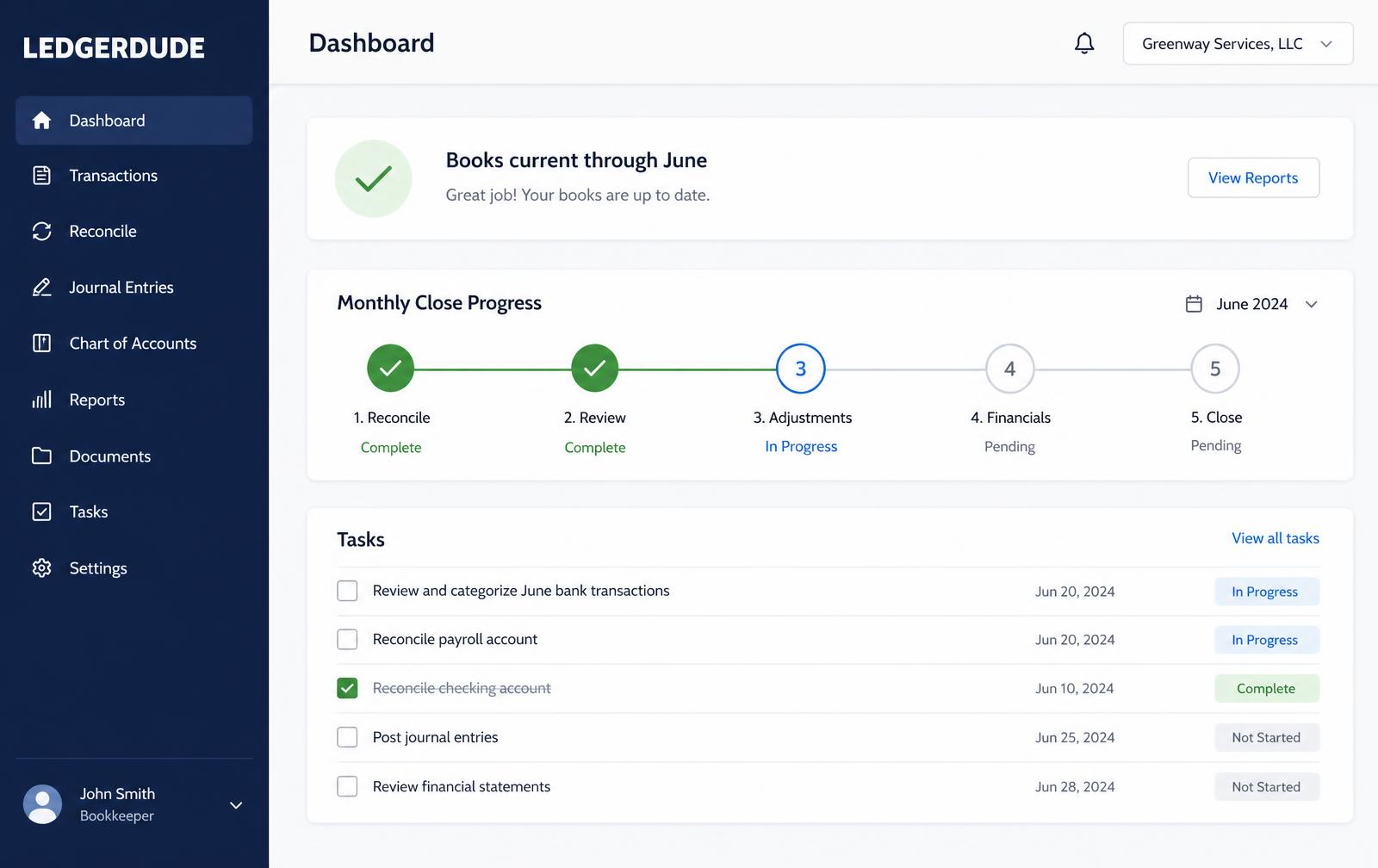
How your Nashville numbers look once the books are closed each month.
Real example
Production company with 61 contractors and no W-9s
Where they started: A studio paid session players by transfer with no tracking, facing a January with no 1099 data.
What we did: We built a contractor onboarding step, back-collected W-9s and tagged eleven months of payments.
How it ended up: All 1099s filed on time with no penalties, and contractor spend became a reportable line.
61
Contractors documented
11 months
Payments tagged
$0
Filing penalties
What changes for Nashville owners
In Nashville the same owner is often a venue, a rental and a production company at once, and Tennessee franchise and excise tax makes that mix expensive to guess at.
Each entity closed on its own
The venue, the rentals and the production work are closed separately, so you can see which one is actually paying for the others.
1099 season stops being a scramble
Player, engineer and crew payments are tracked with vendor details all year, so January is a review instead of a rebuild.
Short-term rental taxes reconciled
Occupancy and platform-collected taxes are matched to payouts every month, so the deposit in your bank ties to the return.
Your next step in Tennessee
See the price
What bookkeeping costs in Nashville
Multiple Nashville entities usually mean a mid plan, since each set of books closes separately at one flat monthly price.
Bookkeeping prices for Nashville businessesSee the proof
Real businesses, real numbers
See what changed for a Nashville owner running a venue and short-term rentals under one roof.
Bookkeeping case studies with real numbersSee what you get
Bookkeeping done for you
See how the monthly close works when your income comes from gigs, doors, rentals and royalties.
Outsourced bookkeeping services in NashvilleQuestions from Nashville owners
Can you keep my venue, rentals and production company separate?
Yes. Each entity gets its own books and its own monthly close, and we can also show a combined view so you can see the whole picture.
How do you handle Tennessee franchise and excise tax?
We keep the books your CPA needs for the return, including a clean net earnings figure and a Balance Sheet that supports the property measure.
What about 1099s for players, engineers and crew?
We track vendor details and payments all year, so January is a short review instead of chasing addresses and totals.
What owners say about work like this in Nashville
These are real quotes from our case studies, in the same trades we see most around Nashville.
“For the first time I know which truck is actually paying for itself.”
Businesses we see most in Nashville
Questions people ask
Does Tennessee tax my business income?
There is no wage income tax, but most entities pay franchise and excise tax, and Nashville businesses also file a gross receipts business tax return. All three are computed from your books.
Do platforms handle my occupancy tax?
Sometimes. It varies by platform and by tax type, so we track collected occupancy tax as a liability per platform and reconcile what was remitted for you.
When should I collect a contractor's W-9?
Before the first payment. Collecting later is how businesses end up filing late 1099s or paying penalties.
What does this cost?
One flat monthly price. No hourly bills, no surprises. Founding plans start at $149 a month, and your rate stays locked.
Keep reading
Bookkeeping services for Austin small businesses
Austin-specific bookkeeping: no state income tax but a Texas franchise tax return, food trailer permits, mixed beverage tax and heavy contractor activity.
Bookkeeping services for Tampa small businesses
Tampa-specific bookkeeping: Florida sales tax and surtax, commercial rent tax, tangible personal property returns and hurricane-season insurance accounting.
Bookkeeping services for Denver small businesses
Denver-specific bookkeeping: home-rule city sales tax, occupational privilege tax, retail delivery fee and construction-heavy job costing.
Bookkeeping by city
Every city page we have written.
Our bookkeeping services
What we do for you every month.
Bookkeeping prices for Nashville businesses
Flat monthly plans based on your revenue.
Bookkeeping case studies with real numbers
What changed for businesses like yours.
Outsourced bookkeeping services in Nashville
Everything included each month, in plain language.
Want your books handled for you?
We read your receipts, match your bank activity, and close your books every month. You get one short list of questions and a dashboard that always tells the truth.