
Denver, Colorado
Bookkeeping services for Denver small businesses
Denver-specific bookkeeping: home-rule city sales tax, occupational privilege tax, retail delivery fee and construction-heavy job costing.
The short answer
- Colorado is a home-rule state, so Denver administers its own sales tax separately from the state — two filings, two rule sets.
- Denver levies an occupational privilege tax per employee that many new businesses miss entirely.
- Colorado's retail delivery fee applies per delivery order and must be tracked as its own liability.
- Construction and outdoor-product businesses dominate, so job costing and inventory discipline matter most.
What is different about Denver books
Denver's local tax administration is the single biggest bookkeeping difference. A business can be perfectly compliant with the state and still be delinquent with the city, because the city collects its own sales tax and requires its own license.
- Denver sales tax is filed with the city, not only the state
- Occupational privilege tax is owed per employee each month or quarter
- Retail delivery fee applies per order with deliveries into Colorado
- Multiple special districts change the effective rate by address
Home-rule sales tax in practice
We track taxable sales by jurisdiction so state and city returns can both be supported from the same ledger. Where sales cross into surrounding districts, rate differences are recorded at the transaction level rather than estimated later.
Occupational privilege tax
The tax has an employee portion and a business portion. It is small per head and expensive in penalties when skipped for a year, so it belongs in the monthly close checklist, not in someone's memory.
Construction, outdoor brands and inventory
Denver's mix of contractors and outdoor product companies means job costing on one side and landed-cost inventory on the other. Both fail the same way: costs recorded without the job or the SKU attached.
Typical results we see
Denver contractor gross margin
23.9%
Higher labor cost than southern markets
Outdoor brand gross margin
44%
Direct-to-consumer channels
Effective combined sales tax
8.81%
Varies by special district
A Denver outdoor brand month with mixed channels
- Website sales
- $74,600
- Marketplace sales
- $52,300
- Sales tax collected (liability)
- $6,570
- Retail delivery fees collected
- $412
- Cost of goods sold at landed cost
- −$71,100
- Ads and fulfillment
- −$28,400
- Contribution margin
- $27,400 (21.6%)
What this tells you: The $6,570 of sales tax and $412 of delivery fees are not revenue. Businesses that book them as income overstate profit and then have nothing set aside when the filings come due.
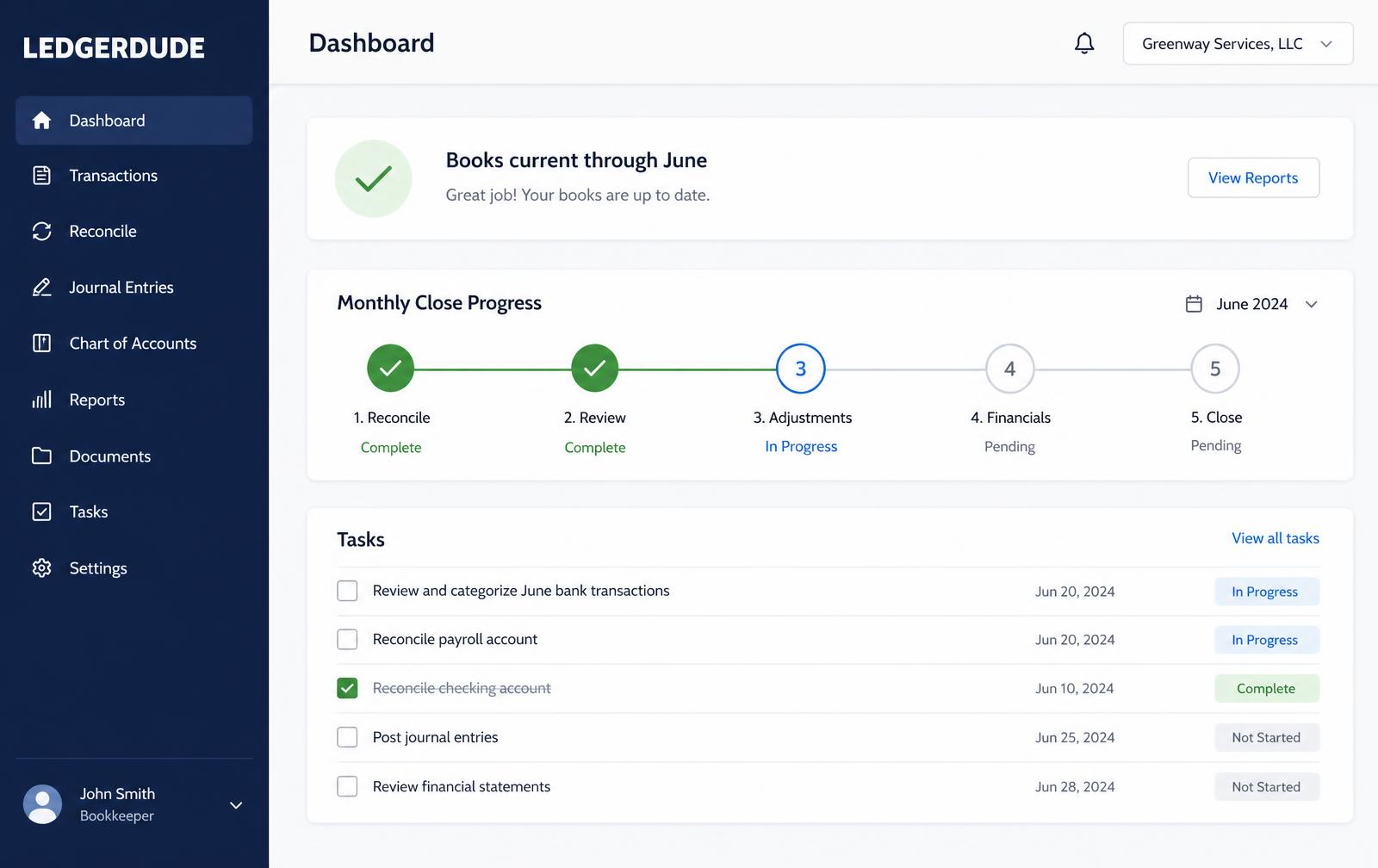
What you see inside LedgerDude
How your Denver numbers look once the books are closed each month.
Real example
Denver contractor delinquent with the city, current with the state
Where they started: The owner had filed state sales tax for two years and had never registered with the city.
What we did: We rebuilt taxable sales by jurisdiction, quantified the city exposure and set up monthly city filings inside the close checklist.
How it ended up: Exposure was resolved with a voluntary filing and the monthly close now proves both filings each period.
24
Months reconstructed
Material
Penalties avoided
2 jurisdictions
Filings automated into close
What changes for Denver owners
Denver is a home-rule city, so sales tax, occupational privilege tax and the retail delivery fee all have to be handled separately from the state — and most software setups do not.
Home-rule city tax kept apart from state
Denver city tax is tracked on its own so the city filing and the state filing both tie back to the books.
Occupational privilege tax on schedule
The head tax is accrued with payroll every month, so it never shows up as a surprise notice.
Job costing your crews can use
Labor, materials and equipment land on the job, so you see margin per project before the next bid goes out.
Your next step in Colorado
See the price
What bookkeeping costs in Denver
Denver contractors with job costing usually need the plan that includes job-level reporting and budgets.
Bookkeeping prices for Denver businessesSee the proof
Real businesses, real numbers
See how a Denver contractor found the two job types that were quietly losing money on every bid.
Bookkeeping case studies with real numbersSee what you get
Bookkeeping done for you
See the whole service in one page — what we do weekly, what we do at close, and what you approve.
Outsourced bookkeeping services in DenverQuestions from Denver owners
Do you handle Denver home-rule city sales tax?
Yes. Denver city tax is tracked separately from Colorado state tax, so the city filing and the state filing both tie back to your books.
What about the occupational privilege tax?
The head tax is accrued alongside payroll each month, so it is already in the numbers instead of arriving as a notice.
Can you cost jobs for a Denver construction crew?
Yes. Labor, materials and equipment are coded to the job, so you get margin per project before the next bid goes out.
Businesses we see most in Denver
Questions people ask
Why do I file sales tax twice in Denver?
Denver is a home-rule city, so it administers and collects its own sales tax in addition to the state. Filing with the state alone leaves you delinquent with the city.
What is the occupational privilege tax?
A per-employee Denver tax with both an employee-paid and business-paid portion. It is easy to miss and best handled as a recurring item in the monthly close.
Does the retail delivery fee apply to me?
If you deliver taxable goods by motor vehicle to a Colorado address, generally yes. It is charged per order and tracked as a liability until it is remitted.
What does this cost?
One flat monthly price. No hourly bills, no surprises. Founding plans start at $149 a month, and your rate stays locked.
Keep reading
Bookkeeping services for Austin small businesses
Austin-specific bookkeeping: no state income tax but a Texas franchise tax return, food trailer permits, mixed beverage tax and heavy contractor activity.
Bookkeeping services for Nashville small businesses
Nashville-specific bookkeeping: Tennessee franchise and excise tax, business license gross receipts, music industry 1099 volume and short-term rental taxes.
Bookkeeping services for Tampa small businesses
Tampa-specific bookkeeping: Florida sales tax and surtax, commercial rent tax, tangible personal property returns and hurricane-season insurance accounting.
Bookkeeping by city
Every city page we have written.
Our bookkeeping services
What we do for you every month.
Bookkeeping prices for Denver businesses
Flat monthly plans based on your revenue.
Bookkeeping case studies with real numbers
What changed for businesses like yours.
Outsourced bookkeeping services in Denver
Everything included each month, in plain language.
Want your books handled for you?
We read your receipts, match your bank activity, and close your books every month. You get one short list of questions and a dashboard that always tells the truth.