
Dallas, Texas
Bookkeeping services for Dallas small businesses
Dallas bookkeeping: Texas franchise tax, professional services and wholesale distribution accounting, and books built for a relocation-heavy market.
The short answer
- Texas has no personal income tax, but most Dallas entities still file a Texas franchise tax report built directly from total revenue in the books.
- Dallas runs on professional services and wholesale distribution, and each needs its own approach: WIP and utilization for services, landed cost and inventory turns for distributors.
- Corporate relocations bring a wave of new consultancies and regional offices each year, and many start with QuickBooks set up for the wrong kind of business.
- Dallas County property tax bills go out in October, so accruing monthly avoids a lumpy December and January.
- LedgerDude works remotely with Dallas businesses through QuickBooks Online with a read-only connection until you approve changes.
What is different about Dallas books
Dallas is a headquarters and distribution town. Professional services firms, wholesale distributors and relocated regional offices make up a large share of the small business base, and each of those needs a different chart of accounts than a typical retail or restaurant setup.
- Consulting and professional services firms need utilization and project profitability, not just total revenue
- Wholesale distributors need landed cost, inventory turns and freight tracked separately from product cost
- Relocated businesses often arrive with a books setup from another state that does not fit Texas franchise tax reporting
- Commission-heavy sales teams need commission accrued in the month the sale happened, not when it is paid
Texas franchise tax without a state income tax
No personal income tax does not mean no filing. Most Dallas entities file a franchise tax report where the revenue figure comes straight from your books. Distributors also need to separate cost of goods sold correctly, since the franchise tax cost of goods deduction has specific rules about what qualifies.
Distribution and inventory discipline
Wholesale margins are thin, so small errors in landed cost — freight in, duty, handling — move the needle. We track inventory by SKU or product line and roll purchases into cost of goods sold as product ships, so gross margin reflects what actually happened rather than what was ordered.
Dallas County property tax timing
Bills land in the fall and are commonly paid in January. Businesses that own their building or carry a triple-net lease should accrue property tax monthly so year-end numbers are not distorted by a single large payment.
Typical results we see
Dallas consulting firm utilization
68%
Billable hours against total available hours
Regional distributor gross margin
22%
Typical for B2B wholesale, before freight recovery
Inventory turns
6.2×
Median for the distributors we support
A Dallas distributor's month, landed cost corrected
- Net sales
- $186,000
- Product cost as invoiced
- $121,000
- Freight in and handling (previously expensed)
- $14,300
- Corrected cost of goods sold
- $135,300 (72.7%)
- Gross margin, corrected
- $50,700 (27.3%)
What this tells you: Freight in was sitting in a general operating expense account instead of cost of goods sold, which made every product line look about six points more profitable than it was. Moving it fixed pricing decisions on the lowest-margin SKUs.
What you see inside LedgerDude
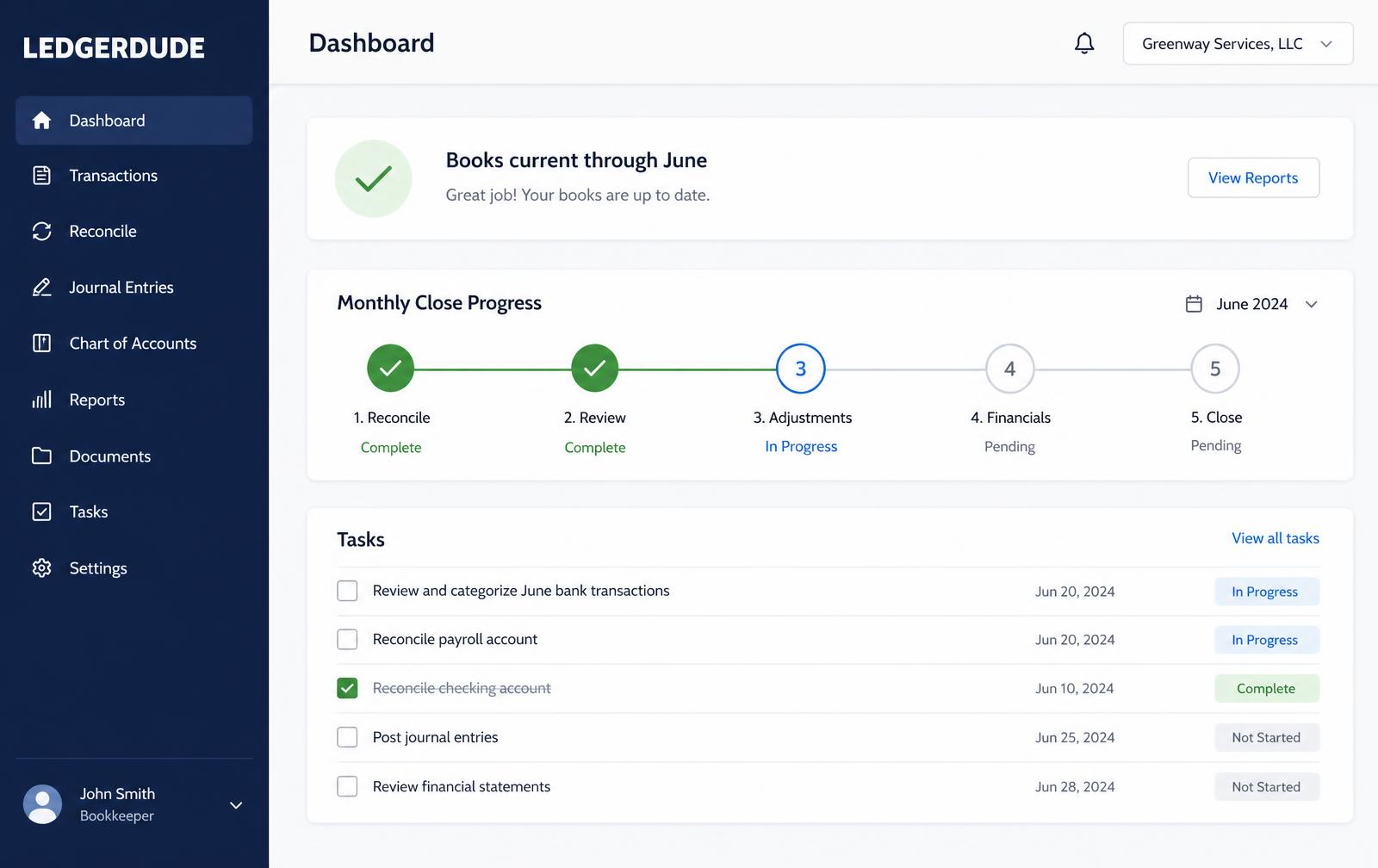
How your Dallas numbers look once the books are closed each month.
Real example
Relocated consulting firm with no project-level view
Where they started: A firm that relocated its regional office to Dallas had QuickBooks set up as a single income account with no way to see which clients or project types were profitable.
What we did: We rebuilt the chart of accounts around projects, tagged prior months by client, and set up a monthly utilization and project margin report alongside the franchise tax revenue reconciliation.
How it ended up: Two client engagements were identified as running below break-even after overhead, and pricing was corrected on the next round of proposals.
2
Client engagements re-scoped
+9 points
Margin improvement on repriced work
7
Months reclassified
What changes for Dallas owners
Dallas books usually break in one of two places: professional services firms tracking unbilled work, and distributors with inventory nobody has counted in a year.
Prepayments land in deferred revenue
Retainers and deposits are held as a liability until the work happens, so a big deposit month does not fake a profit.
Inventory and cost of goods reconciled
Purchases, freight and adjustments are matched to what you actually sold, which makes gross margin trustworthy.
One flat close date every month
Books close on a schedule, so partner meetings and lender requests use the same numbers you do.
Your next step in Texas
See the price
What bookkeeping costs in Dallas
Dallas firms with several bank and card accounts sit comfortably in the middle of the plan ladder.
Bookkeeping prices for Dallas businessesSee the proof
Real businesses, real numbers
Read what happened when a Dallas services firm stopped counting deposits as revenue.
Bookkeeping case studies with real numbersSee what you get
Bookkeeping done for you
See the bookkeeping service end to end, including the reports we hand your CPA at year end.
Outsourced bookkeeping services in DallasQuestions from Dallas owners
How do you handle retainers from Dallas clients?
Retainers and deposits sit in deferred revenue until the work happens, so a big deposit month does not look like a profitable month.
Can you clean up inventory that has not been counted in a year?
Yes. Catch-up work reconciles purchases, freight and adjustments to what you actually sold so gross margin becomes trustworthy.
Will my books be ready for a lender or a partner meeting?
Yes. We close on a schedule each month, so the numbers you present are the same ones we work from.
Businesses we see most in Dallas
Questions people ask
Do I need a bookkeeper in Dallas, TX?
Not one sitting in your office. What matters is a bookkeeper who understands Texas franchise tax and your industry, whether that's professional services or distribution. Everything runs through QuickBooks Online remotely.
How does Texas franchise tax affect a distribution business?
Distributors can generally deduct cost of goods sold when computing the franchise tax margin, but only costs that qualify under the state's rules. Keeping cost of goods sold clean and correctly classified matters more here than for a typical service business.
What is the biggest bookkeeping mistake for Dallas consulting firms?
Tracking revenue as one lump sum instead of by client and project. Without that split, a firm cannot tell which engagements are profitable, which is the single most common reason profitable-looking firms run out of cash.
When are Dallas County property taxes due?
Bills are typically mailed in October and are commonly paid by the end of January. Accruing the expense monthly avoids a distorted December and January on your financial statements.
What does this cost?
One flat monthly price. No hourly bills, no surprises. Founding plans start at $149 a month, and your rate stays locked.
Keep reading
Bookkeeping services for Austin small businesses
Austin-specific bookkeeping: no state income tax but a Texas franchise tax return, food trailer permits, mixed beverage tax and heavy contractor activity.
Bookkeeping services for Nashville small businesses
Nashville-specific bookkeeping: Tennessee franchise and excise tax, business license gross receipts, music industry 1099 volume and short-term rental taxes.
Bookkeeping services for Tampa small businesses
Tampa-specific bookkeeping: Florida sales tax and surtax, commercial rent tax, tangible personal property returns and hurricane-season insurance accounting.
Bookkeeping by city
Every city page we have written.
Our bookkeeping services
What we do for you every month.
Bookkeeping prices for Dallas businesses
Flat monthly plans based on your revenue.
Bookkeeping case studies with real numbers
What changed for businesses like yours.
Outsourced bookkeeping services in Dallas
Everything included each month, in plain language.
Want your books handled for you?
We read your receipts, match your bank activity, and close your books every month. You get one short list of questions and a dashboard that always tells the truth.