
Service
An electrician CFO who makes sure the bid covered the truck, not just the wire
Finance help for electrical contractors: loaded labor rates, margin by service line, bidding that recovers overhead, and cash planning around slow payers.
The short answer
- An electrician CFO handles loaded labor rates, bidding math, margin by service line, cash forecasting and financing decisions part time.
- Healthy electrical contractors usually run 35 to 45 percent gross margin on service and 8 to 12 percent net profit.
- Service work almost always out-earns new construction per hour; most shops under-price service.
- LedgerDude does the bookkeeping every day and starts at $149 a month for the first 25 customers.
Why electrical work hides its profit
One truck can run a $180 service call and a six-week commercial rough-in in the same month. Blended together, the numbers say the company is fine while one line quietly loses money.
- Service and new construction have completely different cost structures
- General contractors pay slowly and hold retainage
- Material cost swings between bid and buy on longer jobs
- Unbilled change orders are the most common leak in the trade
Loaded labor before anything else
A $32 an hour electrician usually costs $52 to $60 once payroll taxes, benefits, the van, tools, insurance and unbillable hours are counted. Bidding on the wage is the fastest way to win work that loses money.
Bidding that recovers overhead
We build the bid from loaded labor hours, material at real cost, an overhead recovery rate from your own books, then divide by one minus your target margin. Not a markup added on top.
Cash around slow payers
Your forecast uses how your customers actually pay — not their terms — including retainage, so you know before you sign whether a big job fits your cash.
Grow the line that pays
Before you add a van or a licensed electrician, we show what has to be true: calls per day, billable hour percentage, average ticket and the cash the ramp-up will eat.
Numbers worth watching
Each one is plain math you can check yourself.
| Number | How to figure it | Good range | Why it matters |
|---|---|---|---|
| Service gross margin | (Service revenue − loaded labor − material) ÷ service revenue | 35% – 45% | Service carries your overhead; thin margin here means the rate is too low. |
| New construction gross margin | (Project revenue − loaded labor − material − subs) ÷ project revenue | 18% – 28% | Longer jobs absorb material swings, so they need checking every month, not at the end. |
| Billable hour percentage | Billable hours ÷ paid hours | 65% – 75% | Every unbillable hour has to be recovered in the rate or it comes out of profit. |
| Change orders billed | Change orders invoiced ÷ change orders performed | 100% | Unbilled extras are the most common source of lost electrical profit. |
| Days to get paid | Average days from invoice to cash | Under 45 days | Growth funded by slow receivables is what causes a profitable shop to run out of cash. |
Illustration: where a $1.8M electrical company's profit comes from
- Service and repair
- $620,000 at 41% gross margin
- Residential new construction
- $740,000 at 22% gross margin
- Small commercial
- $440,000 at 24% gross margin
- Overhead
- $450,000
- Net profit
- $153,000 (about 8.5%)
What this tells you: Example numbers, not a client's books. Service is one third of revenue and nearly half of the gross profit — that is the line worth growing.
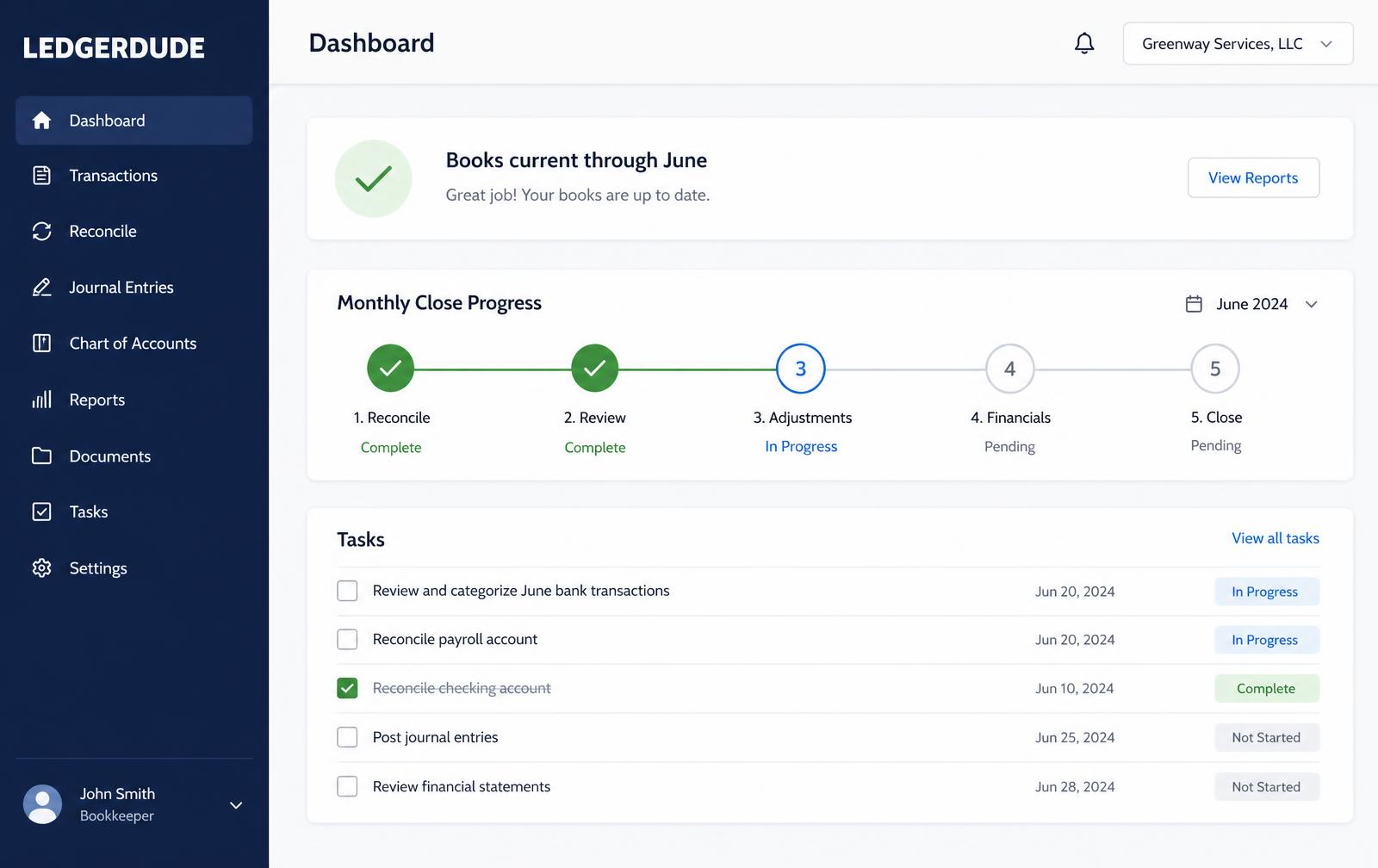
What you see inside LedgerDude
What you see when the work is done: one page with your money on it.
How to get your electrical numbers under control
- 1
Connect QuickBooks
We read the books you already keep — no software switch.
- 2
Split your revenue
Separate service, residential new construction and commercial.
- 3
Load your labor rate
Wages plus taxes, benefits, van, tools, insurance and unbillable time.
- 4
Set overhead recovery
Calculate it from your own last twelve months and put it in every bid.
- 5
Close the change order gap
Track extras performed against extras invoiced every week.
- 6
Review monthly
One short meeting, one page, one to three decisions.
What is included
- Loaded labor cost per electrician and helper
- Margin by job, service line and customer type
- Bid review so every estimate recovers overhead and profit
- Thirteen-week cash forecast built on real payment terms
- Service versus new construction profit, side by side
- Numbers ready for bonding, financing or a line of credit
Founding plans: $149, $249, $499 or $899 a month. Bookkeeping is included in every plan.
Related answers
Straight answers to the other questions electrical owners ask us.
What should an electrician charge per hour?
Most electrical contractors need $95 to $175 an hour. Take loaded labor cost per billable hour, add overhead recovery per hour, then divide by one minus your target margin.
How do you bid electrical jobs?
Count material, estimate labor hours at your loaded labor cost, add overhead recovery, then divide the total by one minus your target margin.
What markup should an electrical contractor use?
For a 40 percent margin you need a 67 percent markup on cost. Pick the margin first, then convert: markup = margin ÷ (1 − margin).
What is a good profit margin for an electrical contractor?
Electrical service work should run 45 to 55 percent gross margin, project and new construction work 22 to 32 percent, with 8 to 12 percent net profit.
What is labor burden rate and how do you calculate it?
Labor burden is everything an employee costs beyond wages — taxes, insurance, benefits, vehicle and tools — and it usually adds 25 to 60 percent on top of the hourly wage.
How do contractors manage cash flow?
Forecast cash weekly for thirteen weeks, invoice the day work is complete, collect deposits on material-heavy jobs, and keep a cash floor equal to six to eight weeks of outflow.
Run a different trade?
Questions people ask
What does an electrician CFO do that my bookkeeper does not?
A bookkeeper records the past. An electrician CFO checks that your loaded labor rate and overhead recovery hold up, shows whether service or construction is carrying the company, and forecasts cash around slow-paying customers.
How do I know if my hourly rate is high enough?
Take loaded cost per billable hour, add overhead recovery per hour, then divide by one minus your target margin. If your current rate is below that number, you are working for less than you think.
Can you help me bid electrical jobs?
We do not estimate the work itself. We give you the cost and margin math behind the bid — loaded labor, overhead recovery and the margin divisor — and review bids against actual results.
What if I run other trades too?
Common. HVAC, plumbing and roofing lines get tracked separately so a strong trade does not hide a weak one.
What does this cost?
One flat monthly price. No hourly bills, no surprises. Founding plans start at $149 a month, and your rate stays locked.
Keep reading
Home services hub
How we set the books up for your trade.
Electrician hourly rate calculator
Free calculator. Nothing to sign up for.
Electrical bid estimator
Free calculator. Nothing to sign up for.
A roofing CFO who checks the job made money before the crew leaves town
Finance help for roofing companies: margin by job and crew, real overhead and profit recovery, commission tied to margin, and cash that survives a slow winter.
A fractional CFO for contractors who need the job numbers to make sense
Finance help built for trade contractors: gross margin by job and crew, loaded labor cost, a 13-week cash forecast, and pricing that covers overhead and profit.
An HVAC CFO who knows what a busy July costs you in January
Finance help built for heating and air companies: gross margin by job, truck and tech, seasonal cash planning, and pricing that covers labor, parts and overhead.
All services
Everything we can take off your plate.
Pricing
Flat monthly plans based on your revenue.
Industries
How we set the books up for your kind of business.
Want your books handled for you?
We read your receipts, match your bank activity, and close your books every month. You get one short list of questions and a dashboard that always tells the truth.