
Quick Answer
How do contractors manage cash flow?
A practical cash flow method for trade contractors: the thirteen-week forecast, deposit and invoicing discipline, a cash floor, and why profit and cash separate.
The short answer
- Profit and cash are different; contractors go under while profitable because of timing.
- A rolling thirteen-week cash forecast is the standard tool and takes about an hour a week.
- Deposits on material-heavy jobs prevent funding the customer's materials from your account.
- Hold a cash floor of six to eight weeks of operating outflow before spending surplus.
Why profit and cash separate
Materials are paid before the job invoices, payroll runs every two weeks regardless, and receivables collect in thirty to sixty days. A growing contractor funds all of that out of pocket, which is why the busiest quarter often feels the tightest.
The thirteen-week forecast
One sheet, updated weekly, with four rows.
- Expected collections by week, based on actual invoices and terms
- Payroll and payroll taxes by week
- Material and subcontractor payments by week
- Fixed costs, loan and equipment payments
Deposits and invoicing discipline
Collect a deposit that covers material on any job where material is a large share. Invoice the day the work is complete, not at month end; a week of delay in invoicing is a week of delay in cash, every single time.
Set a cash floor and defend it
Decide the balance you will not go below, usually six to eight weeks of outflow. Equipment purchases, owner draws and expansion decisions get measured against that floor rather than against the current balance.
What you see inside LedgerDude
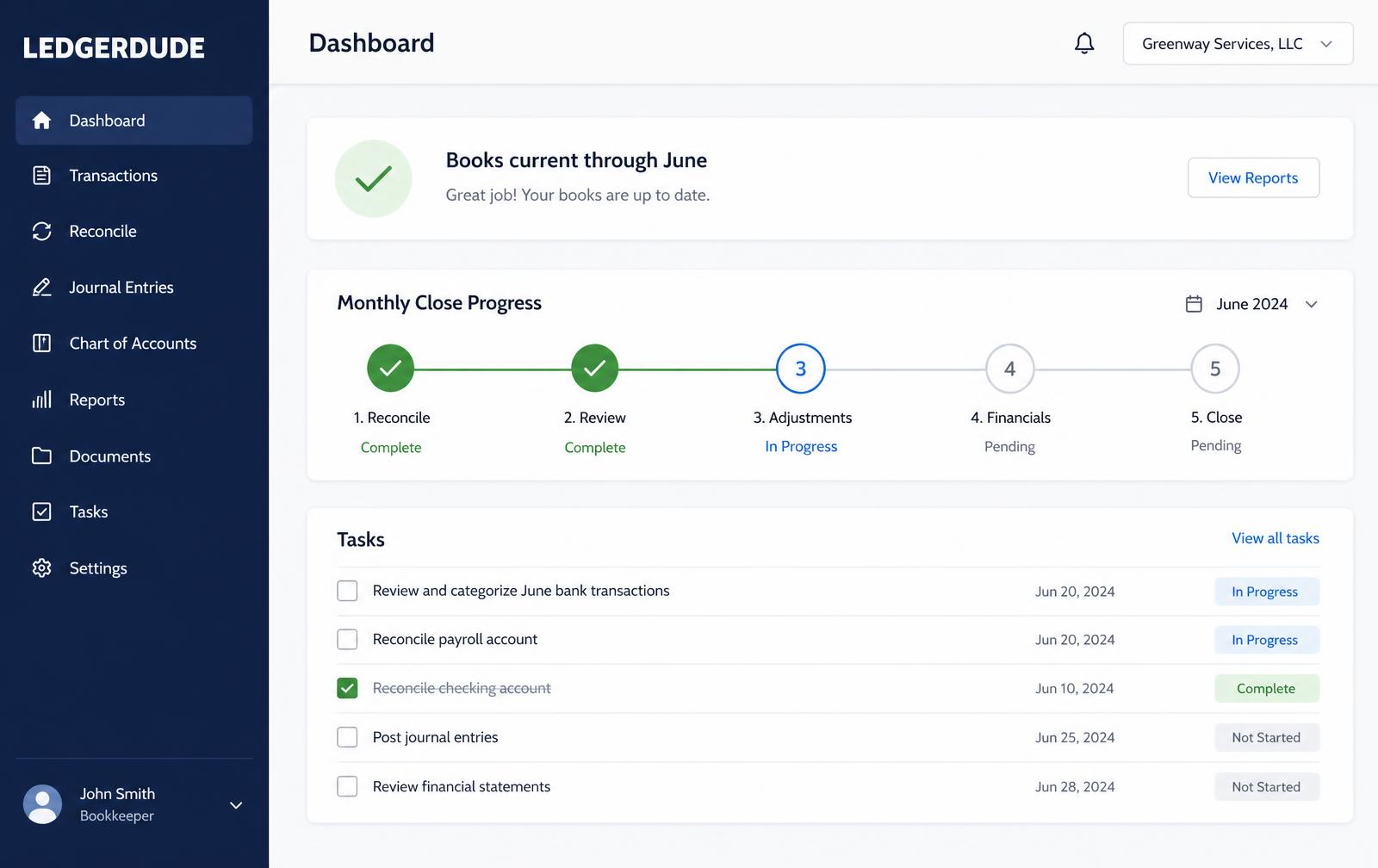
This is the page you get each month once your books are closed — the numbers behind every answer on this site.
In one sentence
Forecast cash weekly for thirteen weeks, invoice the day work is complete, collect deposits on material-heavy jobs, and keep a cash floor equal to six to eight weeks of outflow.
Related answers
Straight answers to the other questions electrical owners ask us.
What should an electrician charge per hour?
Most electrical contractors need $95 to $175 an hour. Take loaded labor cost per billable hour, add overhead recovery per hour, then divide by one minus your target margin.
How do you bid electrical jobs?
Count material, estimate labor hours at your loaded labor cost, add overhead recovery, then divide the total by one minus your target margin.
What markup should an electrical contractor use?
For a 40 percent margin you need a 67 percent markup on cost. Pick the margin first, then convert: markup = margin ÷ (1 − margin).
What is a good profit margin for an electrical contractor?
Electrical service work should run 45 to 55 percent gross margin, project and new construction work 22 to 32 percent, with 8 to 12 percent net profit.
What is labor burden rate and how do you calculate it?
Labor burden is everything an employee costs beyond wages — taxes, insurance, benefits, vehicle and tools — and it usually adds 25 to 60 percent on top of the hourly wage.
Run a different trade?
Questions people ask
How is a cash forecast different from a budget?
A budget is about profit over a period. A cash forecast is about the balance in the account on a given week, including loan payments and receivable timing that never appear on a profit and loss.
Should I use a line of credit for payroll?
As a bridge for a known receivable, yes. As a routine funding source, it is a signal that pricing or collections need fixing.
How long should the forecast look ahead?
Thirteen weeks is the standard because it covers a full quarter of payroll and receivable cycles while staying accurate enough to act on.
What does this cost?
One flat monthly price. No hourly bills, no surprises. Founding plans start at $149 a month, and your rate stays locked.
Keep reading
How do you calculate break-even for a small business?
Divide your fixed monthly overhead by your gross margin percentage to get the revenue you need each month just to cover costs.
What is a good profit margin for a contractor?
Most trade contractors should run 25 to 45 percent gross margin depending on how material-heavy the work is, and 8 to 12 percent net profit.
How do I manage HVAC cash flow in the slow season?
Set aside a fixed share of every peak-season week, go into the slow months with 8 to 13 weeks of cash, and know your monthly break-even before the phones quiet down.
Electrician CFO services
What we do for electrical owners every month.
Home services hub
How we set the books up for your trade.
All answers
Every question we have written a straight answer to.
Pricing
Flat monthly plans based on your revenue.
Want your books handled for you?
We read your receipts, match your bank activity, and close your books every month. You get one short list of questions and a dashboard that always tells the truth.