
Service
An HVAC CFO who knows what a busy July costs you in January
Finance help built for heating and air companies: gross margin by job, truck and tech, seasonal cash planning, and pricing that covers labor, parts and overhead.
The short answer
- An HVAC CFO handles the money side of a heating and air business: margin by job, seasonal cash, pricing and equipment decisions.
- Healthy HVAC companies usually run 40 to 50 percent gross margin on service and 8 to 12 percent net profit.
- The biggest HVAC money risk is spending a strong summer before a slow shoulder season arrives.
- LedgerDude specializes in HVAC, does the bookkeeping every day, and starts at $149 a month for founding customers.
Why HVAC money is different
Your revenue arrives in two hot bursts and two quiet valleys. Parts prices move. Half your profit hides in whether a tech got one call done or three. A general finance service averages all of that into a number that tells you nothing.
- Two peak seasons, two cash valleys every year
- Install jobs and service calls earn completely different margins
- Maintenance agreements are the steadiest money you have
- Equipment and truck payments are easy to sign and hard to carry in a slow month
Margin by job, tech and truck
We split labor, parts and overhead so you can see which work actually pays. Most owners find that one revenue line they assumed was strong is barely breaking even once real labor cost is loaded in.
Plan cash around your seasons
Your plan is built on your own busy and slow months, not a flat yearly average. You see how much of the summer needs to be set aside before you spend it, and how far the slow months can be covered.
Price so the work is worth doing
We work backward from what it costs to put a tech in a truck for an hour — wages, taxes, vehicle, insurance, unbillable time and overhead — then set the rate that leaves the profit you want.
Grow without getting squeezed
Before you add a truck, a tech or a second location, we show what has to be true for it to pay: calls per day, close rate, average ticket and the cash the ramp-up will eat.
Numbers worth watching
Each one is plain math you can check yourself.
| Number | How to figure it | Good range | Why it matters |
|---|---|---|---|
| Service gross margin | (Service revenue − service labor − parts) ÷ service revenue | 45% – 55% | Service is where healthy HVAC companies make their money; thin service margin means your rate is too low. |
| Install gross margin | (Install revenue − install labor − equipment and materials) ÷ install revenue | 30% – 40% | Equipment cost swings fast, so installs need checking every quarter, not every year. |
| Average ticket | Total revenue ÷ number of completed jobs | Rising faster than your costs | The cheapest growth is more value per call, not more calls. |
| Maintenance agreements | Active agreements ÷ total service customers | Grow every quarter | Agreement revenue is what keeps techs busy and cash steady in the slow months. |
| Weeks of cash | Cash on hand ÷ average weekly cash out | 8 – 13 weeks going into a slow season | This is the number that decides whether a slow October is stressful or routine. |
Illustration: where a $2.4M HVAC company's profit actually comes from
- Install revenue
- $1,400,000 at 31% gross margin
- Service revenue
- $780,000 at 49% gross margin
- Maintenance agreements
- $220,000 at 58% gross margin
- Overhead
- $740,000
- Net profit
- $203,000 (about 8.5%)
What this tells you: Example numbers, not a client's books. Installs bring the revenue; service and agreements bring the profit. Cutting install price to win volume is the fastest way to work more for less.
What you see inside LedgerDude
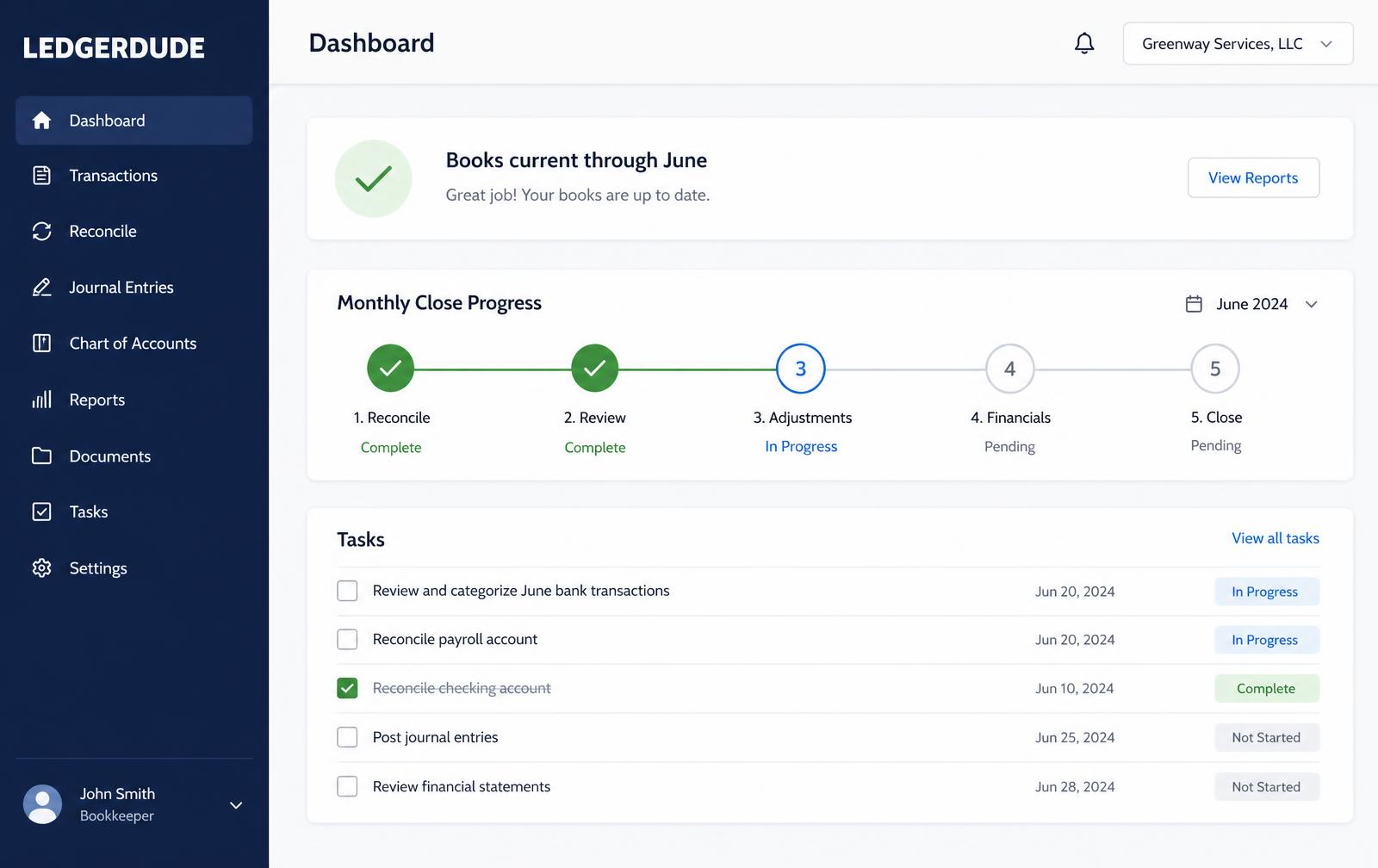
What you see when the work is done: one page with your money on it.
How to get your HVAC numbers under control
- 1
Connect QuickBooks
We read the books you already keep — no software switch.
- 2
Split your revenue
Separate install, service and maintenance so margins stop hiding in one bucket.
- 3
Load your true labor cost
Wages plus taxes, vehicle, insurance and unbillable hours.
- 4
Build the seasonal cash plan
Map your real busy and slow months, then set what summer must hold back.
- 5
Check your rate
Confirm the hourly rate leaves the profit you want at your current close rate.
- 6
Review monthly
One short meeting, one page, one to three decisions.
What is included
- Gross margin by job, tech and truck
- Install versus service versus maintenance profit, side by side
- Seasonal cash plan so summer money survives winter
- Billable hourly rate math that covers real overhead
- Maintenance agreement revenue tracked separately
- Numbers ready for equipment financing or a line of credit
Founding plans: $149, $249, $499 or $899 a month. Bookkeeping is included in every plan.
Related answers
Straight answers to the other questions hvac owners ask us.
How do you price HVAC jobs?
Start from the loaded cost of the job — labor hours, parts, and a share of overhead — then divide by one minus your target margin to get the price.
What is a good profit margin for an HVAC business?
Aim for 45% to 55% gross margin on service, 30% to 40% on installs, and 8% to 12% net profit for the whole company.
What markup should HVAC companies use on parts and equipment?
Most HVAC companies mark parts up 2x to 3x cost and equipment 1.4x to 1.8x, which lands them at 30 to 55 percent gross margin depending on the work.
What KPIs should an HVAC company track?
Track average ticket, gross margin by revenue line, billable hour percentage, close rate, maintenance agreement count and weeks of cash on hand.
How does job costing work for an HVAC company?
Job costing tags every labor hour, part and subcontractor cost to a specific job so you can see the gross profit of that job instead of a monthly average.
How should I price HVAC maintenance agreements?
Price from the loaded cost of the visits plus your target margin — commonly $180 to $360 a year for two visits on one system — and treat the pull-through repair work as a bonus, not a subsidy.
Run a different trade?
Questions people ask
What does an HVAC CFO do that my bookkeeper does not?
A bookkeeper records the past. An HVAC CFO plans the seasons, checks that your hourly rate covers real cost, and shows which work — install, service or maintenance — is carrying the company.
Do I need job costing software?
Not to start. If you use a field service tool we can work with its numbers, but we can also split margins from QuickBooks alone.
Can you help me price a maintenance plan?
Yes. We build it from tech time per visit, expected repair pull-through and the margin you need, not a competitor's price list.
What if I run other trades too?
Common. Plumbing, electrical and roofing lines get tracked separately so a strong trade does not hide a weak one.
What does this cost?
One flat monthly price. No hourly bills, no surprises. Founding plans start at $149 a month, and your rate stays locked.
Keep reading
HVAC bookkeeping hub
How we set the books up for your trade.
HVAC profit margin calculator
Free calculator. Nothing to sign up for.
A roofing CFO who checks the job made money before the crew leaves town
Finance help for roofing companies: margin by job and crew, real overhead and profit recovery, commission tied to margin, and cash that survives a slow winter.
An electrician CFO who makes sure the bid covered the truck, not just the wire
Finance help for electrical contractors: loaded labor rates, margin by service line, bidding that recovers overhead, and cash planning around slow payers.
A fractional CFO for contractors who need the job numbers to make sense
Finance help built for trade contractors: gross margin by job and crew, loaded labor cost, a 13-week cash forecast, and pricing that covers overhead and profit.
All services
Everything we can take off your plate.
Pricing
Flat monthly plans based on your revenue.
Industries
How we set the books up for your kind of business.
Want your books handled for you?
We read your receipts, match your bank activity, and close your books every month. You get one short list of questions and a dashboard that always tells the truth.