
Quick Answer
What is a good profit margin for a roofing company?
Healthy roofing gross and net margins, why repair work outperforms replacement, and how crew productivity and material waste decide the final number.
The short answer
- Residential replacement work targets 30 to 40 percent gross margin.
- Repair and small jobs commonly run 50 percent or more because labor is the main cost.
- Net profit of 8 to 12 percent is healthy once overhead and sales commissions are covered.
- Crew productivity per square and material waste are the two biggest margin swings.
The benchmarks
Split repair from replacement before judging any margin.
- Replacement: 30% – 40% gross margin
- Repair and maintenance: 45% – 60%
- Commercial flat roofing: 25% – 35%
- Net profit: 8% – 12%
Where roofing margin is won or lost
Squares completed per crew day, material waste percentage, and whether tear-off surprises get change-ordered. A single crew running a half-day behind on every job can erase the entire net profit line.
Commissions and insurance work
Sales commissions belong in cost of sales, not overhead, or margin by job is overstated. Insurance-funded work needs its own margin tracking because supplements and adjuster timelines change the economics.
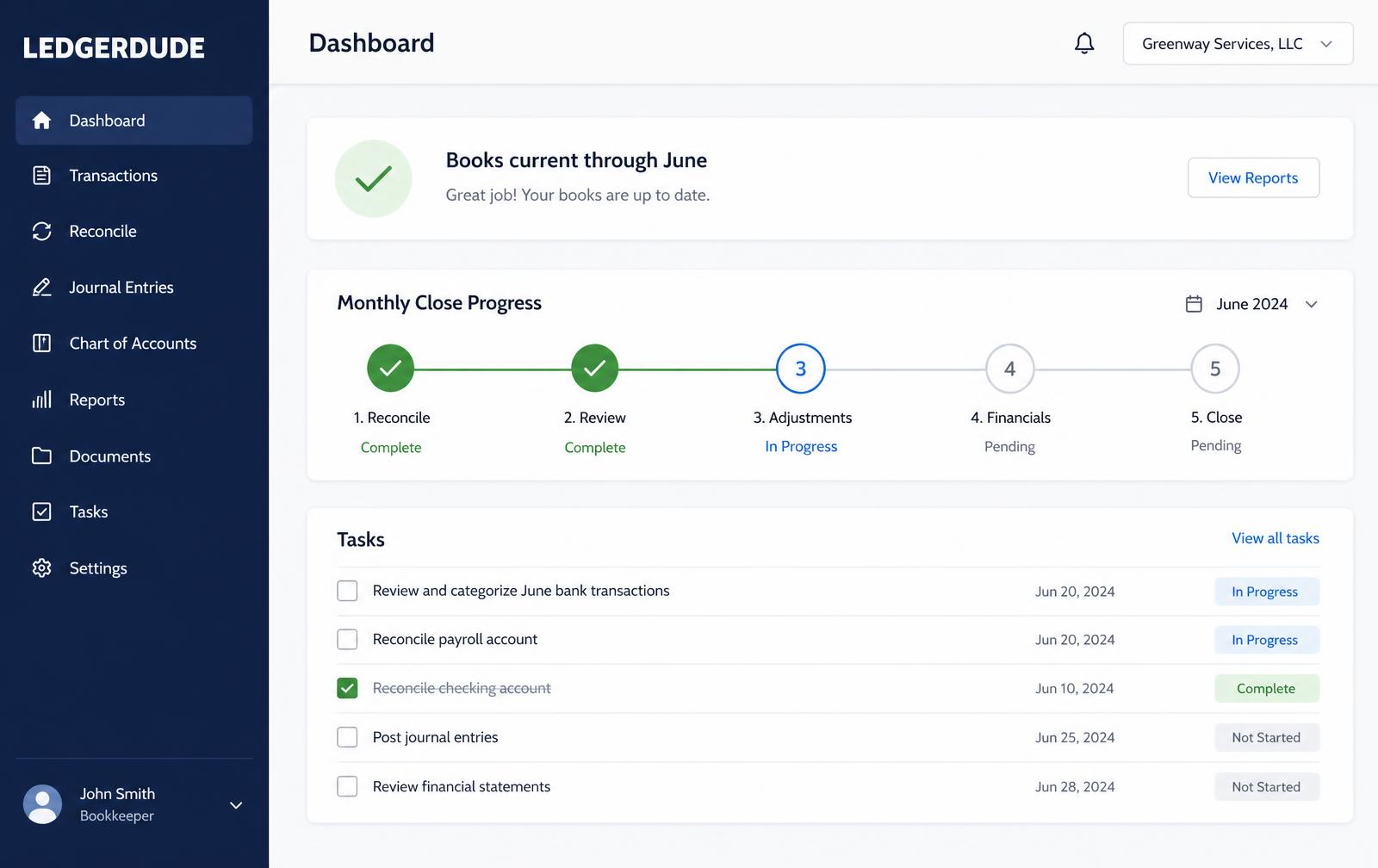
What you see inside LedgerDude
This is the page you get each month once your books are closed — the numbers behind every answer on this site.
In one sentence
Residential roofing should run 30 to 40 percent gross margin and 8 to 12 percent net profit; repair work carries higher margins than full replacements.
Price a roofing job
Put in what one job costs you and the markup you want. We show the price to quote, what you actually keep, and the numbers your books should be watching. Nothing is saved unless you save it.
Shingles, underlayment, flashing, dump fees — everything you buy for this roof.
Crew pay or subcontractor cost for this job, including payroll taxes.
This job's share of trucks, insurance, office and advertising.
How much you add on top of total cost. 35% markup on cost is common.
One square is 100 square feet. Leave at 0 if you do not know.
Total hours all crew members spend on this job.
How many roofs this size you do in a normal month. Used for your monthly targets.
Price to quote
$11,745
Total cost plus your markup.
Profit you keep
$3,045
After materials, labor and overhead.
Profit margin
25.9%
Profit as a share of the price. Healthy roofing work usually lands 10-20%.
Gross margin
38.7%
Price minus material and labor only. This is the number to quote against.
Break-even price
$8,700
Quote below this and the job loses money.
Price per square
$392
Easy way to sanity-check a bid against past jobs.
Numbers your books should track
Profit per square
$102
Compare jobs of different sizes fairly.
Gross profit per crew hour
$76
What one hour on the roof earns you before overhead.
Sales per labor dollar
3.92x
Every $1 of crew pay should bring in $3 or more.
Materials share of price
35.8%
Creeping up? Supplier prices moved and your bids did not.
Labor share of price
25.5%
Rising here usually means jobs are taking longer than you bid.
Overhead covered
$4,545
Gross profit has to cover $1,500 of overhead on this job.
What if costs move?
Slide these to see what happens to this job if material or labor cost changes and your price stays the same.
Now $4,200 instead of $4,200.
Now $3,000 instead of $3,000.
Profit at those costs
$3,045
Same quoted price, new costs.
Profit margin then
25.9%
What the same job would really pay you.
Cost change
$0
Dollars added to or taken off this job.
Your monthly targets
Based on 8 jobs like this one each month.
Revenue to book
$93,960
What you should quote and collect this month.
Overhead to cover
$12,000
Trucks, insurance, office and advertising.
Profit you should keep
$24,360
After all costs and overhead.
Gross profit needed
$36,360
Price minus material and labor, added up.
Jobs just to break even
2.6
Below this, the month loses money.
Crew hours to sell
480 hrs
Make sure you have the crew to cover it.
Take this with you
Download a one-page PDF with your overhead, gross margin and monthly targets. Good for the truck, the bank, or your next crew meeting.
Related answers
Straight answers to the other questions roofing owners ask us.
How do you price a roofing job?
Add up squares of material, crew labor, dumpster, permit and subs to get job cost, add your overhead recovery rate, then divide by one minus your target margin.
How do you calculate overhead and profit in roofing?
Overhead is last year's operating costs divided by revenue, added to job cost. Profit is applied by dividing that total by one minus your target margin.
What KPIs should a roofing company track?
Track gross margin by job, material cost share, close rate, average job size, weeks of cash and days to get paid. Six numbers, once a month.
What is a good profit margin for a contractor?
Most trade contractors should run 25 to 45 percent gross margin depending on how material-heavy the work is, and 8 to 12 percent net profit.
What is labor burden rate and how do you calculate it?
Labor burden is everything an employee costs beyond wages — taxes, insurance, benefits, vehicle and tools — and it usually adds 25 to 60 percent on top of the hourly wage.
Run a different trade?
Questions people ask
Should commissions be in cost of sales?
Yes for job-based commissions. They vary directly with the job, so leaving them in overhead makes every job look more profitable than it is.
Why is my busy season not producing profit?
Usually material waste, crew productivity or unbilled tear-off surprises. Cost five recent jobs individually and the pattern shows up quickly.
Is 25 percent gross margin ever workable?
Only at high volume with tight overhead. For most residential roofers it leaves nothing after sales and warranty cost.
What does this cost?
One flat monthly price. No hourly bills, no surprises. Founding plans start at $149 a month, and your rate stays locked.
Keep reading
How do you price a roofing job?
Add up squares of material, crew labor, dumpster, permit and subs to get job cost, add your overhead recovery rate, then divide by one minus your target margin.
How do you calculate overhead and profit in roofing?
Overhead is last year's operating costs divided by revenue, added to job cost. Profit is applied by dividing that total by one minus your target margin.
What KPIs should a roofing company track?
Track gross margin by job, material cost share, close rate, average job size, weeks of cash and days to get paid. Six numbers, once a month.
Roofing CFO services
What we do for roofing owners every month.
Contractor bookkeeping hub
How we set the books up for your trade.
All answers
Every question we have written a straight answer to.
Pricing
Flat monthly plans based on your revenue.
Want your books handled for you?
We read your receipts, match your bank activity, and close your books every month. You get one short list of questions and a dashboard that always tells the truth.