
Quick Answer
What is a good profit margin for an HVAC business?
Healthy HVAC gross and net margin ranges, why service beats installs on profit, and the five reasons margins come in low.
The short answer
- Service work should run 45 to 55 percent gross margin; installs typically run 30 to 40 percent.
- Whole-company net profit of 8 to 12 percent is healthy for a residential HVAC contractor.
- Maintenance agreements usually carry the highest margin and steady the slow months.
- Low margins are almost always labor cost loading, unbillable time, or an hourly rate set years ago.
The numbers to aim at
Gross margin is revenue minus the labor and materials it took to do the work. Net profit is what is left after overhead. Track them separately by revenue line or the strong work hides the weak work.
- Service gross margin: 45% – 55%
- Install gross margin: 30% – 40%
- Maintenance agreements: 50% – 60%
- Net profit for the company: 8% – 12%
- Under 5% net: the business is paying you for a job, not for owning it
Why installs look better than they are
Installs bring big invoices, so they feel like the profit engine. Once equipment cost, two techs for a day, crane or permit costs and callbacks are loaded in, they usually earn less per hour than service. Volume at a thin margin just means more work for the same money.
Five reasons your margin comes in low
Almost every low-margin HVAC company we see has at least two of these.
- Labor is booked at wages only, ignoring taxes, vehicle and insurance
- Unbillable hours — drive time, warehouse, callbacks — are never counted
- The hourly rate has not moved since equipment prices jumped
- Install and service revenue sit in one account, so nothing can be compared
- Warranty and callback costs get buried in general expenses
How to fix it in one quarter
Split revenue by line, load the real cost of an hour in the truck, then reprice the weakest line. Most owners find 3 to 6 points of margin without a single new customer.
Illustration: same revenue, different margin
- Revenue
- $1,800,000
- Gross margin at 34%
- $612,000
- Gross margin at 42%
- $756,000
- Overhead (unchanged)
- $540,000
- Net profit difference
- $72,000 → $216,000
What this tells you: Example numbers. Eight points of gross margin tripled net profit with the same trucks, the same techs and the same number of calls.
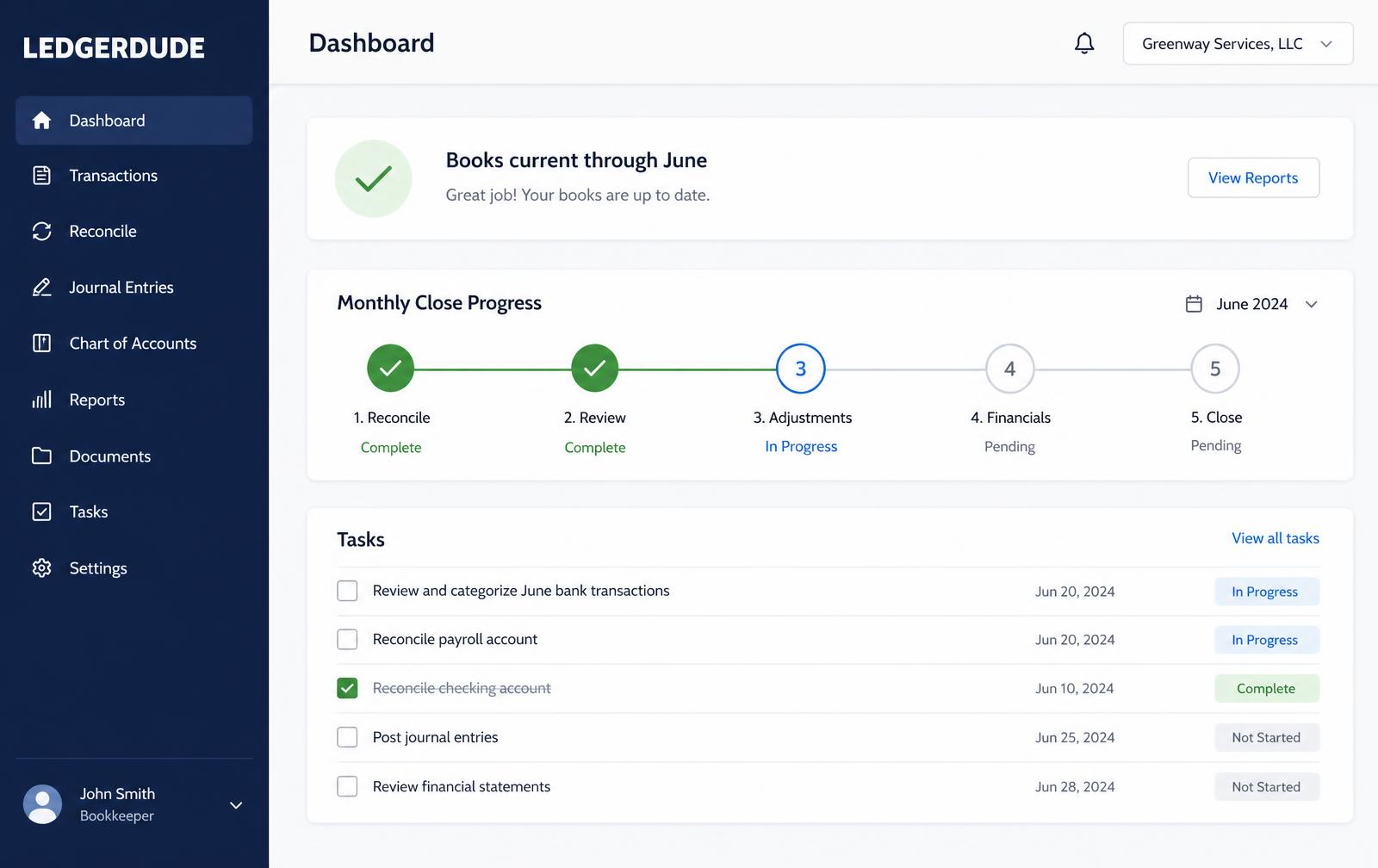
What you see inside LedgerDude
This is the page you get each month once your books are closed — the numbers behind every answer on this site.
In one sentence
Aim for 45% to 55% gross margin on service, 30% to 40% on installs, and 8% to 12% net profit for the whole company.
Try it with your own numbers
Use one month, one quarter, or one job. Nothing is saved and nothing is sent anywhere.
What customers paid you.
Units, parts, filters, refrigerant.
Wages, payroll taxes and benefits for time on jobs.
Office, trucks, ads, software, owner pay.
Commissions, permits, subs, disposal — anything that only happens when you do a job.
How many jobs or calls you completed in this period.
Hours your techs actually spent on customer work.
Your target: cents of profit per dollar of sales, after everything.
Gross margin
33.3%
$40,000 left after job costs
Net profit margin
15.0%
$18,000 left after everything
Job costs
66.7%
$80,000 of materials and labor
Materials share
31.7%
Healthy HVAC shops sit near 25–35%.
Labor share
35.0%
Healthy HVAC shops sit near 25–35%.
Overhead share
18.3%
Aim to keep this under 30%.
Contribution margin and labor productivity
Contribution margin
28.3%
$34,000 left to cover overhead and profit
Contribution per job
$243
$857 average sale per job
Sales per labor dollar
$2.86
Most healthy shops make $3 or more of sales per $1 of tech pay.
Sales per tech hour
$109
Your billable rate in real life, after slow days.
Gross profit per tech hour
$36
What one hour of tech time really earns you.
Hours to cover overhead
605 hrs
Tech hours needed before the shop starts making money.
What if costs move?
Drag a slider to see what happens to your margin if labor or materials go up or down.
$42,000 of tech labor
$38,000 of materials
Gross margin, what-if
33.3%
+0.0 points vs now
Net profit, what-if
15.0%
$18,000 left after everything
Both sliders are at zero, so this matches your numbers above.
Your 12% profit target
You are already there. These numbers keep 15.0% after everything.
What this means
Close, but thin. A few points of price or less overhead makes a big difference.
At this margin you need about $66,000 in sales just to break even.
Numbers to watch every month
- • Gross margin per job type — service work should beat installs.
- • Contribution margin — what is left after every cost that moves with the work.
- • Sales and gross profit per tech hour — the fastest read on productivity.
- • Labor cost as a share of sales, including payroll taxes and benefits.
- • Overhead share of sales — it should shrink as you grow.
- • Unpaid customer invoices over 30 days old.
- • Cash in the bank compared with one month of costs.
Related answers
Straight answers to the other questions hvac owners ask us.
How do you price HVAC jobs?
Start from the loaded cost of the job — labor hours, parts, and a share of overhead — then divide by one minus your target margin to get the price.
What markup should HVAC companies use on parts and equipment?
Most HVAC companies mark parts up 2x to 3x cost and equipment 1.4x to 1.8x, which lands them at 30 to 55 percent gross margin depending on the work.
What KPIs should an HVAC company track?
Track average ticket, gross margin by revenue line, billable hour percentage, close rate, maintenance agreement count and weeks of cash on hand.
How does job costing work for an HVAC company?
Job costing tags every labor hour, part and subcontractor cost to a specific job so you can see the gross profit of that job instead of a monthly average.
How should I price HVAC maintenance agreements?
Price from the loaded cost of the visits plus your target margin — commonly $180 to $360 a year for two visits on one system — and treat the pull-through repair work as a bonus, not a subsidy.
Run a different trade?
Questions people ask
Is 20% gross margin ever okay in HVAC?
Only on a one-off job you took for a strategic reason. As a normal rate it will not cover overhead, and growth will make the cash problem worse.
What net profit should a $1M HVAC company make?
Roughly $80,000 to $120,000 after paying the owner a real market wage. If the profit only exists because you are unpaid, it is not profit.
Should I compare myself to national averages?
Use them as a sanity check, then compare your own months against each other. Your trend matters more than someone else's average.
Do maintenance agreements really help margin?
Yes, twice: the visit itself carries high margin, and agreement customers produce the repair and replacement work that keeps slow months busy.
What does this cost?
One flat monthly price. No hourly bills, no surprises. Founding plans start at $149 a month, and your rate stays locked.
Keep reading
How much should an HVAC company charge per hour?
Work backward from the true cost of an hour in the truck — usually $65 to $95 fully loaded — then add your target margin, which puts most residential rates between $125 and $200 an hour.
How do I manage HVAC cash flow in the slow season?
Set aside a fixed share of every peak-season week, go into the slow months with 8 to 13 weeks of cash, and know your monthly break-even before the phones quiet down.
HVAC CFO services
What we do for hvac owners every month.
HVAC bookkeeping hub
How we set the books up for your trade.
All answers
Every question we have written a straight answer to.
Pricing
Flat monthly plans based on your revenue.
Want your books handled for you?
We read your receipts, match your bank activity, and close your books every month. You get one short list of questions and a dashboard that always tells the truth.