
Quick Answer
How do you price HVAC jobs?
A simple pricing method for HVAC service calls and installs: loaded labor cost, parts, overhead recovery, and the margin divisor that sets the final price.
The short answer
- Price from cost plus target margin, never by matching a competitor's number.
- Loaded labor cost includes wages, payroll taxes, benefits, truck, insurance and unbillable hours.
- Divide loaded cost by (1 − target margin). Do not add the margin as a percentage on top.
- Service and install need different target margins because their cost structures are different.
The four numbers every price needs
Any HVAC price, flat rate or hourly, is built from these four pieces.
- Labor: hours on the job times your fully loaded hourly cost
- Materials: parts and equipment at your real cost, including freight
- Overhead: your share of rent, office, software, advertising and admin pay
- Profit: the margin you intend to keep after all of the above
Use the divisor, not the markup
Adding 40 percent to a $600 cost gives $840, which is a 28.6 percent margin, not 40. Dividing $600 by 0.60 gives $1,000, which is a true 40 percent margin. That gap is where a lot of contractor profit disappears.
Different targets for service and install
Service calls carry more overhead per dollar and should target 45 to 55 percent gross margin. Installs move more material and typically target 30 to 40 percent. Pricing both the same way guarantees one of them is wrong.
Check the price after the job, not just before
Compare quoted hours to actual hours every month. If jobs consistently run long, your price is right on paper and wrong in the truck.
Illustration: pricing a condenser replacement
- Equipment and materials
- $2,100
- Labor: 9 hours at $78 loaded
- $702
- Permit and disposal
- $140
- Total loaded cost
- $2,942
- Price at 35% target margin ($2,942 ÷ 0.65)
- $4,526
What this tells you: Example numbers. Adding 35 percent on top instead would have priced the job at $3,972 and quietly given away $554.
What you see inside LedgerDude
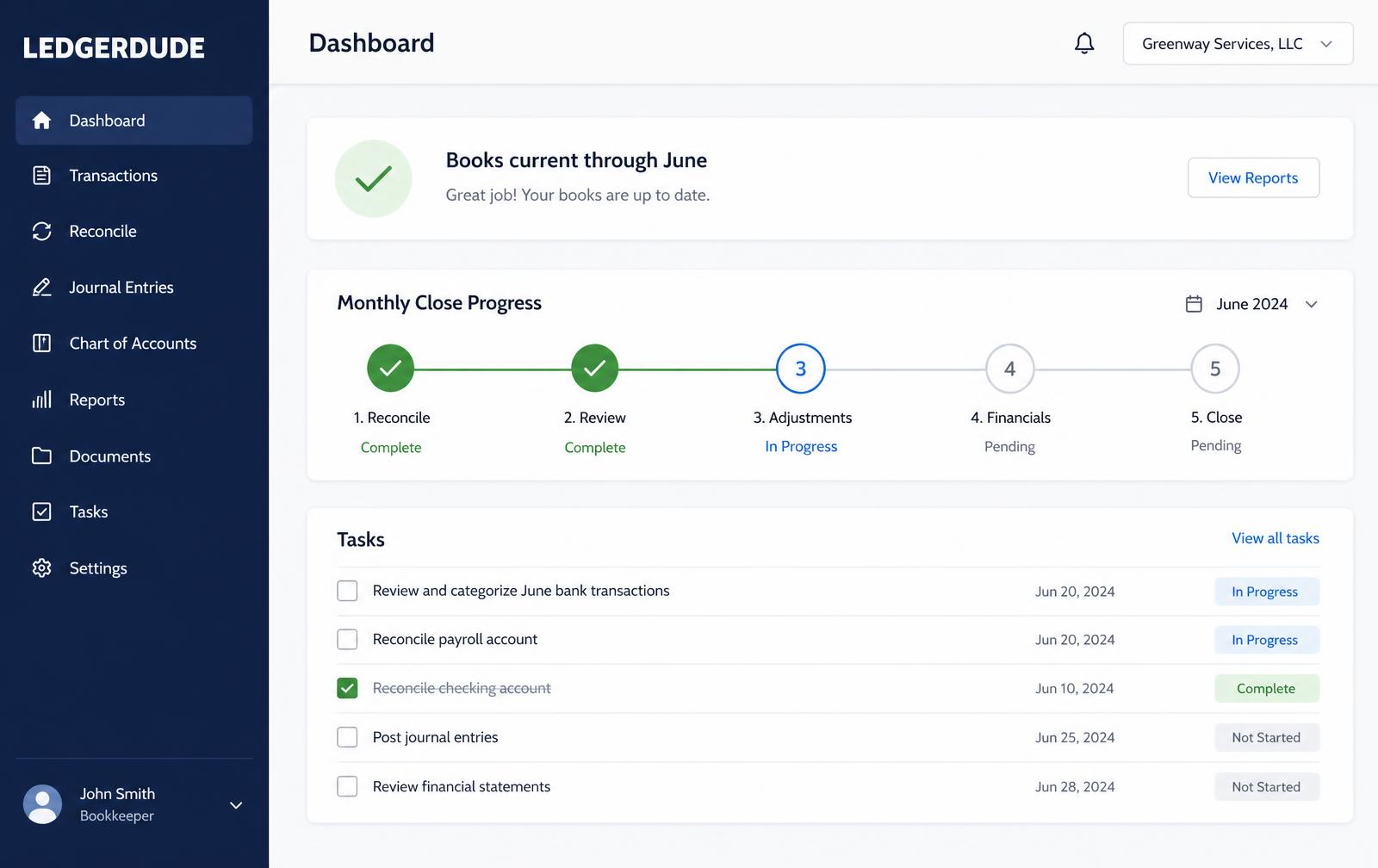
This is the page you get each month once your books are closed — the numbers behind every answer on this site.
Price an HVAC job
- 1
Load your labor cost
Add payroll taxes, benefits, vehicle, fuel, insurance and tools to the wage, then divide by real billable hours.
- 2
Add materials at true cost
Include freight, and use current pricing rather than last year's invoice.
- 3
Recover overhead
Divide annual overhead by annual billable hours and add that per hour on the job.
- 4
Apply the margin divisor
Divide total loaded cost by one minus your target gross margin.
- 5
Review actuals monthly
Compare quoted hours against actual hours and adjust the standard hours you quote.
In one sentence
Start from the loaded cost of the job — labor hours, parts, and a share of overhead — then divide by one minus your target margin to get the price.
Try it with your own numbers
Use one month, one quarter, or one job. Nothing is saved and nothing is sent anywhere.
What customers paid you.
Units, parts, filters, refrigerant.
Wages, payroll taxes and benefits for time on jobs.
Office, trucks, ads, software, owner pay.
Commissions, permits, subs, disposal — anything that only happens when you do a job.
How many jobs or calls you completed in this period.
Hours your techs actually spent on customer work.
Your target: cents of profit per dollar of sales, after everything.
Gross margin
33.3%
$40,000 left after job costs
Net profit margin
15.0%
$18,000 left after everything
Job costs
66.7%
$80,000 of materials and labor
Materials share
31.7%
Healthy HVAC shops sit near 25–35%.
Labor share
35.0%
Healthy HVAC shops sit near 25–35%.
Overhead share
18.3%
Aim to keep this under 30%.
Contribution margin and labor productivity
Contribution margin
28.3%
$34,000 left to cover overhead and profit
Contribution per job
$243
$857 average sale per job
Sales per labor dollar
$2.86
Most healthy shops make $3 or more of sales per $1 of tech pay.
Sales per tech hour
$109
Your billable rate in real life, after slow days.
Gross profit per tech hour
$36
What one hour of tech time really earns you.
Hours to cover overhead
605 hrs
Tech hours needed before the shop starts making money.
What if costs move?
Drag a slider to see what happens to your margin if labor or materials go up or down.
$42,000 of tech labor
$38,000 of materials
Gross margin, what-if
33.3%
+0.0 points vs now
Net profit, what-if
15.0%
$18,000 left after everything
Both sliders are at zero, so this matches your numbers above.
Your 12% profit target
You are already there. These numbers keep 15.0% after everything.
What this means
Close, but thin. A few points of price or less overhead makes a big difference.
At this margin you need about $66,000 in sales just to break even.
Numbers to watch every month
- • Gross margin per job type — service work should beat installs.
- • Contribution margin — what is left after every cost that moves with the work.
- • Sales and gross profit per tech hour — the fastest read on productivity.
- • Labor cost as a share of sales, including payroll taxes and benefits.
- • Overhead share of sales — it should shrink as you grow.
- • Unpaid customer invoices over 30 days old.
- • Cash in the bank compared with one month of costs.
Related answers
Straight answers to the other questions hvac owners ask us.
What is a good profit margin for an HVAC business?
Aim for 45% to 55% gross margin on service, 30% to 40% on installs, and 8% to 12% net profit for the whole company.
What markup should HVAC companies use on parts and equipment?
Most HVAC companies mark parts up 2x to 3x cost and equipment 1.4x to 1.8x, which lands them at 30 to 55 percent gross margin depending on the work.
What KPIs should an HVAC company track?
Track average ticket, gross margin by revenue line, billable hour percentage, close rate, maintenance agreement count and weeks of cash on hand.
How does job costing work for an HVAC company?
Job costing tags every labor hour, part and subcontractor cost to a specific job so you can see the gross profit of that job instead of a monthly average.
How should I price HVAC maintenance agreements?
Price from the loaded cost of the visits plus your target margin — commonly $180 to $360 a year for two visits on one system — and treat the pull-through repair work as a bonus, not a subsidy.
Run a different trade?
Questions people ask
Should I show customers an hourly rate?
Most residential companies quote a flat price per task and keep the hourly math internal. Customers compare a single number more comfortably than a rate plus hours.
How often should HVAC prices change?
Review at least twice a year, and immediately when equipment costs or wages move. Prices set before a supplier increase are losing money every day.
What margin should a replacement job carry?
Aim for 30 to 40 percent gross margin on installs. Below 25 percent, a busy install season can produce almost no profit.
What does this cost?
One flat monthly price. No hourly bills, no surprises. Founding plans start at $149 a month, and your rate stays locked.
Keep reading
What markup should HVAC companies use on parts and equipment?
Most HVAC companies mark parts up 2x to 3x cost and equipment 1.4x to 1.8x, which lands them at 30 to 55 percent gross margin depending on the work.
How much should an HVAC company charge per hour?
Work backward from the true cost of an hour in the truck — usually $65 to $95 fully loaded — then add your target margin, which puts most residential rates between $125 and $200 an hour.
Is flat rate pricing better than hourly for HVAC?
Flat rate is better for residential HVAC because the customer approves one clear number, and your margin no longer depends on how fast the tech works.
HVAC CFO services
What we do for hvac owners every month.
HVAC bookkeeping hub
How we set the books up for your trade.
All answers
Every question we have written a straight answer to.
Pricing
Flat monthly plans based on your revenue.
Want your books handled for you?
We read your receipts, match your bank activity, and close your books every month. You get one short list of questions and a dashboard that always tells the truth.